Develop a more exclusive model after demand is proven.
This approach reduces tooling and inventory risk while still creating brand differentiation.
How Should Lead Time and Repeat Orders Be Managed?
Export orders should use a milestone-based schedule rather than one general delivery estimate.
Ask the factory to provide estimated dates for:
Specification confirmation
Artwork approval
Component preparation
Sample completion
Sample revisions
Production start
Final inspection
Packing
Shipment readiness
Repeat orders should also be planned around component availability. Buyers should ask:
Will approved components remain available?
How will substitutions be communicated?
Can the factory reserve critical components?
Is the same color and packaging repeatable?
Are spare parts available separately?
Stable repeat production is one of the strongest indicators of a dependable export partner.
What After-Sales Support Should Export Buyers Arrange?
After-sales support should be discussed before the first shipment.
A practical support plan may include:
Spare batteries
Chargers
Displays
Controllers
Brake components
Lights and wiring
Tires and tubes
Racks and fenders
Troubleshooting guides
Technical diagrams
Warranty procedures
The spare-parts quantity should reflect the order size, product complexity, and local service capability.
For distributor and dealer networks, access to replacement parts can be as important as the original bicycle price.
Why Consider Joboev as an Electric Bike Export Manufacturer?
Joboev provides multiple product platforms for global B2B buyers, allowing importers, distributors, brands, and mobility companies to select models based on different applications.
Buyers can learn more about the company through the Joboev About Us page, compare available products on the product page, and review additional purchasing guidance in the Joboev blog.
To receive a more accurate recommendation and quotation, prepare:
An electric bike export manufacturer produces and prepares electric bicycles for international B2B orders, including product configuration, manufacturing, testing, packaging, documentation, and shipment support.
2. How is an export manufacturer different from a local supplier?
An export manufacturer should understand international packaging, documentation, battery transport requirements, buyer communication, and repeat-order management.
3. Can an export manufacturer produce private-label e-bikes?
Yes. Private-label options may include logos, colors, model names, labels, manuals, packaging, and selected technical configurations.
4. What documents are required to export electric bikes?
Requirements vary by destination and product configuration. Buyers should confirm commercial documents, battery transport information, charger documentation, labels, manuals, and required market-specific reports.
5. How can I verify bulk-order quality?
Use an approved sample, written specification sheet, component list, production inspection, pre-shipment photos or videos, and third-party inspection when appropriate.
6. Can manufacturers change components during production?
Changes should only be made after the buyer reviews and approves the proposed replacement in writing.
7. What electric bikes are suitable for export distribution?
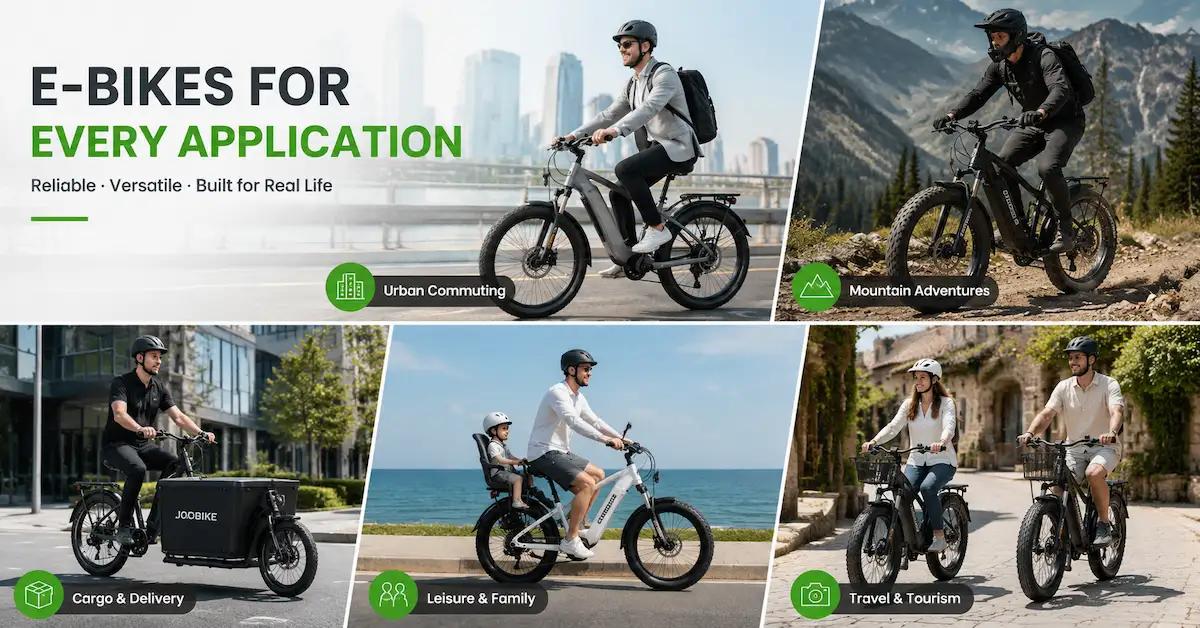
City, folding, cargo, mountain, off-road, shared, and tricycle platforms can all be suitable when configured for the destination market.
8. How long does an export order take?
The schedule depends on the model, customization, sample revisions, quantity, component availability, inspection, and packaging requirements.
9. Should spare parts be included with the first order?
Yes. A planned spare-parts package can improve local service and reduce customer downtime.
10. How can I request an export quotation from Joboev?
Send the destination market, preferred model, quantity, configuration, branding, packaging, and delivery requirements through the Joboev contact page.
Conclusion
Choosing an electric bike export manufacturer requires a broader evaluation than comparing product photos and unit prices.
A reliable export partner should help buyers:
Select suitable products
Lock technical specifications
Validate samples
Control bulk production
Prepare export documentation
Protect products during shipment
Provide spare parts
Maintain repeat-order consistency
For importers, distributors, and private-label brands, these capabilities reduce commercial risk and support long-term market growth.