How to Choose an Electric Trail Bike Manufacturer Before Bulk Ordering
Choose an electric trail bike manufacturer by checking whether it can reproduce the approved bike—not merely supply an impressive sample. Request a fixed specification, a route-based evaluation plan, model-specific documentation, and written control over component changes. For brands and importers, the objective is a product that rides as expected, can be serviced locally, and arrives with the configuration that was approved. JOBO’s electric mountain bike range provides several starting platforms, but the final selection should follow the intended riding conditions and market requirements.
Define the Trail Product Before Choosing the Platform
For this guide, an electric trail bike means a pedal-assisted bicycle being evaluated for off-road riding, not an electric dirt motorcycle. “Trail” alone does not describe the severity of the terrain or prove that a model is suitable for jumps, downhill competition, or unrestricted public access. Write down the intended use before comparing configurations: maintained forest tracks, mixed gravel routes, and rocky singletrack present different evaluation questions. Include climb length, descent conditions, rider experience, expected total load, weather exposure, and access to maintenance. This approach is useful for private-label brands building a trail range, importers comparing suppliers, and rental businesses selecting bikes for known routes. A brand product manager may prioritize fit, assistance feel, and component positioning; a rental operator may place more weight on inspection time and replacement parts. Do not approve a conventional trail platform for gravity riding or motorcycle-style use merely because it has suspension and a large motor. Establish those requirements as a separate development project.
Build a Technical Specification That Can Be Approved
An electric trail bike manufacturer should be able to turn the riding brief into a version-controlled specification. The table below is a suggested RFQ checklist, not a list of standard features fitted to every JOBO model. An RFQ is a request for quotation; its purpose here is to make suppliers quote the same requirements.
| Specification Area | What the Buyer Should Define | Evidence to Request |
|---|---|---|
| Intended use | Route surfaces, rider profile, load, and excluded uses | Written intended-use statement |
| Frame and fit | Material, sizes, geometry, motor mounting, and battery interfaces | Dimensioned drawing and configuration revision |
| Motor and controls | Exact motor, rated-power basis, assistance settings, and control behavior | Component identifiers and agreed settings |
| Battery and charger | Voltage, capacity, pack identity, charging equipment, and removal method | Battery documentation and compatibility confirmation |
| Suspension | Fork model, travel, rear shock where fitted, and adjustment range | Component specification and service requirements |
| Brakes | Calipers, rotors, pads, and lever configuration | Exact parts list and agreed validation plan |
| Wheels and tires | Wheel size, tire model, casing, and clearance | Approved wheel-and-tire specification |
| Weight and loading | Finished-bike weight and clearly defined load limits | Measurement conditions and supporting documentation |
| Service package | Wear parts, proprietary parts, and technical information | Parts list, availability terms, and service documents |
Motor Output Is Only One Part of the Climbing Assessment
Specify how the complete bicycle must behave on the intended climb: starting under load, maintaining controllable assistance, and responding when the rider changes pedaling effort. Do not use a wattage label as the sole acceptance criterion. Request the motor model, controller settings, and drivetrain configuration, then assess the approved combination on a representative route. JOBO’s high-torque e-MTB sourcing guide provides related questions for evaluating drive-system requirements. Treat an alternative motor as an engineering change requiring review, not an interchangeable item selected only by advertised power.
Translate Battery Capacity Into a Route Test
Nominal battery energy is calculated as voltage multiplied by ampere-hours. A listed 48 V, 14 Ah battery therefore represents approximately 672 Wh of nominal energy; it does not establish a guaranteed riding distance. In the sample plan, record route distance and elevation, rider and equipment load, assistance settings, starting charge, and ambient conditions. Define an acceptable remaining-charge reserve with the supplier and evaluate the agreed route before publishing a range claim. Use the same test conditions when comparing configurations rather than comparing unrelated maximum-distance figures.
Approve the Suspension, Brakes, and Frame Together
A full-suspension proposal needs more detail than “front and rear suspension.” Ask for the fork and shock models, travel, adjustment range, mounting dimensions, and service information. For either a hardtail or full-suspension design, check the specified tires, brake parts, and rider fit as part of the complete package. A change in fork, tire, or brake specification should trigger a documented compatibility review. Buyers should not infer jumping capability, a permitted rotor size, or a rider-weight limit from a product photograph or a general category name.
Compare Two JOBO Platforms Without Assuming They Are Equivalent
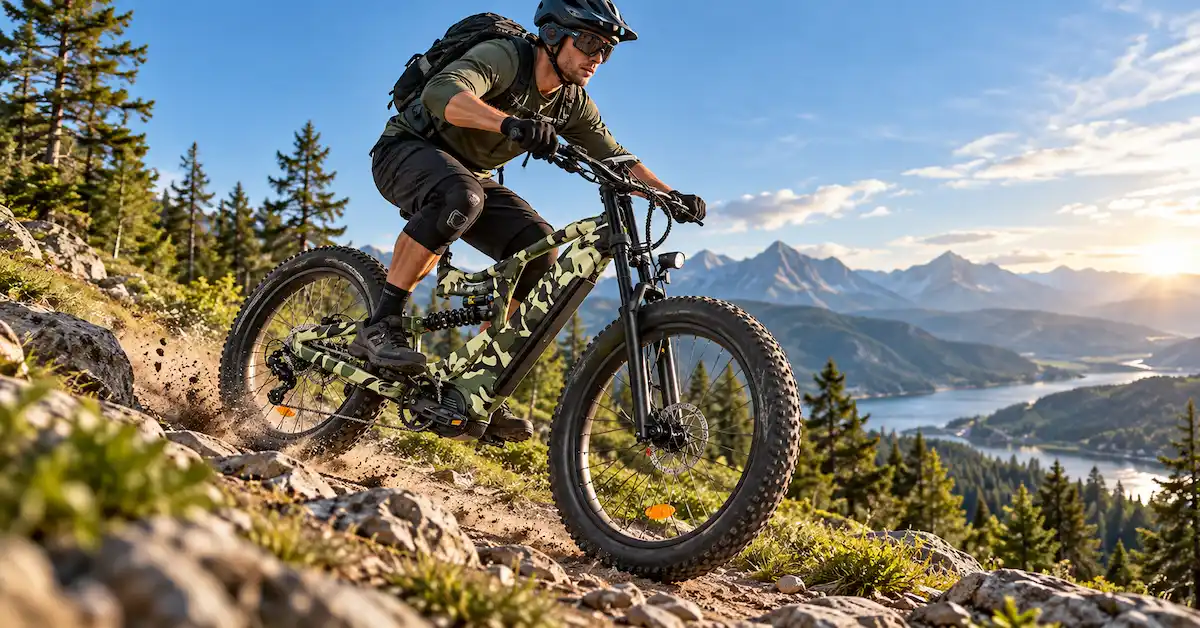
JOBO publishes the JB-TDE33Z-F All Terrain Electric Bike and the JB-TDE43L-F Full Suspension Mountain Ebike as different starting points for OEM evaluation. Their published specifications share a 48 V, 14 Ah battery option and 26 × 4.0-inch tires, while the drive and suspension descriptions differ. The table summarizes listed configurations, not an independently tested ranking, a quotation, or a guarantee of availability in every market.
| Published Feature | JB-TDE33Z-F: All Terrain Electric Bike | JB-TDE43L-F: Full Suspension Mountain Ebike |
|---|---|---|
| Motor description | 48 V, 750 W hub-motor configuration; other options also listed | Bafang M600, 48 V, 500 W mid-drive |
| Battery | 48 V, 14 Ah LG battery option | 48 V, 14 Ah LG battery |
| Frame material | 6061 aluminum alloy | 6061 aluminum alloy |
| Suspension description | Front suspension fork | Full suspension with front fork and rear shock |
| Drivetrain | Shimano 7-speed | Shimano 9-speed |
| Tire size | 26 × 4.0 inches | 26 × 4.0 inches |
| Brake clarification | Written confirmation required; page descriptions differ | Hydraulic disc brakes listed |
| Suggested evaluation focus | Suitability of the hub-drive and front-suspension configuration for the proposed route | Suitability of the mid-drive, rear suspension, and service requirements for the proposed route |
The E33 page contains both hydraulic and mechanical brake descriptions. Resolve that discrepancy in the quotation and signed specification rather than assuming either is the approved build. For both platforms, request missing details such as complete geometry, suspension travel, load limits, and the exact market version. Neither shared battery capacity nor matching tire dimensions establishes equal climbing behavior, handling, or range.
Inspect Manufacturing Evidence, Not Just the Finished Sample
Frame Production and Workmanship
JOBO’s in-house frame factory describes aluminum-frame manufacturing that includes CNC cutting, drilling and bending, robotic welding, T4/T6 heat-treatment stages, correction and measurement, coating, and final testing. These are useful audit topics for an electric trail bike manufacturer. Ask how the selected frame is identified through production, which dimensions are checked, and how inspection results connect to its drawing revision. A good-looking weld or smooth finish is not a substitute for the model’s structural validation records.
Quality Control and Traceability
JOBO’s QC Labs describe a workflow covering incoming inspection, in-process checks, final inspection, and quality assurance. Ask the electric trail bike manufacturer what records will be retained at each stage of your order. Useful checks include the identity of incoming components, frame and assembly inspection results, electrical-system verification, and the final configuration check. Also agree how a nonconforming unit is isolated and corrected. Equipment lists demonstrate available resources; the purchase decision needs evidence relevant to the actual model and production batch.
Certification and Intended-Use Documentation
Use JOBO’s certifications and patents page as a starting point for requesting documents, not as blanket approval for a customized bicycle. Ask which reports cover the exact frame, electrical system, and supplied configuration, and which changes would require further assessment. Keep product documentation and permission to use a particular trail as separate questions. Before placing an order, obtain appropriate confirmation for the destination market and intended operating routes. Do not approve use beyond documented limits because another model displays a similar certificate.
Move From OEM Proposal to an Approved Production Specification
Start With a Defined Customization Scope
Existing-platform customization and a new frame-development project should be quoted separately. JOBO’s China manufacturing operation describes OEM/ODM engineering and system-integration support. Use that discussion to identify feasible changes to branding, components, battery integration, or frame design. Tell the electric trail bike manufacturer which features define your brand and which remain open to proposals. Request a written division between confirmed options and changes needing engineering work. For proprietary development, settle drawing ownership, tooling ownership, confidentiality, and approval responsibilities before treating a concept as a production-ready design.
Give the Sample a Written Acceptance Plan
Before the sample arrives, agree who will evaluate it and what constitutes acceptance. Qualified riders and technicians should assess it within documented use limits on an approved route. Record fit, low-speed control, assistance response, shifting, braking, battery attachment, cable clearance, and access for routine service. Photograph the actual components and record the relevant settings. When a change is requested, identify whether it needs a drawing update, another component check, or a repeat ride evaluation. A favorable first impression should begin the review, not end it.
Keep the Production Batch Matched to the Approved Bike
After approval, retain a reference sample and a signed bill of materials—the list of components defining the build. Link them to drawings, paint references, electrical settings, packaging, and labels. Agree which substitutions require buyer approval and how a pilot batch will be checked before full production. This is where an electric trail bike manufacturer must demonstrate repeatability: the shipment should match the approved specification, including details that may not be obvious in product photographs.
Confirm Capacity, Delivery, and Service as Separate Commitments
China Production Planning
JOBO’s China factory page lists a 50,000-square-meter facility, three assembly lines, and approximately 300,000 bikes of annual production capacity. These are company-published capacity figures, not a reserved production slot for a particular order. Ask for project milestones covering specification approval, component readiness, sampling, testing, production, and dispatch. Establish which milestone starts the quoted lead time and what happens when a requested change affects it.
European Supply and Service Arrangements
For European projects, JOBO’s Poland operation describes local assembly, distribution, and spare-parts support. Confirm whether those services apply to the selected model and order, where replacement components will be stocked, and who handles technical questions. Do not substitute an in-stock delivery estimate for a new OEM production schedule. Regional support is most useful when the actual parts, responsibilities, and delivery terms are written into the project plan.
Compare Total Project Cost, Not Only the Bicycle Price
Ask each electric trail bike manufacturer to separate the bicycle price from development, samples, tooling where needed, validation, packaging, freight, destination charges, and the initial spare-parts package. Compare quotations only after aligning the motor, battery, suspension, brakes, and included services. A proposal with fewer included items is not necessarily a lower-cost project. Request prices for likely replacement parts at the same time, particularly model-specific items that local dealers cannot readily substitute. Before approving the purchase order, resolve any mismatch among the quotation, product page, sample, and component list. Also confirm who authorizes substitutions, which documents accompany delivery, and how a service claim is handled. These are practical approval conditions rather than promises that all future problems can be eliminated. The aim is to identify responsibilities while the specification is still changeable.
Frequently Asked Questions
What Should I Request From an Electric Trail Bike Manufacturer First?
Send a riding brief and request the proposed model, versioned specification, customization scope, sample plan, and relevant documentation. Include the destination market, rider profile, route conditions, target price position, and expected quantity. This gives the supplier a defined project to assess instead of an open-ended request for its “best trail bike.”
Should I Choose a Hardtail or a Full-Suspension Platform?
Shortlist the structures against your route, rider expectations, and service resources. Ask what additional components, adjustments, and maintenance the full-suspension proposal requires, then compare representative samples. Do not choose solely from appearance or assume that rear suspension establishes suitability for every type of technical riding.
Is a 750 W Hub Motor Better Than a 500 W Mid-Drive?
The labels alone do not answer that question. Compare the complete configurations under the same route, load, and assistance conditions. Request the exact motor, drivetrain, and controller details, and define what acceptable climbing and low-speed control mean for the project. Do not rank the two JOBO platforms solely by watts.
How Much Battery Capacity Does an OEM Trail Bike Need?
Set the requirement around the intended ride and an agreed reserve. Record test conditions and evaluate the sample rather than treating the advertised maximum range as a procurement guarantee. Voltage and ampere-hours help compare nominal energy, but they do not replace a route-based acceptance test.
Can JOBO Support a Custom Trail E-Bike Frame?
JOBO describes custom frame design and OEM/ODM manufacturing support through its frame manufacturing capabilities. Submit the required geometry, motor and battery interfaces, suspension concept, and intended-use brief for engineering review. Confirm feasibility, development charges, tooling arrangements, and validation requirements before agreeing on a sample date.
What Is the Minimum Order Quantity?
Request the MOQ for the exact platform and customization package. The reviewed public material does not establish one minimum quantity for every trail-bike project. Ask whether requirements apply per model, size, color, or component combination, and separate the sample order from the proposed production order.
How Long Does OEM Production Take?
Obtain a project-specific schedule after the configuration and development scope are defined. Clarify whether the quotation covers sampling, testing, production, and transport separately. General factory capacity and regional stock-delivery claims do not establish the lead time for a new customized order.
Can Components Change After Sample Approval?
Set a written change-control rule before ordering. The supplier should identify the proposed substitute, its effect on compatibility and documentation, and any further verification needed. Specify which changes require written buyer approval so that an equivalent-sounding component description does not conceal a different build.
Does Certification Mean the Bike Can Use Every Public Trail?
Do not treat those questions as interchangeable. Request documents applicable to the supplied configuration and obtain separate confirmation of the rules governing the intended riding area. Keep approved uses and exclusions in the operating information supplied to dealers or fleet staff.
Which Spare Parts Should Be Discussed Before Ordering?
Start with the selected model’s wear parts and proprietary interfaces: brake pads, drivetrain parts, tires, derailleur hangers, chargers, and model-specific electrical parts. For a full-suspension platform, discuss pivot and shock-service requirements as well. Confirm identifiers, compatibility, prices, and availability rather than requesting an undefined “standard spare-parts kit.”
Conclusion
The right electric trail bike manufacturer connects the riding brief to a controlled, serviceable production specification. Choose the platform, verify the missing details, evaluate a representative sample, and keep the approved configuration consistent through delivery. JOBO offers mountain-bike platforms, frame manufacturing, and OEM/ODM support that can be assessed against that process. To begin, contact JOBO with your target market, route profile, rider requirements, expected quantity, and customization priorities, and request a model recommendation, sample proposal, and itemized quotation.