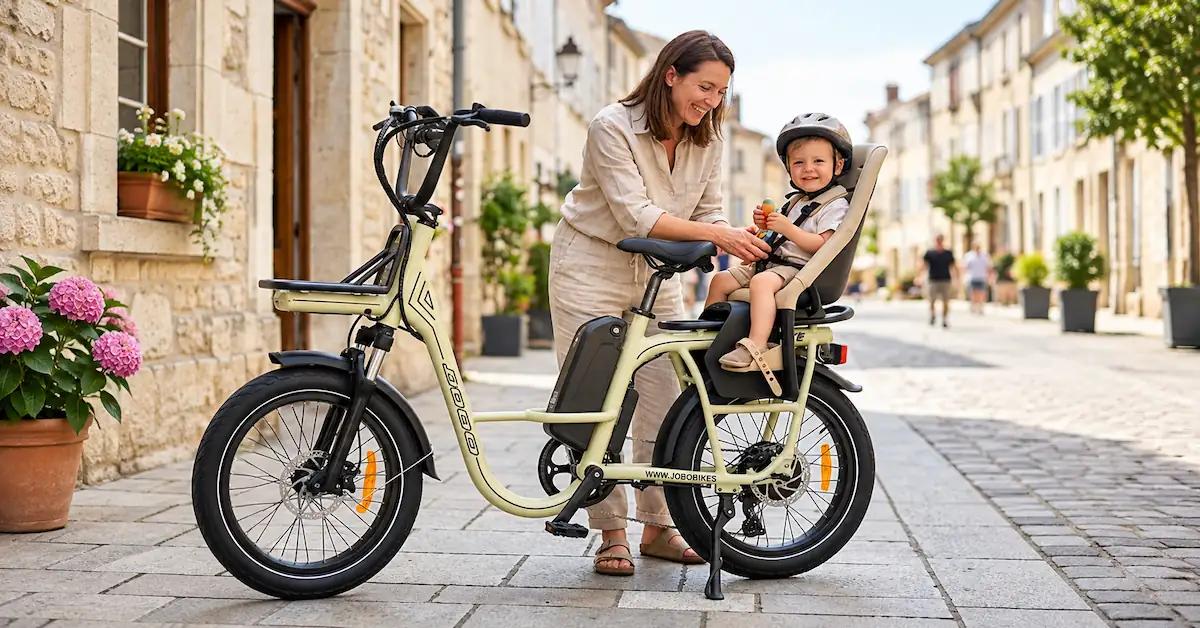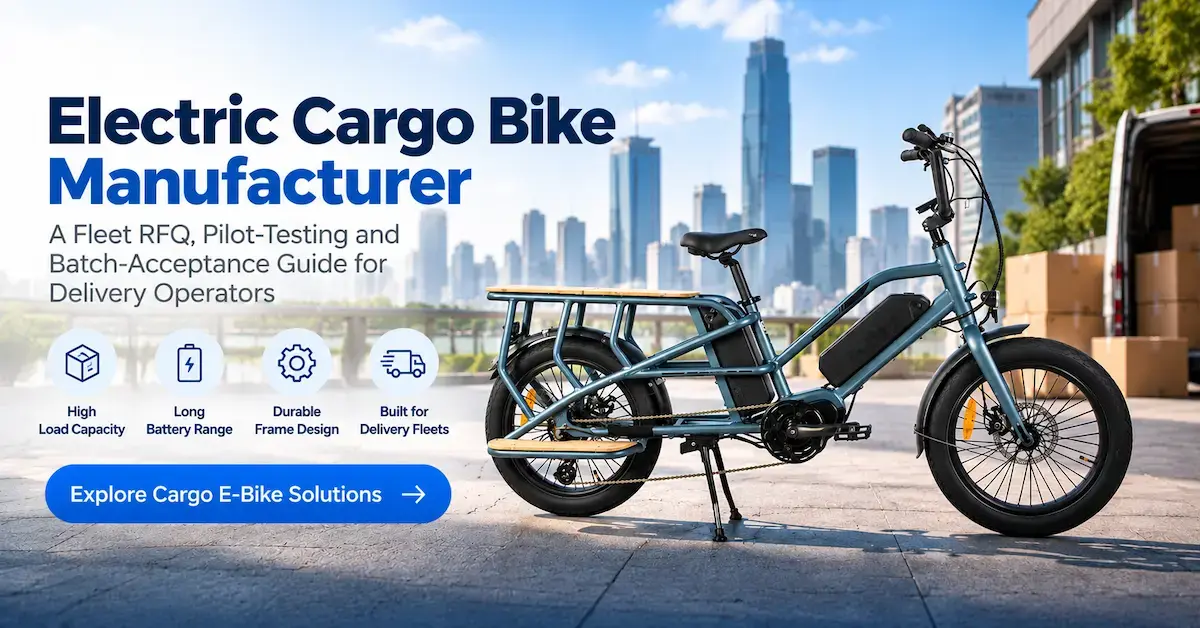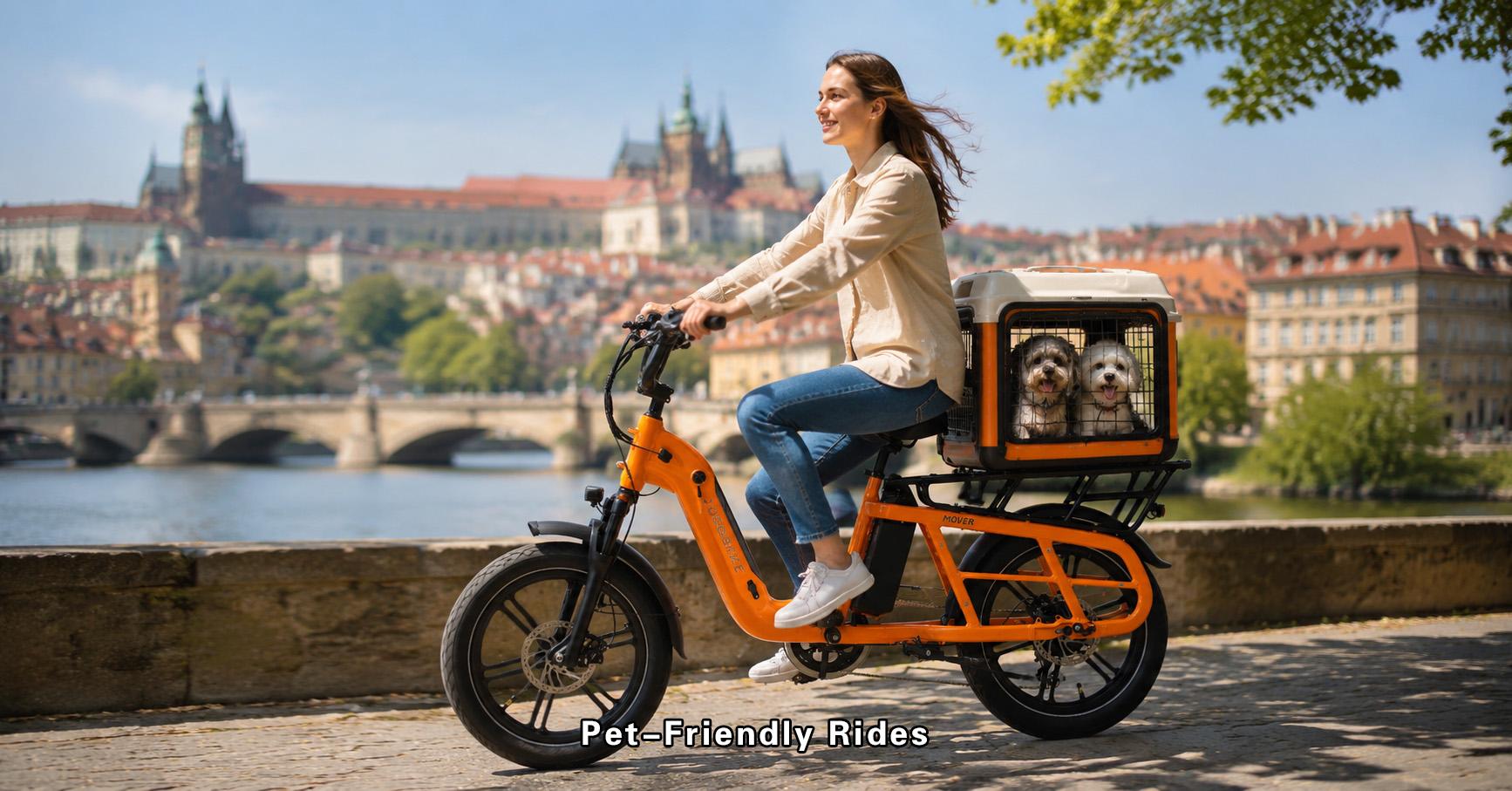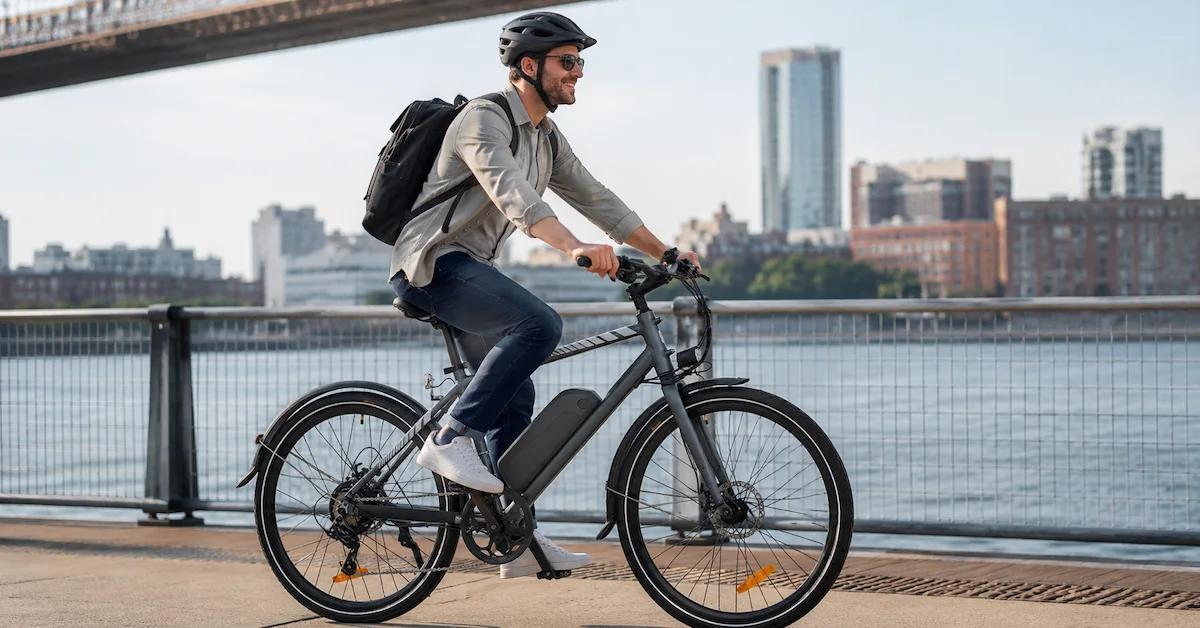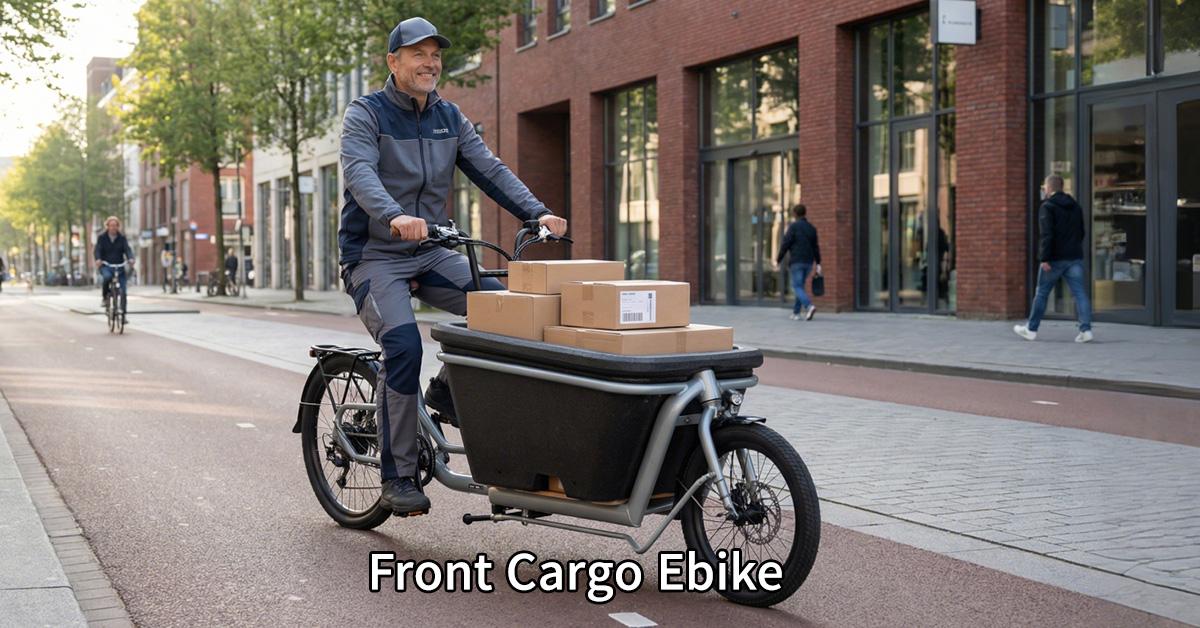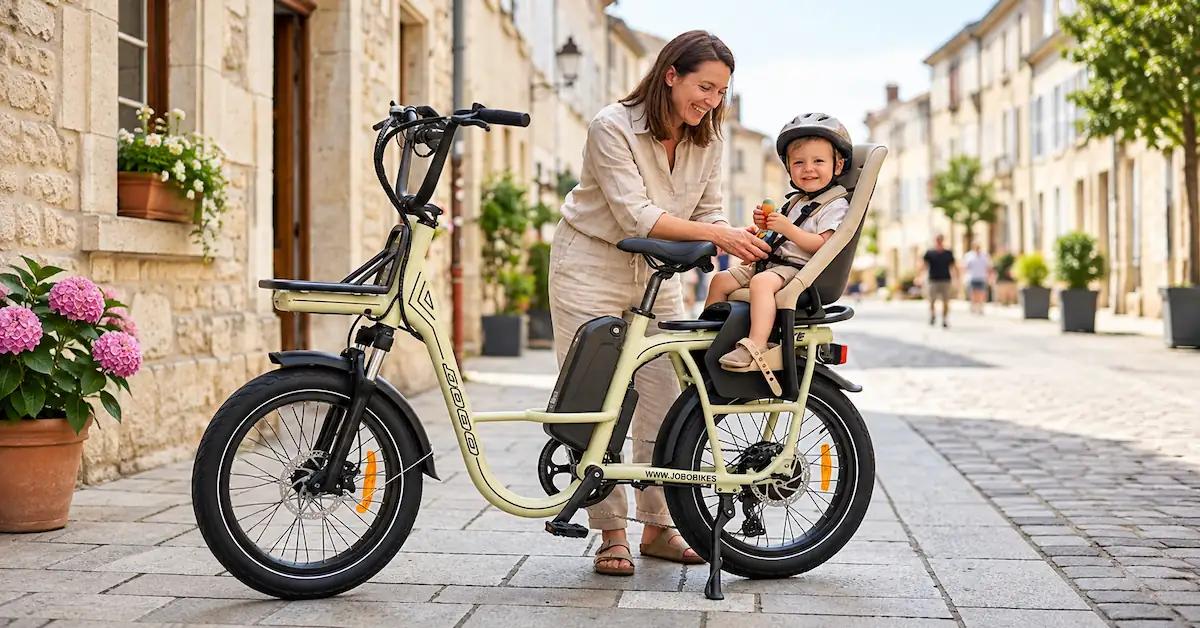
Family cargo electric bikes are becoming an important product category for bicycle retailers, urban mobility brands, and distributors serving households that want practical alternatives for short everyday journeys.
Unlike conventional commuter e-bikes, family cargo models are expected to accommodate different combinations of groceries, school bags, shopping items, and potentially passengers where the bicycle and accessories are specifically approved for that purpose.
This creates a different set of purchasing requirements.
A distributor cannot evaluate a family cargo e-bike only by looking at motor power, battery capacity, or wheel size. The real questions concern the rear structure, load distribution, approved seating equipment, stability during loading, and ease of handling for different riders.
Working with an experienced family cargo e-bike manufacturer can help brands develop products around these practical needs.
The JOBO JB-TDN57Z-F provides a relevant starting platform. Its published reference configuration includes a 48V 750W motor, 48V 20Ah battery, low step-through 6061 aluminum alloy frame, mechanical disc brakes, and 20×3.0-inch tires.
However, any claim involving child seats or passenger carrying must be supported by the approved product configuration, load ratings, accessory compatibility, and relevant testing.
This buying guide explains how OEM brands and wholesale distributors can evaluate the JB-TDN57Z-F and prepare a more reliable family cargo e-bike program.
Quick Answer: What Should Buyers Look for in a Family Cargo E-Bike Manufacturer?
A reliable family cargo e-bike manufacturer should provide clearly defined vehicle and rack load ratings, verified accessory compatibility, controlled frame production, appropriate braking performance, model-specific testing documentation, and dependable replacement-parts support.
For the JOBO JB-TDN57Z-F, buyers should begin by confirming the actual rear-rack capacity, any approved passenger configuration, the 48V 20Ah battery specification, and the legal motor configuration for the destination market.
Before bulk production, request a representative sample and validate the bicycle under its intended rider, cargo, and accessory conditions.
Explore JOBO's Cargo and Utility E-Bike Range.
1. Why Family Cargo E-Bikes Require a Different OEM Purchasing Strategy
Family transportation places different demands on an electric bicycle than urban commuting or commercial delivery.
A rider may need to carry groceries in the morning, transport everyday household items later, and use the bicycle for recreational trips on weekends.
If passenger transport is part of the intended product concept, the technical requirements become even more specific.
The frame, rear structure, seating system, protective accessories, and load distribution must be evaluated together.
Who buys family cargo electric bikes?
| Target customer | Primary requirement | OEM purchasing priority |
|---|---|---|
| Urban families | Everyday errands and household mobility | Practical storage and handling |
| Parents considering child transport | Approved seating arrangements | Verified seat and vehicle compatibility |
| Suburban households | Grocery and utility transport | Rack capacity and battery range |
| Family-oriented bicycle retailers | Products that can be demonstrated clearly | Defined features and safety documentation |
| Outdoor and leisure distributors | Versatile recreational utility bikes | Comfort and accessory compatibility |
| Private-label mobility brands | Differentiated family product lines | OEM design and quality consistency |
For these buyers, an attractive specification is only the starting point.
The bicycle must suit the customer's actual use.
A family cargo e-bike should be chosen around who or what it is approved to carry—not simply how much weight the manufacturer advertises.
2. JOBO JB-TDN57Z-F: Technical Specifications and Buyer Considerations
The JB-TDN57Z-F is presented by JOBO as a family-oriented utility cargo e-bike platform with a step-through frame and integrated carrying areas.
Its configuration is designed to support practical urban riding and OEM customization.
JB-TDN57Z-F specification overview
| Specification | Published reference | B2B buyer consideration |
|---|---|---|
| Product model | JB-TDN57Z-F | Confirm latest production revision |
| Motor | 48V 750W | Verify motor model and market eligibility |
| Battery | 48V 20Ah | Confirm pack, cells, BMS and charger |
| Display | LCD | Review functions and visibility |
| Maximum speed | 32 km/h | Confirm destination-market configuration |
| Advertised riding distance | 50 km | Request defined test conditions |
| Frame | 6061 aluminum alloy | Review structure and fatigue testing |
| Wheel format | 20-inch | Check geometry and handling |
| Drivetrain | Shimano 7-speed | Confirm exact components |
| Brakes | Mechanical disc brakes | Verify loaded braking performance |
| Front fork | Suspension | Confirm model and approved loading |
| Tires | 20×3.0 inches | Evaluate tire ratings and service availability |
| Rear carrying area | Passenger-oriented design described | Confirm approved passenger and rack ratings |
| Child-seat compatibility | Not established by the specification graphic | Require written compatibility evidence |
| Complete bicycle weight | Not confirmed in supplied materials | Request measured production weight |
The table reflects the supplied product information. Final specifications, available options, and approved applications must be confirmed through the current JOBO technical documentation.
How should buyers interpret these specifications?
The 48V 750W motor provides a reference for powertrain selection, but actual climbing capability and loaded performance depend on the full vehicle configuration.
Similarly, the 50 km distance is an advertised figure, not a guaranteed family riding range under every load and route condition.
The 20-inch wheel format and step-through frame create a compact utility-style appearance, but buyers should still evaluate rider fit, stability, and the intended carrying arrangement.
The key is to translate individual specifications into practical purchasing criteria.
3. Verify Passenger and Child-Seat Compatibility Before Wholesale Orders
This is one of the most important sections for a family cargo e-bike sourcing project.
The JB-TDN57Z-F product description refers to a passenger-ready rear area and family-oriented utility applications.
However, a rear rack or extended passenger-looking platform does not automatically establish that the bicycle can safely carry a child or adult passenger.
The permitted carrying configuration must be defined and supported by the manufacturer.
Seven questions every distributor should ask
-
What is the maximum permissible total vehicle mass?
-
What is the maximum rider weight?
-
What are the separate front and rear rack load limits?
-
Is the rear structure approved for passengers, cargo only, or specific accessories?
-
Which exact child-seat models and mounting systems are compatible, if any?
-
Are passenger footrests, wheel protection, restraints, or other protective components required?
-
What testing and instructions support the proposed configuration?
These questions should be answered in the final product specification.
Understanding the different load ratings
| Load term | Meaning | Why it matters |
|---|---|---|
| Maximum permissible total mass | Maximum allowed mass of the complete loaded system | Determines overall loading limits |
| Rider weight limit | Maximum approved weight of the rider | Important for product positioning |
| Rear rack load rating | Maximum load permitted on the rear structure | Determines cargo and accessory limits |
| Front rack load rating | Maximum permissible front carrying load | Prevents unsupported front loading |
| Passenger rating | Approved passenger arrangement, if any | Must be separately established |
| Child-seat rating | Child-seat manufacturer's approved weight and fit | Must be compatible with the bicycle |
The permitted total mass must account for the bicycle, rider, cargo, passengers where allowed, and relevant accessories.
A manufacturer may publish a general loading-capacity figure, but buyers must confirm exactly what that number includes.
An older JB-TDN57Z-F manufacturer listing mentions a 120 kg loading capacity without clearly defining its components. It should not be treated as a current rear-rack rating or proof of child-passenger approval.
Child-seat requirements for European programs
For buyers targeting European markets, standards such as EN 14344 address relevant bicycle child-seat safety requirements, while the EN 17860 series addresses aspects of carrier-cycle design and use.
Their scopes are different, and additional national rules may apply.
A distributor should ask for documentation covering the actual bicycle, mounting system, and child seat rather than assuming that compliance with one standard automatically covers the assembled product.
Procurement recommendation: Do not advertise the JB-TDN57Z-F as carrying a specified number of children until JOBO confirms the approved configuration in writing.
4. Why Step-Through Frame Geometry Matters for Family Riders
The JB-TDN57Z-F uses a low step-through frame layout.
This geometry may offer practical advantages for everyday utility riding, particularly when riders frequently stop, dismount, and load household items.
However, easy mounting should not be confused with guaranteed stability under load.
Important design considerations
Step-over height: Buyers should request a measured dimension rather than relying only on the term "low step-through."
Rider fit: Saddle adjustment, handlebar reach, and control access should suit the target customer population.
Weight distribution: Rear-mounted cargo or approved passenger equipment changes how the bicycle handles.
Stand design: A stable parking arrangement matters during ordinary loading and unloading, but the manufacturer's instructions must define whether loading while parked is permitted.
Wheel and frame geometry: Wheelbase, tire size, frame stiffness, and steering geometry affect handling.
What should be tested?
Use a production-representative sample to evaluate slow-speed maneuvering, mounting and dismounting, parking, turning, and stopping.
Conduct tests under the approved cargo configuration, following the manufacturer's instructions.
For a passenger-approved configuration, additional evaluation should address the relevant passenger loading and protection requirements.
The objective is to ensure that the finished product works for its intended users—not merely that its frame looks accessible.
5. Compare Family Cargo E-Bike Layouts Before Choosing an OEM Platform
Different cargo e-bike architectures are suitable for different household activities.
A compact rear-carrying utility bicycle is not identical to an extended long-tail or front-loading cargo model.
Family cargo platform comparison
| Platform type | Main characteristics | Suitable purchasing objective |
|---|---|---|
| Compact rear-carrying utility bike | Step-through frame, practical racks, relatively compact package | Household errands and approved accessories |
| Extended long-tail cargo bike | Longer rear carrying area | Programs requiring a larger approved rear carrying system |
| Front-load cargo bike | Carrying area ahead of the rider | Larger or differently shaped household cargo |
| Three-wheel cargo cycle | Multiple-wheel carrying architecture | Applications requiring a different load platform |
The JB-TDN57Z-F belongs to the family-oriented utility category and is a useful reference for retailers seeking a compact cargo-style product.
When is the JB-TDN57Z-F a good starting point?
It may be appropriate for distributors prioritizing step-through accessibility, compact 20-inch wheels, battery-assisted utility riding, and customizable carrying accessories.
When might another platform be better?
A distributor whose core requirement is transporting a particular passenger arrangement, carrying oversized items, or supporting very high cargo loads may need a different frame architecture.
JOBO offers several cargo and utility platforms that can be compared according to their intended functions.
Browse JOBO Electric Cargo Bike Platforms.
6. Evaluate Motor Power, Battery Range and Real Family Riding Conditions
Family cargo bicycles often experience changing payloads.
A trip to a grocery store may begin with a lightly loaded bicycle and end with additional shopping bags.
The actual energy consumption can therefore differ from a manufacturer's reference test.
JB-TDN57Z-F battery configuration
The product materials list a 48V 20Ah battery.
This represents approximately 960Wh of nominal battery energy:
48V × 20Ah = 960Wh
Nominal battery energy is not the same as guaranteed usable energy or distance.
Actual riding range depends on assistance settings, route gradients, total load, tire pressure, temperature, speed, and battery condition.
How should distributors validate the 50 km advertised range?
Ask for the conditions used to obtain the figure.
Then test a representative bicycle using realistic rider weight, approved cargo load, intended terrain, and assistance settings.
Record distance traveled, starting and ending battery state, environmental conditions, and relevant riding behavior.
Do not use an unloaded demonstration result to promise a loaded family riding range.
Motor requirements differ by market
The supplied JB-TDN57Z-F configuration lists a 750W motor and a maximum speed of 32 km/h.
These figures should not be assumed to qualify automatically for every country's electric bicycle category.
For example, standard European electrically assisted bicycle requirements may call for a lower rated motor output and assistance speed limit.
Buyers should identify their destination-market classification before requesting the final powertrain configuration.
An OEM program may require changes to motor rating, controller settings, assistance behavior, or other components, subject to engineering feasibility and applicable requirements.
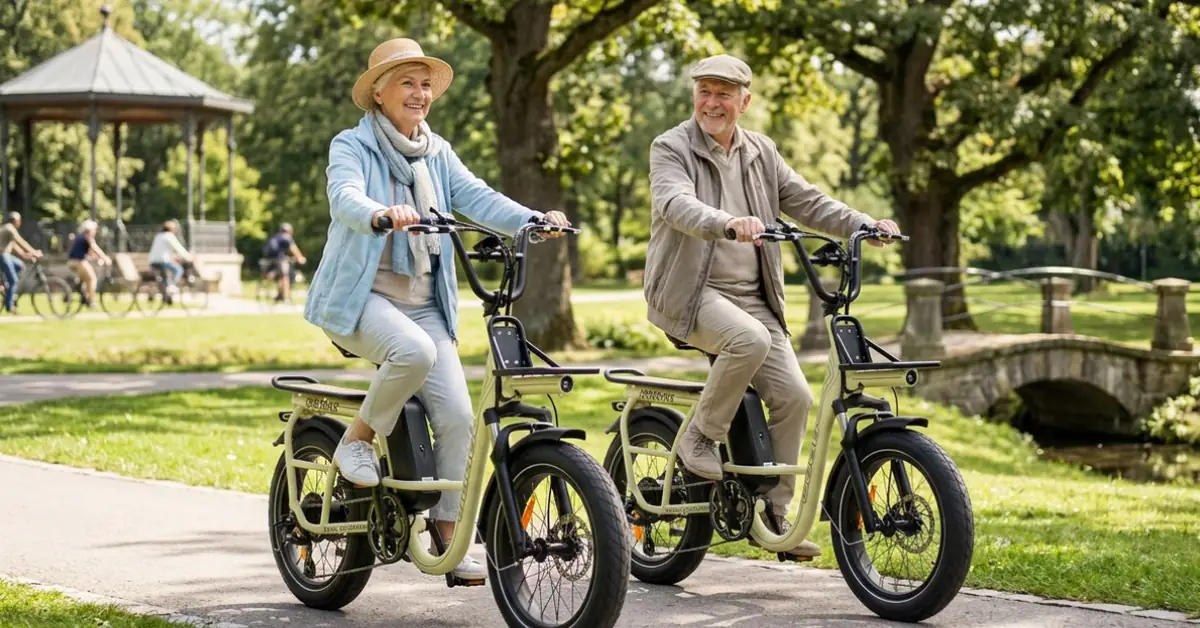
7. Braking, Tires and Suspension for Family Utility Riding
A family-oriented electric bicycle should be evaluated using the real loads and routes for which it is intended.
The JB-TDN57Z-F reference includes mechanical disc brakes, 20×3.0-inch tires, and a suspension fork.
Mechanical disc brakes
Mechanical disc brakes can be serviced using appropriate procedures and compatible parts.
However, the presence of disc brakes does not by itself establish that a particular loaded configuration meets its required stopping-performance criteria.
Buyers should request the exact brake component specification and relevant complete-bicycle test evidence.
20×3.0-inch tires
The tire format may provide a practical balance of width and compact wheel size.
Actual grip, durability, puncture resistance, and permissible tire load depend on the specific tire.
For a family cargo OEM project, tire selection should consider pavement conditions, tire clearance, expected loads, and local replacement availability.
Suspension fork
The product includes a suspension fork in its reference specification.
Buyers should confirm its construction, maintenance requirements, and approved use for the intended riding conditions.
The suitability of the complete bicycle must be evaluated as a system, including its frame, wheels, brakes, suspension, and cargo equipment.
8. What Can Be Customized Through a Family Cargo E-Bike OEM Program?
A successful private-label family cargo bicycle must offer meaningful value without compromising the approved design.
JOBO describes OEM/ODM services covering product configuration, engineering, branding, manufacturing, sample approval, and quality control.
Potential customization options
| Customization area | Retail or brand objective | Required verification |
|---|---|---|
| Frame color and branding | Distinct product identity | Finish and artwork approval |
| Front and rear racks | Household carrying convenience | Mounting and load ratings |
| Passenger-related accessories | Defined family transport application | Specific compatibility and safety validation |
| Motor configuration | Match destination-market requirements | Electrical and regulatory review |
| Battery capacity | Match expected journey length | Electrical compatibility and range testing |
| Brakes | Match approved loaded operating conditions | Component and performance validation |
| Tires | Match local road conditions | Load rating and handling |
| Display | Improve rider information | Functions and electrical integration |
| Packaging | Support retail distribution | Transit protection and instructions |
Separate cosmetic changes from engineering changes
Changing the bicycle's frame color is usually less technically demanding than redesigning its rear carrying structure.
Modifying passenger-related components, changing frame geometry, or altering the electrical system may require additional validation.
For each proposed change, buyers should request an approved drawing, final BOM, representative sample, and revised testing documentation where applicable.
Explore JOBO OEM/ODM Electric Bike Manufacturing.
9. Quality Control: What Should Family Cargo E-Bike Buyers Inspect?
Quality control is particularly important when a product may be marketed for family use.
Buyers should not assume that general factory certifications or a laboratory photograph establish passenger suitability.
They need evidence relating to the exact model and approved configuration.
JOBO describes in-house testing capabilities covering frame fatigue, complete-bike testing, brake-related testing, battery testing, and production inspections.
Learn More About JOBO's QC Laboratory.
Recommended inspection checklist
| Inspection item | Buyer acceptance requirement |
|---|---|
| Frame welding | Approved drawings and structural inspection |
| Front and rear racks | Correct mounting and approved load specifications |
| Passenger accessories | Compatibility and relevant validation, where applicable |
| Brake assembly | Approved component and adjustment |
| Motor and controller | Match signed BOM |
| Battery and charger | Compatibility, retention, labeling, documentation |
| Tire and wheel assembly | Approved components and correct setup |
| Lighting and controls | Required operation and configuration |
| Final vehicle | Matches approved production sample |
| Packaging | Correct accessories, instructions, and protection |
For an OEM family cargo program, the inspection plan should be documented before mass production.
Critical changes to passenger-carrying structures or electrical components should require engineering review and buyer approval.
Why batch consistency matters
Retailers need to know that replacement components will fit the products they have already sold.
If component specifications change without notice, after-sales support may become more complicated.
A controlled BOM, traceable production records, and consistent service documentation help protect the retailer's long-term customer relationship.
10. Evaluate Wholesale Pricing Beyond the Factory Unit Cost
A family cargo e-bike manufacturer's quotation should be compared using equivalent specifications.
A lower-priced bicycle may not include accessories, documentation, or service arrangements offered by another supplier.
Wholesale cost evaluation
| Cost category | What buyers should confirm |
|---|---|
| Base bicycle | Exact motor, battery, brakes, tires and frame |
| Cargo equipment | Included racks, mounting hardware, accessories |
| Passenger equipment | Whether any approved seating system is supplied |
| OEM branding | Painting, logo, packaging and artwork charges |
| Product development | Sample and tooling costs |
| Testing | Scope of included model-specific validation |
| Freight | Packing dimensions, shipping and Incoterms |
| Import requirements | Destination-market documents and duties |
| After-sales | Warranty, spare parts, service support |
| Reorders | MOQ, configuration stability, scheduling |
Family cargo bicycles may also require additional retail staff training and demonstration time.
Buyers should include these costs when evaluating contribution margin.
A practical product assortment strategy
A distributor entering this category may begin with a limited number of configurations:
-
A household utility build with approved cargo accessories.
-
A clearly documented family-oriented configuration if passenger transport is validated.
-
A private-label version tailored to a specific regional market.
This is a proposed assortment strategy, not a statement that all three variants are currently available from JOBO.
Restricting unnecessary options can simplify customer education, inventory planning, and replacement-parts management.
11. How to Prepare a Family Cargo E-Bike Wholesale RFQ
A clear request for quotation allows the manufacturer to recommend a suitable platform and distinguish standard components from custom development requirements.
Family cargo OEM RFQ checklist
| RFQ item | Required information |
|---|---|
| Business type | Distributor, retailer, private-label brand |
| Destination market | Country and applicable vehicle classification |
| Product model | JB-TDN57Z-F or alternative platform |
| Intended use | Household cargo, errands, approved passenger transport |
| Rider fit | Target rider dimensions and adjustment requirements |
| Load requirements | Rider, front/rear cargo, passengers if permitted |
| Seating equipment | Exact child-seat or passenger accessory requirements |
| Motor | Required legally appropriate configuration |
| Battery | Capacity, charging and range expectations |
| Brakes and tires | Preferred approved components |
| Branding | Logo, color, packaging |
| Purchase quantity | Samples, initial order, annual forecast |
| Testing | Required reports and acceptance criteria |
| Commercial terms | MOQ, quotation, production timing |
| After-sales | Warranty and replacement-parts support |
Suggested OEM inquiry to JOBO
"We are a bicycle distributor or private-label brand serving [target market] and are interested in the JOBO JB-TDN57Z-F family cargo electric bike platform.
Our intended customers include urban households seeking electric bicycles for daily errands, shopping, and family-oriented utility travel.
Please provide the latest technical specification, including the complete-bike weight, maximum permissible total mass, rider weight limit, front and rear rack ratings, approved passenger arrangements, and compatible child-seat systems, if any.
We would also like to confirm the 48V 750W motor and 48V 20Ah battery configuration, available destination-market alternatives, range-testing conditions, quality-control documentation, MOQ, sample availability, OEM branding options, production schedule, and spare-parts support.
Our estimated initial order is [quantity] units, with further orders subject to sample approval and market demand."
Request a Family Cargo E-Bike OEM Quotation from JOBO.
12. Frequently Asked Questions
1. What is a family cargo e-bike?
A family cargo e-bike is an electric bicycle intended for everyday household utility and carrying tasks. Some models may support approved passenger arrangements, but this must be verified for the particular bicycle and accessories.
2. Is the JOBO JB-TDN57Z-F suitable for transporting children?
The product description identifies a family-oriented rear area, but the supplied materials do not establish a complete approved child-carrying configuration. Request written confirmation of compatible seats, permissible loads, protective equipment, and relevant testing before making passenger claims.
3. What motor does the JB-TDN57Z-F use?
The published reference configuration lists a 48V 750W motor. Buyers must confirm the final motor and controller specifications and their suitability for the destination market.
4. What battery does the JB-TDN57Z-F have?
The supplied product specification lists a 48V 20Ah battery. The final pack design, manufacturer, charger, battery-management system, and service arrangements should be confirmed before ordering.
5. What is the maximum load capacity of the JB-TDN57Z-F?
An older manufacturer listing mentions a 120 kg loading capacity, but the supplied current product information does not define the complete set of relevant load ratings. Buyers must obtain the latest approved total-mass, rider, rack, and passenger limits separately.
6. Can a child seat be installed on the rear rack?
Only if the exact bicycle, rear carrying structure, child seat, and attachment system are approved as compatible. A standard cargo rack should not be assumed to support a child seat.
7. What is the riding range of the JB-TDN57Z-F?
The published product reference advertises 50 km. Actual range depends on rider and cargo weight, battery condition, assistance settings, terrain, and other operating factors.
8. Can JOBO customize family cargo e-bikes for private-label brands?
JOBO offers OEM/ODM development and manufacturing services. Possible areas include branding, component selection, accessories, and engineering changes, subject to feasibility, testing, commercial terms, and final approval.
9. What is the MOQ for a custom family cargo e-bike order?
The supplied product materials do not establish a fixed MOQ. Minimum quantities may depend on the selected platform, customization, components, branding, and production requirements.
10. How can I request wholesale pricing for the JB-TDN57Z-F?
Contact JOBO with your target market, intended carrying requirements, preferred configuration, expected quantity, and sample needs. Request a current technical specification, applicable documentation, and a written OEM quotation.
Conclusion
Selecting the right family cargo e-bike manufacturer requires more than comparing motor specifications or the appearance of a rear carrying rack.
For distributors and private-label brands, the most important questions concern approved load limits, child-seat compatibility, practical frame geometry, battery performance, braking, product testing, and long-term after-sales support.
The JOBO JB-TDN57Z-F provides a family-oriented utility platform with a low step-through frame, published 48V 750W motor and 48V 20Ah battery configuration, 20-inch wheels, and customizable carrying equipment.
However, the available product information should not be interpreted as automatic approval for transporting children or other passengers. Those capabilities require specific technical confirmation.
A successful OEM purchasing program should begin with a clear intended-use brief, continue through representative sample evaluation, and establish a controlled BOM and inspection standard before bulk production.
For family mobility brands, bicycle distributors, and wholesale buyers, this approach can reduce sourcing uncertainty and support a more consistent retail product range.
Looking for a family cargo e-bike manufacturer for your next OEM or wholesale project?
Contact JOBO to Discuss JB-TDN57Z-F Samples, Family Cargo Configurations and Wholesale Pricing.
Share your destination market, required cargo or passenger arrangement, preferred specifications, and expected purchasing volume to receive a tailored product recommendation.