Food delivery platforms, courier companies, and logistics distributors need electric bicycles that perform consistently across demanding urban routes. Frequent stops, changing cargo loads, battery charging schedules, and daily maintenance can all affect delivery efficiency.
For B2B buyers, choosing a custom delivery electric bike is therefore more complex than selecting an attractive frame or comparing motor wattage.
A suitable vehicle must match the operator's actual routes, riders, cargo requirements, charging facilities, and destination-market regulations.
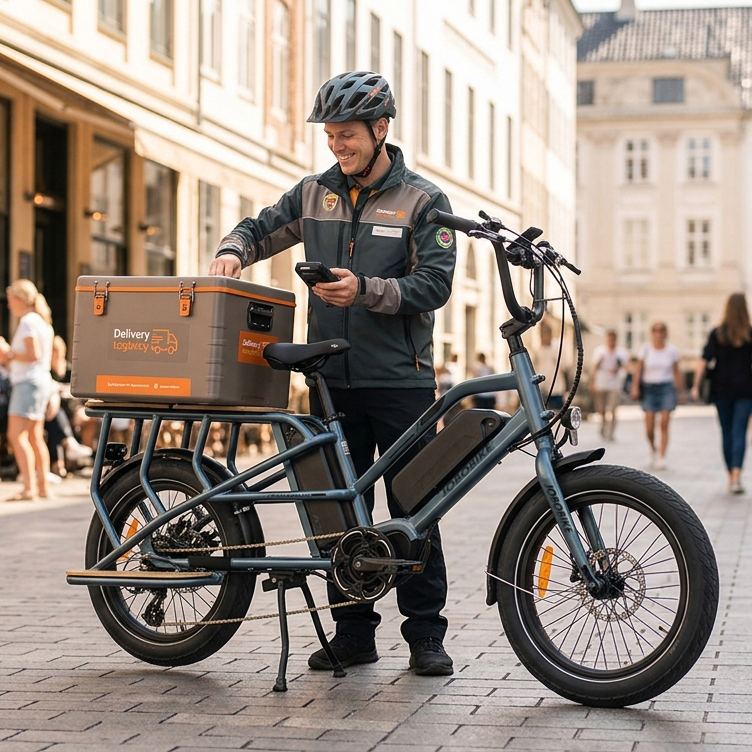
The JOBO JB-TDN50L provides a practical starting point for this process. Designed as a configurable delivery e-bike platform, it combines a 48V 350W mid-drive system with a 20-inch aluminum alloy frame, Shimano 7-speed drivetrain, and cargo-oriented features.
JOBO also offers configuration options for battery systems, braking components, display functions, cargo equipment, and private-label branding.
This guide explains how courier companies, food delivery operators, distributors, and mobility brands can develop a reliable OEM specification before ordering wholesale electric delivery bicycles.
Quick Answer: How Should Buyers Configure a Custom Delivery Electric Bike?
A custom delivery electric bike should be configured around five requirements: daily delivery distance, rider and cargo weight, route conditions, charging availability, and maintenance capability.
For the JOBO JB-TDN50L, buyers can begin with its published 48V 350W mid-drive platform, 48V 15Ah battery, 20×3.0-inch tires, and mechanical disc brakes.
They should then evaluate whether their operations require a different approved motor configuration, optional dual batteries, reinforced cargo equipment, alternative brakes, or connected display functions.
Before production, confirm the final bill of materials (BOM), obtain a representative sample, validate the intended operating conditions, and agree on inspection and replacement-parts requirements.
Explore the JOBO JB-TDN50L Custom Delivery Electric Bike.
1. Why Courier Fleets Need Customized Electric Delivery Bikes
Urban delivery vehicles experience different demands from conventional commuter bicycles.
A typical courier may repeatedly accelerate from traffic lights, stop outside restaurants, park beside apartment buildings, and carry packages of varying weights throughout the working day.
These conditions affect battery consumption, braking, drivetrain wear, cargo stability, and rider comfort.
A vehicle that works for occasional personal travel may not provide the most suitable equipment for continuous commercial use.
Match the bike to the delivery application
| Delivery application | Common operating challenge | OEM configuration priority |
|---|---|---|
| Food delivery | Repeated short trips and insulated bags | Rack compatibility and manageable handling |
| Parcel courier | Variable package sizes and frequent stops | Approved cargo carrying capacity |
| Grocery delivery | Changing load weights | Braking, stability, and cargo mounting |
| Urban postal routes | Predictable routes with many stops | Battery planning and serviceability |
| Delivery vehicle rental | Different riders using the same fleet | Rider adjustment and standardized components |
| Multi-depot logistics | Vehicles deployed across several locations | Consistent BOM and replacement parts |
This is why the best configuration is not necessarily the most expensive.
A food delivery operator may benefit from a simple, easily serviced drivetrain and a secure rear delivery box.
A courier company with longer routes may place greater importance on battery availability and charging arrangements.
A distributor launching a private-label delivery range may prioritize consistent specifications, standardized spare parts, and reliable batch production.
The OEM project should begin with these differences.
2. JOBO JB-TDN50L: Technical Specifications and Purchasing Considerations
The JB-TDN50L is positioned by JOBO as a customizable electric delivery bicycle for logistics companies, distributors, and commercial mobility brands.
Its published product configuration provides a technical foundation for discussing a fleet-specific build.
JB-TDN50L product specification overview
| Specification | Published reference | Buyer verification |
|---|---|---|
| Model | JB-TDN50L | Final configuration and revision |
| Motor | Bafang 48V 350W mid-drive | Rated output and legal classification |
| Battery | 48V 15Ah LG battery | Exact pack specification and quantity |
| Battery option | Single or dual-battery configuration | Electrical compatibility and approved installation |
| Display | Bafang C18 LCD color display | Functions and optional connectivity |
| Maximum speed | 25–38 km/h listed | Market-specific assistance limits |
| Advertised range | 40–60 km | Battery setup and defined test conditions |
| Frame | 6061 aluminum alloy | Geometry, maximum loads, structural evidence |
| Wheel format | 20-inch | Geometry and component compatibility |
| Drivetrain | Shimano 7-speed | Exact component model |
| Braking | TEKTRO mechanical disc brakes | Approved brake model and loaded performance |
| Fork | Integrated fork | Construction and intended-use specification |
| Tires | CST 20×3.0-inch | Tread, rating, puncture protection |
| Charger | 48V 3A; 100–240V AC input listed | Battery compatibility and regional plug |
| Charging time | 4–6 hours listed | Actual pack and charger configuration |
| Carton dimensions | 168 × 33 × 85 cm | Final packing specification |
These figures are based on the published reference build. Optional modifications can change vehicle performance, dimensions, weight, battery requirements, and documentation. Obtain a signed specification for the actual order.
What makes the JB-TDN50L relevant to commercial buyers?
The combination of a mid-drive motor, 7-speed drivetrain, smaller wheel format, and delivery-oriented rack options makes the model worth evaluating for frequent urban delivery operations.
However, the published 40–60 km driving-distance figure is not a guaranteed range for a fully loaded courier vehicle.
Likewise, the stated 25–38 km/h speed range describes published configurations, not universal legal suitability.
The final vehicle must be matched to its target market.
3. How to Select the Right Motor for Delivery Routes
Motor configuration affects acceleration behavior, climbing ability, drivetrain loading, and maintenance.
The standard JB-TDN50L reference uses a Bafang 48V 350W mid-drive motor.
A mid-drive system transfers power through the bicycle's drivetrain, allowing motor operation to interact with available gear ratios.
This architecture can be useful where routes involve variable gradients, frequent starting, and changing rider effort.
However, the actual result depends on controller settings, gearing, total load, motor design, and rider behavior.
Important motor selection questions
How often does the rider stop?
Frequent starts can place repeated demands on the motor and drivetrain.
Are there significant hills?
Gradient, load, and gearing should be included in a representative route assessment.
How heavy is the expected cargo?
A motor should not be evaluated separately from the bicycle's approved carrying capacity.
What are the local legal requirements?
The factory's published motor rating and speed options may need modification for the destination market.
Can local workshops maintain the drivetrain?
Mid-drive service planning should include compatible chains, gears, motor parts, and diagnostic procedures.
For brands entering multiple markets, different approved motor or controller configurations may be necessary.
Buyers should request the exact motor model, rated output, controller specification, assistance characteristics, and applicable technical documentation before approving production.
4. Single Battery or Dual Battery: Choose Based on Duty Cycle
Battery planning is often the most important customization decision for electric delivery fleets.
The JB-TDN50L product materials identify a 48V 15Ah LG battery as a reference configuration while also advertising dual-battery capability.
These details should not be interpreted as confirmation that every bicycle includes two batteries.
The specific arrangement must be identified in the quotation.
Comparing battery strategies
| Battery strategy | Potential application | Purchasing considerations |
|---|---|---|
| Single 48V 15Ah battery | Shorter delivery routes with charging access | Route range and charging time |
| Approved dual-battery configuration | Longer or more demanding duty cycles | Weight, control system, wiring, and integration |
| Spare removable battery program | Operations with planned battery exchanges | Replacement compatibility and safe handling |
| Depot charging arrangement | Multi-vehicle centralized operation | Charging equipment, electrical capacity, and safety procedures |
A nominal 48V 15Ah pack represents approximately 720Wh of nominal energy.
However, usable range cannot be calculated reliably from battery capacity alone.
Factors affecting delivery range
Range changes with rider weight, cargo weight, gradients, assistance settings, stop frequency, temperature, tire condition, and battery age.
For a fleet traveling multiple routes, battery planning should include the most demanding normal shift rather than only an easy demonstration route.
A business considering a dual-battery configuration should also confirm whether the system is factory-approved, how the packs are electrically managed, and whether both batteries are included in the quoted unit price.
Battery safety and charging
Commercial buyers should use approved chargers and replacement battery packs and provide clear charging instructions to operators.
Charging procedures must account for the actual battery system, electrical supply, storage environment, and applicable safety requirements.
A battery option that increases nominal capacity may also increase vehicle weight, acquisition cost, and maintenance requirements.
The objective is not maximum battery capacity. It is dependable energy availability throughout the planned operating schedule.
5. Configure Cargo Racks Around Actual Delivery Loads
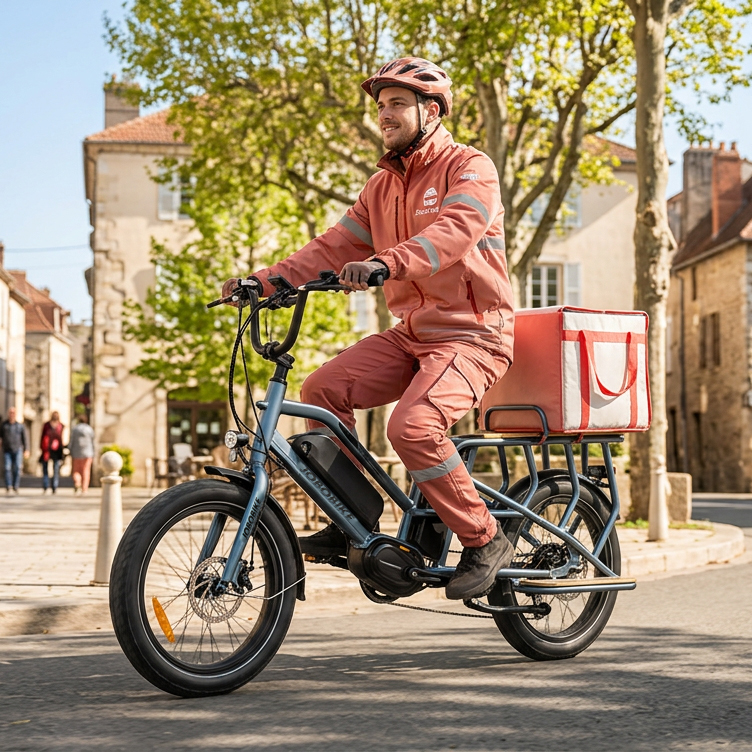
The JB-TDN50L is described as having a heavy-duty rear rack suitable for commercial delivery applications.
For B2B purchasing, this is an important product feature—but the rack must be evaluated using its actual approved load rating.
A delivery box, grocery bag, or parcel carrier may change the bicycle's center of gravity and handling characteristics.
Cargo equipment requirements
Buyers should define the following before selecting accessories:
-
Typical and maximum cargo weight.
-
Cargo box dimensions.
-
Approved mounting points.
-
Required box security.
-
Loading and unloading frequency.
-
Effects on rider access and visibility.
-
Clearance from tires, brakes, and electrical components.
The permissible rack load and maximum vehicle load must be confirmed independently.
A cargo rack capable of holding a box does not automatically mean the complete bicycle is approved for every load placed inside it.
Food delivery versus parcel delivery
Food delivery businesses often prioritize insulated box mounting, convenient rider access, and secure loading.
Parcel operators may require different box dimensions, fasteners, and access arrangements.
A private-label manufacturer can help buyers discuss suitable rack and accessory layouts, but modifications affecting structural loads should undergo engineering review and appropriate validation.
6. Choose Tires and Brakes for the Intended Urban Environment
Tires and brakes are frequent points of maintenance attention in commercial fleets.
The JB-TDN50L reference configuration specifies CST 20×3.0-inch tires and TEKTRO mechanical disc brakes.
Tire selection
The 20×3.0-inch format offers a relatively wide tire profile for this wheel size.
JOBO lists puncture-protection and reflective-sidewall options for the model.
Buyers should verify actual tire construction, recommended inflation pressure, approved load, and replacement availability.
Tire choice should account for the intended road surfaces, but a wider tire alone does not establish suitability for every terrain or weather condition.
Brake selection
Mechanical disc brakes are listed in the reference BOM.
JOBO also describes optional brake system configurations for different applications.
Before requesting a change, buyers should assess loaded stopping performance, service accessibility, replacement parts, and local workshop capabilities.
A more expensive brake configuration is not automatically the correct choice for every fleet.
The selection should reflect actual loads, route conditions, maintenance resources, and applicable requirements.
7. Compare Three OEM Configurations for Different Courier Businesses
A practical OEM development process should avoid creating unnecessary variations.
Instead, buyers can define a small number of clear product specifications for distinct operational needs.
The following are illustrative sourcing concepts, not confirmed JOBO stock variants or guaranteed available packages.
| Configuration concept | Urban food delivery | Extended-route courier | Branded distributor |
|---|---|---|---|
| Starting platform | JB-TDN50L | JB-TDN50L | JB-TDN50L |
| Motor | Market-approved reference setup | Route-validated configuration | Target-market configuration |
| Battery | Single battery if sufficient | Evaluate approved dual-battery option | Standardized approved battery |
| Cargo | Insulated box mount | Parcel-oriented rack | Modular accessories |
| Brakes | Verified reference system | Evaluate under heavier duty cycle | Consistent serviceable BOM |
| Display | Standard LCD | Assess optional fleet connectivity | Standard or branded interface |
| Branding | Operator identification | Fleet numbering | Private-label finish |
| Main priority | Simple daily operation | Shift completion | Repeatable wholesale supply |
Which concept should a buyer choose?
An urban food delivery operator may prefer fewer configuration variables and easy routine maintenance.
An extended-route courier should begin with measured energy consumption and route length before requesting an additional battery.
A wholesale distributor should prioritize stable components and documentation that can be used across repeated orders.
For all three, the complete vehicle must be validated against its real operating requirements.
8. Private Label and OEM Options for Delivery E-Bike Brands
A custom delivery electric bike program may include visual branding, product configuration, accessories, and technical documentation.
JOBO describes an OEM/ODM process covering product development, component selection, frame and painting work, sample testing, production, and shipment preparation.
Common customization categories
| Customization area | Potential buyer requirement | Important approval step |
|---|---|---|
| Frame and finish | Brand colors and geometry options | Engineering and sample approval |
| Battery | Single or dual configuration | Electrical design validation |
| Motor | Market-specific rated output | Regulatory and performance review |
| Brakes | Alternative approved components | Loaded braking verification |
| Cargo rack | Delivery box compatibility | Load and mounting validation |
| Display | LCD or connected options | Hardware/software compatibility |
| Tires | Different tread or protection | Load, handling, and clearance review |
| Packaging | Branded cartons and instructions | Transit testing and final approval |
A cosmetic branding change generally differs from an engineering modification.
Changing a frame structure, adding a battery, or redesigning load-bearing accessories may require additional development work and testing.
Buyers should ask JOBO which changes are available for their selected platform, whether tooling is required, and how MOQ and pricing are affected.
Explore JOBO's OEM/ODM manufacturing services.
9. How JOBO Develops Custom Delivery E-Bikes
JOBO describes a connected OEM/ODM development process from requirements gathering to final inspection.
For a delivery project, this workflow can help prevent miscommunication between procurement, engineering, production, and after-sales teams.
Step 1: Define the delivery application
The buyer provides the destination market, route conditions, rider profile, payload requirements, budget, and target purchase quantity.
Step 2: Review configuration and BOM
The manufacturer and buyer discuss motor, battery, controller, brakes, rack design, tires, display, and accessories.
Step 3: Confirm design changes
Engineering teams evaluate whether the requested configuration is compatible with the base platform and production requirements.
Step 4: Build representative samples
Samples should reflect the intended production specification—not merely a similar display model.
Step 5: Complete relevant testing
Structural, electrical, braking, and cargo-related checks should be selected according to the actual product configuration.
Step 6: Approve the production standard
The approved sample, BOM, artwork, packaging, and inspection requirements become the purchasing reference.
Step 7: Manufacture and inspect
Incoming material checks, assembly controls, in-process inspection, and final inspection should be documented as agreed.
Step 8: Arrange shipment and after-sales support
Delivery planning should include packaging, documentation, replacement-parts arrangements, and warranty procedures.
This process allows brands to make purchasing decisions using controlled technical information rather than relying on changing catalogue descriptions.
10. Quality Control and Component Consistency
Delivery operators need more than a bicycle that looks correct when it leaves the factory.
They need predictable quality across batches and components that can be serviced throughout the operating life of the fleet.
JOBO publishes information about its in-house quality-control laboratory, including frame fatigue testing, vibration-related evaluation, and brake-related test equipment.
View JOBO Quality-Control Laboratory.
Recommended quality-control checkpoints
Frame and rack: Confirm approved materials, structural requirements, mounting points, and relevant load-testing evidence.
Electrical system: Inspect battery installation, connectors, wiring protection, controller functions, and charging compatibility.
Drivetrain: Check correct assembly and adjustment of the mid-drive system, chain, gears, and related components.
Braking: Confirm the exact brake specification and complete-bike operating performance.
Final configuration: Verify that the finished bicycle matches the signed BOM and approved sample.
Packaging: Confirm accessories, manuals, labels, battery shipment documents, and protective packaging.
A manufacturer's laboratory capabilities should not be confused with proof that a particular model has every certification.
Buyers must request applicable documentation for the precise configuration and destination market.
11. Compare Purchase Price with Long-Term Fleet Requirements
Wholesale cost is important, but a commercial buyer should evaluate the complete supply arrangement.
A low unit price may become less attractive if replacement batteries, brake parts, controllers, or compatible accessories are difficult to obtain.
Cost factors to include in an RFQ
| Cost factor | Buyer question |
|---|---|
| Base vehicle | What components are included in the quoted price? |
| Battery options | Are additional batteries included or separately priced? |
| Cargo accessories | What racks, boxes, and fittings are supplied? |
| Branding | Are artwork, painting, and packaging charged separately? |
| Engineering | Are development or tooling charges required? |
| Testing | What verification is included? |
| Shipment | Which Incoterms and packaging arrangements apply? |
| Service parts | Can parts be reordered independently? |
| Warranty | What coverage and claim procedures are offered? |
| Repeat orders | How will component specifications remain consistent? |
Request quotations using an identical specification wherever possible.
Comparing two prices without comparing their BOMs can lead to misleading purchasing decisions.
For distributors, the cost of managing multiple incompatible components across successive orders may also be significant.
12. What to Include in a JB-TDN50L OEM Request for Quotation
A detailed RFQ helps the manufacturer identify the right configuration and reduces the need for repeated clarification.
Wholesale RFQ checklist
| Required information | Example or description |
|---|---|
| Business type | Delivery operator, distributor, private-label brand |
| Destination market | Country and intended vehicle category |
| Application | Food delivery, courier, parcels |
| Route profile | Typical distance, gradients, stops |
| Rider and payload | Expected weights and fit requirements |
| Motor | Required legal and operating configuration |
| Battery | Single/dual preference and charging arrangement |
| Cargo equipment | Box, rack, mounting, approved loads |
| Branding | Colors, logos, graphics |
| Display | Standard LCD or requested connectivity |
| Quantity | Sample units, initial order, forecast |
| Documentation | Testing, compliance, manuals |
| Commercial details | MOQ, price, lead time, shipping terms |
| After-sales | Warranty and replacement parts |
Sample inquiry to JOBO
"We are a delivery fleet operator/distributor serving [target market] and are evaluating the JOBO JB-TDN50L platform.
Our primary application is [food delivery/courier/parcel distribution], with an average daily route of [distance], typical cargo weight of [weight], and expected purchase quantity of [quantity].
Please recommend an appropriate motor, battery, brake, and cargo configuration.
We would also like to confirm the 48V 15Ah battery specification, optional dual-battery arrangement, approved rack load, real-world range-testing method, private-label possibilities, applicable compliance documents, MOQ, production schedule, and replacement-parts support.
Please provide a current technical specification and quotation, together with information about sample approval."
Request a Custom Delivery E-Bike Quotation from JOBO.
13. Frequently Asked Questions
1. What is a custom delivery electric bike?
A custom delivery electric bike is an electric bicycle configured for a particular commercial transport application, with options involving its electrical system, cargo equipment, branding, and other approved components.
2. Is the JOBO JB-TDN50L suitable for food delivery?
The JB-TDN50L is positioned for commercial last-mile logistics, including food delivery. Buyers should verify approved payloads, cargo mounting, range, and route compatibility before purchasing.
3. What motor does the JB-TDN50L use?
The published reference configuration lists a Bafang 48V 350W mid-drive motor. Market-specific alternatives must be confirmed with JOBO.
4. Does the JB-TDN50L come with two batteries?
The product page describes dual-battery customization, but its reference specification lists a 48V 15Ah battery. Buyers should confirm whether a quoted vehicle has one battery or an approved dual-battery configuration.
5. What is the riding range of the JB-TDN50L?
JOBO publishes a 40–60 km driving-distance range. Actual performance depends on the battery configuration, riding conditions, cargo load, assistance settings, and other variables.
6. Can I customize delivery boxes and rear cargo racks?
JOBO describes rear-rack and accessory customization options. Any selected cargo system should have confirmed mounting compatibility and approved load limits.
7. Does the JB-TDN50L include GPS tracking?
The reference configuration includes an LCD display, and JOBO describes IoT-ready options involving GPS or 4G. Connected tracking should be treated as an optional development requirement unless expressly included in the approved quotation.
8. Can JOBO provide private-label delivery electric bikes?
JOBO offers OEM/ODM services, including branding and configuration discussions. Buyers should confirm available finishes, minimum quantities, tooling needs, and sample requirements.
9. What is the MOQ for wholesale JB-TDN50L orders?
The supplied product information does not establish a fixed MOQ. Minimum order quantities may depend on the configuration, branding, component availability, and production requirements. Request written terms from JOBO.
10. How can a distributor order the JB-TDN50L from JOBO?
Provide your target market, delivery application, desired technical configuration, sample requirements, estimated order quantity, and preferred schedule. Contact JOBO to request the current specification, quotation, and OEM development options.
Conclusion
Choosing a custom delivery electric bike is fundamentally an engineering and procurement decision.
The right vehicle must fit the actual delivery route, battery duty cycle, cargo requirements, rider profile, maintenance resources, and target market.
The JOBO JB-TDN50L offers a relevant starting platform for these requirements, combining a published Bafang 48V 350W mid-drive system, 48V 15Ah battery reference, Shimano 7-speed drivetrain, 20×3.0-inch tires, and configurable cargo and branding options.
For food delivery platforms, courier companies, and mobility distributors, the strongest purchasing strategy is to define requirements clearly, approve a representative sample, document the final BOM, and confirm production and spare-parts arrangements before placing a wholesale order.
Working with an established OEM manufacturer can help buyers coordinate these decisions through a consistent product development process.
Looking for a custom delivery electric bike manufacturer for your next courier or logistics project?
Contact JOBO to Discuss JB-TDN50L OEM Configurations, Samples, and Wholesale Pricing.
Share your target market, expected fleet quantity, route requirements, and preferred customization to request a tailored product recommendation.