For food delivery platforms, courier operators, and urban logistics companies, an electric bike is a revenue-generating asset. Every vehicle must withstand frequent starts, repeated braking, variable cargo loads, changing weather, and long working hours.
A standard consumer e-bike may perform well during occasional commuting but become expensive to maintain when used continuously for commercial delivery.
The real challenge is not simply finding a powerful motor or a large battery. Fleet buyers must evaluate operating range, serviceability, component durability, rider ergonomics, replacement-parts availability, and total cost of ownership (TCO).
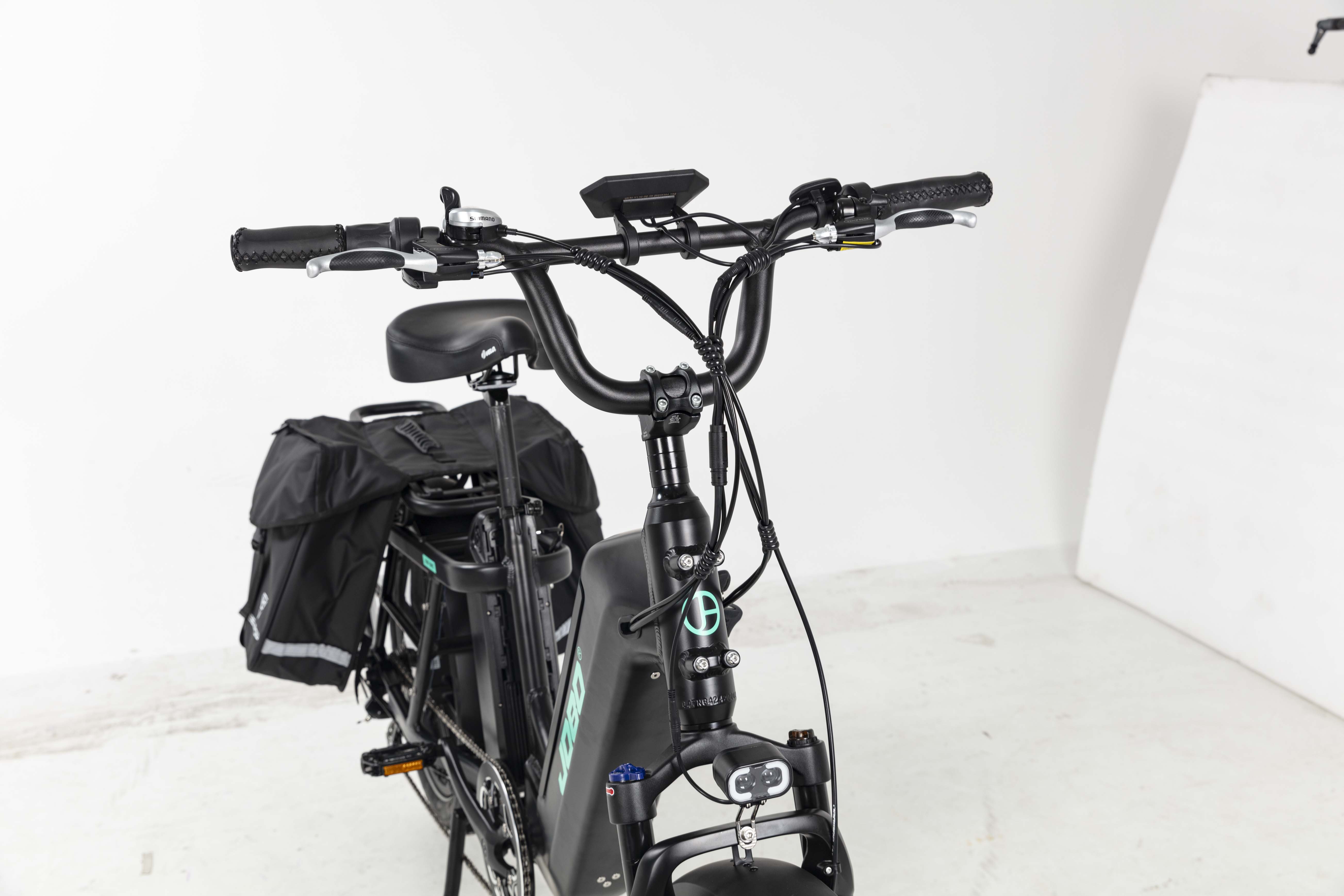
The JOBO JB-TDN64Z-F commercial delivery e-bike provides a relevant platform for this evaluation. Its published configuration includes a 48V 500W motor, 20-inch 6061 aluminum alloy frame, Shimano 7-speed drivetrain, suspension fork, and 20×3.0-inch tires.
This guide explains how to evaluate a commercial delivery e-bike fleet using the JB-TDN64Z-F as a practical sourcing reference, helping procurement teams plan pilot programs, reduce operating risks, and prepare for scalable wholesale purchasing.
Quick Answer: What Should Fleet Buyers Check Before Ordering Commercial Delivery E-Bikes?
A reliable commercial delivery e-bike fleet should be selected based on its actual daily workload, not advertised specifications alone.
Buyers should verify five essentials: route-tested battery range, approved cargo capacity, braking performance under load, maintenance requirements, and replacement-parts support.
For the JOBO JB-TDN64Z-F, these checks should include confirming the exact battery configuration, brake system, operating speed, rack load ratings, and market-specific compliance documentation.
Before a large order, evaluate representative samples on real delivery routes and use the results to finalize the production specification.
Explore the JOBO JB-TDN64Z-F Commercial Delivery E-Bike
1. Why Commercial Delivery Fleets Require Purpose-Built Electric Bikes
Delivery bicycles face a demanding operating environment.
A courier may complete numerous stops in one shift, repeatedly accelerating from traffic lights, navigating intersections, parking, unloading goods, and continuing to the next customer.
These cycles increase demands on the drivetrain, brakes, tires, battery connectors, and cargo hardware.
Typical commercial applications
| Application | Operating requirements | Fleet purchasing priority |
|---|---|---|
| Food delivery | Frequent stops, insulated delivery bags | Stable racks and predictable battery performance |
| Parcel delivery | Variable loads and repeated loading | Cargo mounting and approved payload |
| Grocery delivery | Short routes with changing load weight | Braking and low-speed handling |
| Corporate delivery fleets | Regular daily routes | Maintenance consistency and uptime |
| Urban courier services | Dense traffic and frequent acceleration | Maneuverability and serviceable components |
| Delivery vehicle rental | Multiple riders and intensive use | Easy inspection and replaceable parts |
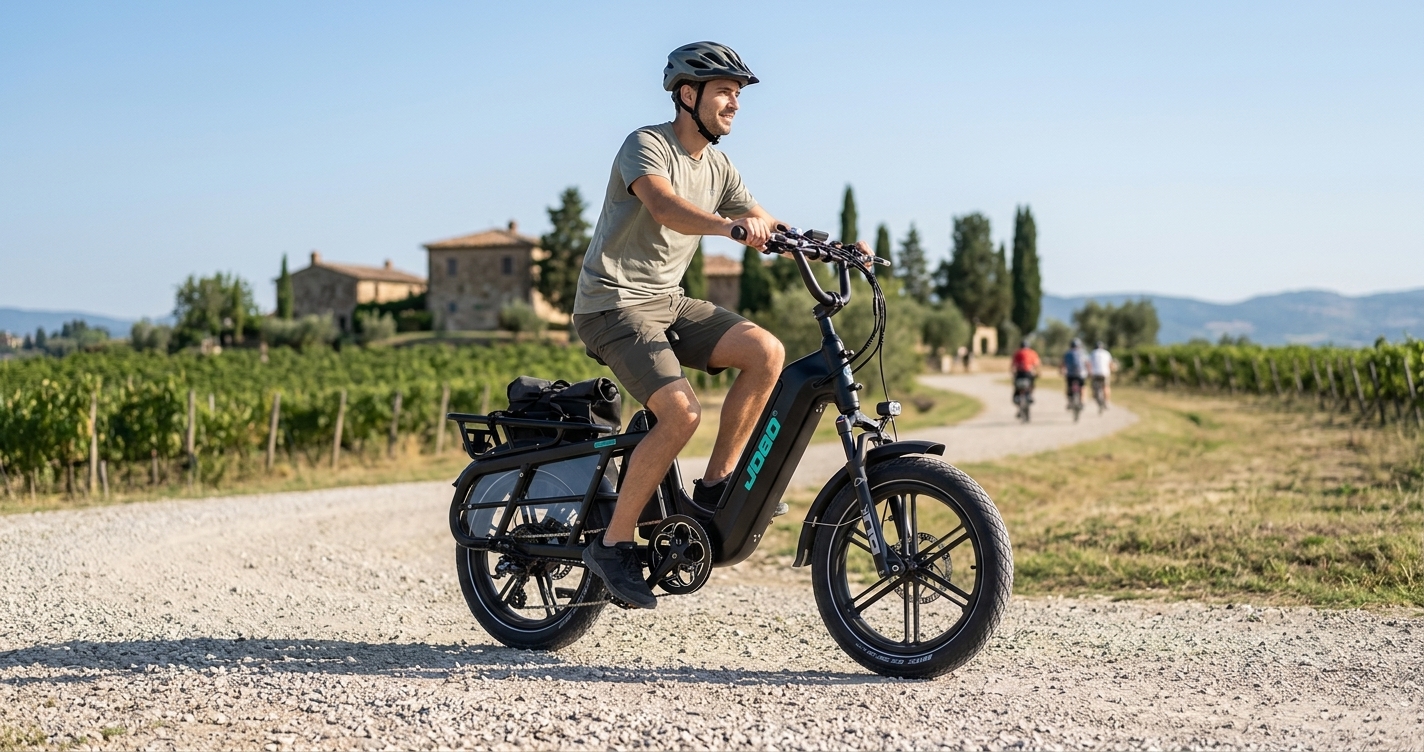
The JB-TDN64Z-F is positioned as a commercial fleet platform, with a low step-through design and cargo-oriented features described in its product materials.
However, this does not mean every version is appropriate for every operator.
Companies transporting unusually heavy freight, operating beyond a model's approved load limits, or requiring a different legal vehicle category may need another cargo platform.
Fleet suitability should be established through the actual delivery task, approved product configuration, and representative testing.
2. JOBO JB-TDN64Z-F: Key Specifications for Fleet Procurement
The JB-TDN64Z-F offers a starting point for businesses seeking electric bicycles for urban delivery and commercial fleet programs.
Published product specification overview
| Specification | JB-TDN64Z-F information | Procurement consideration |
|---|---|---|
| Motor | 48V 500W | Confirm rated power and local vehicle classification |
| Battery | 48V 15Ah shown; dual-battery wording also appears | Verify pack quantity and usable energy |
| Display | LCD | Check rider visibility and required functions |
| Maximum speed | 32 km/h advertised | Confirm legal configuration for destination market |
| Riding distance | Up to 120 km advertised | Require defined test conditions and route validation |
| Frame | 20-inch, 6061 aluminum alloy | Check structural and maximum-load information |
| Drivetrain | Shimano 7-speed | Review maintenance and replacement-parts availability |
| Braking | Disc brakes | Confirm whether the quoted version uses mechanical or hydraulic brakes |
| Front fork | Suspension | Verify suspension specification and intended use |
| Tires | 20×3.0 inches | Assess puncture protection and tire supply |
| Cargo hardware | Front/rear commercial rack features described | Obtain the actual approved rack load ratings |
| Battery handling | Quick-swap feature described | Confirm removal, locking, connector, and swapping procedures |
Important: These details reflect the supplied product materials. The battery and brake descriptions are not fully consistent across published materials. The final approved bill of materials (BOM), written quotation, and representative sample must establish the exact production configuration.
Why these specifications matter
A 500W motor specification may suggest a commercial-oriented configuration, but motor power alone does not predict climbing performance, usable range, or permitted road use.
Likewise, 20×3.0-inch tires provide a distinctive wheel format, yet their suitability depends on tire construction, inflation, load rating, road conditions, and maintenance.
For professional buyers, a technical specification becomes valuable only when it can be connected to measurable fleet performance.
3. Cargo Design, Rider Access, and Stop-and-Go Efficiency
The JB-TDN64Z-F product description highlights several features intended for frequent commercial use.
Low step-through frame
A low step-through design can make repeated mounting and dismounting more convenient for delivery riders.
This matters when drivers make frequent stops outside restaurants, office buildings, residential complexes, and pickup stations.
Fleet managers should evaluate rider fit across the intended workforce rather than assuming one frame size is universally suitable.
Commercial cargo racks
The product materials describe reinforced front and rear cargo arrangements and modular rack options.
These features may support insulated delivery boxes, courier bags, or approved accessories.
However, a rack's appearance is not evidence of its permissible carrying capacity.
Before finalizing an order, buyers should request:
-
Maximum approved front and rear rack loads.
-
Maximum permissible gross vehicle weight.
-
Approved delivery box mounting interfaces.
-
Accessory installation instructions.
-
Structural validation for the intended cargo arrangement.
A fully loaded delivery bicycle must remain controllable during starting, cornering, braking, and parking.
Center stand and loading stability
The product materials also describe a dual-leg center stand.
For commercial delivery, a suitable stand can help support routine loading and unloading when used within its approved limits.
Fleet operators should test the stand on relevant parking surfaces and confirm the manufacturer's restrictions on loading while parked.
A practical cargo e-bike must perform well during the entire delivery cycle—not only while moving.

4. Battery Range and Swapping: Plan Around Actual Delivery Shifts
Battery performance is one of the largest variables in commercial electric bike operations.
A vehicle that cannot complete its assigned route may require a second bicycle, an additional battery, charging downtime, or changes to dispatch planning.
Understanding the published battery figures
The supplied specification displays a 48V 15Ah battery and an advertised driving distance of 120 km.
A single nominal 48V 15Ah battery has approximately:
48 V × 15 Ah = 720 Wh of nominal energy.
This figure does not establish the bicycle's real-world driving range.
The product materials also refer to a dual-battery arrangement, while another JOBO fleet reference describes a single-pack configuration.
Therefore, buyers should establish whether the quoted vehicle includes one battery, two batteries, or a configurable option.
Why advertised range differs from fleet range
Actual consumption depends on:
-
Rider and cargo weight.
-
Number of delivery stops.
-
Motor assistance level.
-
Road gradients.
-
Wind and temperature.
-
Tire pressure.
-
Operating speed.
-
Battery condition and usable capacity.
For illustration, if a bicycle consumes 20 Wh per kilometer on a particular route, a nominal 720 Wh battery represents approximately 36 km before accounting for operational reserve and other limitations.
This is a hypothetical calculation, not a measured JB-TDN64Z-F result.
Battery swapping for fleet operations
Where an approved quick-swap system is included, battery replacement may help fleets reduce the time vehicles spend unavailable for deliveries.
However, successful battery swapping also requires a compatible battery inventory, charging procedures, trained personnel, reliable connectors, and safe storage arrangements.
A fleet buyer should request clear answers about battery identification, removal methods, charging equipment, battery-management protections, replacement availability, and transport documentation.
A useful battery specification describes how the vehicle performs throughout a real shift—not simply the maximum range advertised under unspecified conditions.
5. Braking Performance and Maintenance Under Commercial Loads
Delivery vehicles experience frequent braking, sometimes while carrying substantial cargo.
That makes the braking system a critical fleet procurement consideration.
The supplied product materials describe hydraulic disc brakes in one section and mechanical disc brakes in the technical specifications.
Rather than assuming either version is standard, buyers should confirm the exact brake manufacturer, component model, rotor specifications, and approved configuration.

Mechanical versus hydraulic disc brakes
| Evaluation factor | Mechanical disc brakes | Hydraulic disc brakes |
|---|---|---|
| Actuation | Cable-operated | Hydraulic fluid system |
| Typical maintenance | Cable adjustment and wear inspection | Hydraulic inspection and service procedures |
| Parts requirements | Compatible cables, pads, rotors | Compatible pads, fluid, seals, and service components |
| Service considerations | Familiar mechanical adjustments | Requires appropriate hydraulic service capability |
| Procurement priority | Maintenance access and consistent performance | Brake specification and trained service support |
Neither type should be selected from a category label alone.
Brake quality depends on component design, setup, testing, rider load, road conditions, and maintenance.
For the JB-TDN64Z-F, buyers should request the approved brake BOM and test the complete vehicle under its intended loaded condition.
6. Run a Fleet Pilot Before Placing a Bulk Order
A controlled pilot helps procurement teams identify problems while changes are still manageable.
For a commercial delivery e-bike fleet, the pilot should reproduce real working conditions as closely as possible.
Recommended pilot process
Stage 1: Define the route
Document daily distance, typical stops, gradients, road conditions, rider profile, and planned cargo weight.
Stage 2: Approve the sample configuration
Confirm the motor, battery, controller, brakes, tires, racks, firmware, and accessories before testing.
Stage 3: Operate representative routes
Use trained riders on approved routes and record performance over multiple working days.
Stage 4: Track operational results
Collect comparable information on range, battery use, charging requirements, maintenance, rider feedback, and downtime.
Stage 5: Review failures and improvements
Identify recurring issues and determine whether they can be resolved through servicing, component changes, or a revised operating plan.
Stage 6: Approve the production standard
Only proceed to a larger order after the pilot vehicle and final BOM have been accepted.
Suggested pilot scorecard
| Metric | What to measure | Why it matters |
|---|---|---|
| Completed deliveries | Deliveries per rider shift | Operational productivity |
| Real-world range | Distance under measured load | Battery planning |
| Charging time | Time using approved equipment | Shift scheduling |
| Unplanned downtime | Hours unavailable for service | Fleet capacity |
| Brake maintenance | Adjustments and parts replacement | Service workload |
| Tire incidents | Punctures and replacements | Route suitability |
| Cargo handling | Loading time and stability | Rider efficiency |
| Rider feedback | Fit, comfort, handling | Adoption and retention |
| Component failures | Failure type and frequency | Supplier corrective action |
The pilot should compare results against the operator's defined acceptance criteria.
A successful pilot is not merely one in which the bicycle completes a test ride. It is one that provides enough evidence to make a responsible purchasing decision.
7. Calculate the Total Cost of Ownership of Delivery E-Bikes
The lowest purchase price is not always the lowest operating cost.
Fleet operators should evaluate the complete expense of owning and operating a bicycle over a defined period.
Commercial e-bike fleet TCO framework
| Cost category | Examples |
|---|---|
| Initial acquisition | Bike price, freight, import expenses |
| Deployment | Assembly, inspection, rider setup |
| Electrical system | Batteries, chargers, replacement components |
| Preventive maintenance | Brakes, tires, chain, adjustments |
| Unscheduled repairs | Failed components, workshop labor |
| Downtime | Lost vehicle availability and substitute transport |
| Fleet operations | Storage, charging infrastructure, administration |
| End-of-life | Disposal, recycling, residual value |
Why downtime changes the economics
Consider two hypothetical bicycles:
| First-year cost factor | Bike A | Bike B |
|---|---|---|
| Acquisition cost | $1,000 | $1,150 |
| Maintenance and parts | $320 | $260 |
| Downtime cost | $480 | $180 |
| Total illustrative cost | $1,800 | $1,590 |
Although Bike A costs less initially, its higher maintenance and downtime costs make it more expensive in this example.
These figures are purely illustrative and are not JOBO quotations or performance claims.
The lesson is straightforward: procurement teams should compare lifecycle cost, not only factory price.
For a fleet of dozens or hundreds of vehicles, even small differences in service intervals and vehicle availability may materially influence operating budgets.
8. Manufacturing Quality Control: What Fleet Buyers Should Verify
Reliable commercial operations depend on consistent vehicle production.
Fleet operators cannot efficiently manage maintenance when identical model names conceal changing components, incompatible batteries, or undocumented electrical systems.
JOBO describes integrated electric bike manufacturing and quality-control capabilities, including frame testing, brake-related testing, complete-bike evaluation, and battery testing.
These capabilities provide relevant topics for supplier due diligence.
Learn About JOBO's Quality-Control Laboratory
Recommended quality-control checkpoints
Incoming component inspection
Verify frame materials, motors, battery systems, controllers, brakes, and other critical parts against the approved BOM.
Frame and cargo attachment verification
Review applicable structural tests and confirm that racks and mounted accessories are approved for their intended loads.
Electrical system inspection
Check battery retention, connections, wiring protection, display functions, charging compatibility, and controller operation.
Brake and drivetrain testing
Verify correct installation, adjustment, operating behavior, and relevant inspection records.
Final vehicle inspection
Confirm the finished bicycle matches the approved sample, including labeling, firmware, accessories, packaging, and operating instructions.
Documentation matters as much as physical testing
Fleet buyers should request applicable model-specific test reports, batch traceability, component specifications, inspection requirements, and warranty procedures.
An in-house testing capability does not automatically mean every product configuration holds every international certification.
Final compliance depends on the actual product version, destination market, and the documents issued for that version.
9. OEM Customization for Delivery Platforms and Fleet Operators
Different delivery businesses may require different vehicle configurations.
A food delivery platform may prioritize insulated cargo boxes and frequent stop-and-go operation. A courier company may prioritize modular luggage carrying capacity. A rental fleet may value standardized components and straightforward maintenance.
JOBO offers OEM/ODM services for electric bike platforms, making customization part of the supplier evaluation.
Potential customization areas
| Customization | Business value | Validation requirement |
|---|---|---|
| Fleet branding | Consistent operator identity | Approved colors and graphics |
| Cargo racks and boxes | Match delivery goods | Load rating and mounting safety |
| Battery arrangement | Support duty-cycle planning | Compatibility and electrical testing |
| Braking components | Match route and service requirements | Approved BOM and performance testing |
| Tires | Suit operating environment | Load, wear, and handling evaluation |
| Display and controls | Simplify rider operation | Configuration and market requirements |
| Wiring and accessories | Support approved fleet equipment | Electrical integration review |
| Packaging | Improve deployment efficiency | Transit protection and assembly instructions |
Buyers should distinguish cosmetic customization from engineering modifications.
Changing paint color generally presents a different development challenge from redesigning a frame, installing a second battery, or altering a cargo structure.
For new engineering configurations, request prototype testing, documented revisions, and final sample approval.
Explore JOBO OEM/ODM Electric Bike Manufacturing
10. How to Select a Commercial Delivery E-Bike Manufacturer
A manufacturer should be evaluated on more than pricing and catalogue variety.
For fleet procurement, the supplier must support product consistency throughout the vehicle's service life.
Key supplier evaluation questions
-
Can the manufacturer provide a current, model-specific technical specification?
-
Are the motor, battery, controller, brakes, and tires defined in a controlled BOM?
-
Can the proposed vehicle support the intended rider and cargo loads?
-
What sample and pilot-testing arrangements are available?
-
Which quality-control records can be provided for the production batch?
-
Are replacement batteries, chargers, controllers, and brake parts available?
-
How are component substitutions approved and communicated?
-
What warranty terms and claim procedures apply?
-
Can the manufacturer support repeat orders with consistent configurations?
-
What compliance documents are available for the destination market?
The best supplier relationship reduces uncertainty across ordering, delivery, maintenance, and future replenishment.
For companies building a commercial delivery e-bike fleet, reliable documentation and spare-parts planning are especially important because unexpected vehicle downtime can disrupt daily operations.
11. Prepare a Commercial Delivery E-Bike Wholesale RFQ
A detailed request for quotation helps manufacturers recommend a suitable platform and provide more accurate commercial terms.
Fleet procurement RFQ checklist
| RFQ item | Information to provide |
|---|---|
| Intended market | Country or region of operation |
| Fleet application | Food delivery, courier, parcel, rental |
| Route profile | Daily distance, stops, road conditions |
| Rider requirements | Height range, fit, usage pattern |
| Payload | Rider weight, cargo weight, accessories |
| Motor | Approved power and assistance configuration |
| Battery | Required shift range and charging arrangements |
| Brake system | Required specification and service capability |
| Cargo equipment | Rack and box dimensions, load limits |
| Branding | Logo, colors, labels, packaging |
| Compliance | Destination-market requirements and documentation |
| Initial quantity | Pilot order and planned bulk purchase |
| Replacement parts | Battery, brake, tire, controller availability |
| Quality control | Inspection plan and acceptance criteria |
| Commercial terms | MOQ, quotation, Incoterms, lead time, warranty |
Example inquiry to JOBO
We are a commercial delivery fleet operator or distributor serving [target market].
We are evaluating the JOBO JB-TDN64Z-F for food delivery, courier operations, or other urban logistics applications.
Our expected fleet quantity is [quantity], with a daily operating distance of [distance] and a typical cargo load of [weight].
Please provide the latest technical specification, confirmed battery configuration, brake system, cargo load rating, motor and speed options, applicable compliance documentation, sample availability, OEM customization options, MOQ, warranty terms, spare-parts support, and production schedule.
We would also like to arrange a representative sample evaluation before confirming a bulk order.
Request a Commercial Delivery E-Bike Fleet Quotation
12. Frequently Asked Questions
1. What is a commercial delivery e-bike?
A commercial delivery e-bike is an electric bicycle configured for transporting goods during professional operations such as food delivery, courier services, and local distribution. Its suitability depends on cargo capacity, duty cycle, braking, electrical performance, and serviceability.
2. Is the JOBO JB-TDN64Z-F suitable for food delivery fleets?
The JB-TDN64Z-F is marketed as a commercial fleet platform with cargo-oriented features. Buyers should verify the exact rack and payload ratings, battery configuration, and performance on their own delivery routes before deployment.
3. What motor does the JB-TDN64Z-F use?
The supplied product specification lists a 48V 500W motor. Buyers should confirm its exact rating, controller configuration, and permitted use in the intended destination market.
4. Does the JB-TDN64Z-F support dual batteries?
The supplied product materials mention a dual-battery arrangement, while another JOBO fleet reference describes a single 48V 15Ah battery. Confirm the exact number of installed batteries and whether additional packs are part of the quoted configuration.
5. Can the JB-TDN64Z-F travel 120 km on one charge?
The product materials advertise a distance of up to 120 km, but they do not establish the conditions or exact battery configuration behind that figure. Fleet operators should request supporting test information and measure range under realistic delivery loads.
6. Does the JB-TDN64Z-F have hydraulic disc brakes?
Hydraulic brakes appear in the product description, while mechanical disc brakes appear in the supplied specification graphic. The final brake model and type should be confirmed through the approved BOM and representative sample.
7. Can commercial delivery e-bikes be customized with company branding?
JOBO offers OEM/ODM services, including branding and configuration discussions. Specific colors, accessories, component changes, quantities, and engineering requirements must be confirmed during the quotation process.
8. What is the best battery system for a delivery e-bike fleet?
The appropriate system depends on daily route length, charging access, rider and cargo loads, operating hours, and fleet service arrangements. A larger battery or battery-swapping capability is useful only when compatible with the actual operating plan.
9. How should fleet operators test delivery e-bikes before bulk purchasing?
Use representative samples on real routes with typical riders and cargo. Record range, charging needs, handling, maintenance, component failures, and downtime, then compare the results with defined acceptance criteria.
10. How can I buy JB-TDN64Z-F commercial delivery e-bikes wholesale?
Contact JOBO with your target market, fleet size, duty cycle, cargo needs, preferred specifications, and intended order schedule. Request a written quotation, current BOM, relevant documentation, and sample-testing arrangements.
Conclusion
Building a reliable commercial delivery e-bike fleet requires more than selecting a vehicle with an attractive motor specification or advertised riding range.
The purchasing decision should connect product design to actual delivery routes, rider requirements, cargo handling, charging arrangements, maintenance capacity, and operating costs.
The JOBO JB-TDN64Z-F offers a relevant commercial fleet platform for evaluating these requirements, with a published 48V 500W motor configuration, 6061 aluminum alloy frame, Shimano 7-speed drivetrain, and cargo-oriented design features.
Before placing a wholesale order, fleet operators should confirm the final battery and brake specifications, verify approved cargo loads, conduct representative pilot testing, and agree on production quality controls and replacement-parts support.
For food delivery platforms, courier businesses, fleet distributors, and private-label operators, a well-defined OEM purchasing program can reduce sourcing uncertainty and support more consistent long-term fleet management.
Ready to evaluate the JB-TDN64Z-F for your business?
Contact JOBO to Discuss Commercial Delivery E-Bike Samples, OEM Options, and Wholesale Pricing
Share your fleet size, intended market, daily delivery distance, cargo requirements, and expected order volume to begin developing a practical procurement plan.