A successful urban electric bike brand needs more than an attractive commuter bicycle. It needs a product range that gives retailers clear selling points, matches regional riding and legal requirements, protects margins, and remains manageable when repeat orders, replacement parts, and new color variants enter the business.
This is where selecting the right urban electric bike OEM manufacturer becomes a strategic procurement decision. The manufacturer must be able to translate market positioning into practical frame platforms, motor and battery configurations, component choices, production documentation, and repeatable quality-control procedures.
For many importers and private-label brands, the biggest challenge is not finding an electric bicycle that looks competitive. It is building a coherent product family without multiplying unnecessary specifications, stocking too many slow-moving variants, or introducing compatibility problems between models.
An entry-level city bike, a low-maintenance belt-drive commuter, and a smart premium model may appear to require three completely independent engineering projects. In practice, a carefully planned OEM strategy can identify which parts and processes should be shared, where product differentiation genuinely matters, and which configurations need separate technical or regulatory validation.
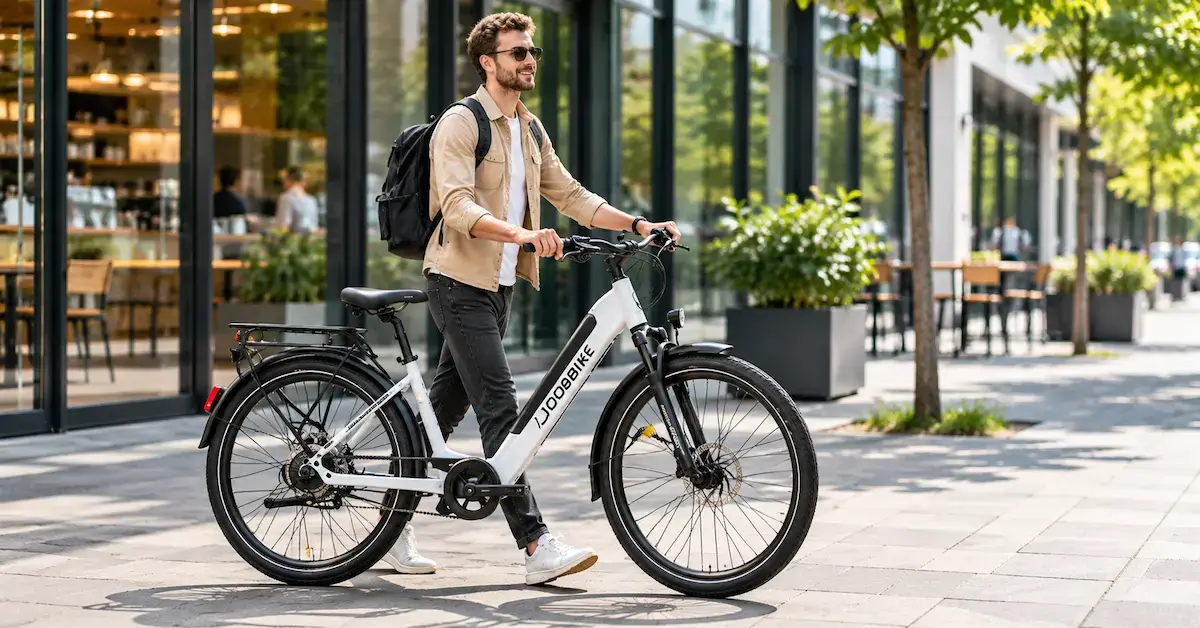
This guide explains how to create that strategy using publicly available commuter platforms from JOB, a China-based electric bicycle manufacturer offering OEM/ODM development, in-house frame manufacturing, assembly, and quality-control support.
It is intended for electric bike brand owners, importers, distributors, product managers, and B2B purchasing teams planning a new urban mobility product line or restructuring an existing range.
Quick Answer: How Should Buyers Choose an Urban Electric Bike OEM Manufacturer?
A reliable urban electric bike OEM manufacturer should help buyers build a commercially differentiated commuter range while controlling engineering complexity and production variation. Before placing a bulk order, define the target riders and markets, choose a limited number of base platforms, create clear entry-level and premium configurations, and establish which batteries, motors, brakes, displays, and replacement components can be standardized.
The manufacturer should also provide a controlled bill of materials (BOM), representative production samples, relevant quality and compliance documentation, realistic production schedules, and an approved process for managing component changes.
The objective is not to offer the largest number of urban electric bike models. It is to offer the right models with fewer unnecessary SKUs, predictable costs, and reliable repeat-order support.
For initial product research, explore JOBO's Custom City E-Bike range, review its OEM/ODM manufacturing services, or contact JOBO for a project quotation.
1. Why Urban E-Bike Product-Line Planning Matters Before OEM Production
Urban electric bicycles are purchased for different reasons.
Some riders need affordable transportation for short daily journeys. Others want a comfortable step-through bicycle for commuting and shopping. Premium customers may prioritize a quieter drivetrain, refined pedal assistance, integrated displays, or attractive frame design.
A manufacturer can technically accommodate many component combinations, but this flexibility can create a commercial problem when every possible configuration becomes a separate sellable product.
Consider an illustrative private-label brand planning its first commuter range.
The company wants three models, two frame sizes, four colors, and two battery capacities.
The number of combinations is:
3 models × 2 sizes × 4 colors × 2 batteries = 48 potential finished-bike SKUs.
If the brand launches with 20 units of each combination, it would need to commit to 960 bicycles merely to support that assortment evenly.
This is an illustrative inventory calculation, not a JOBO production requirement or minimum order quantity.
The issue becomes more complicated when some configurations require different motors, chargers, display firmware, or compliance documents.
A technically flexible product catalogue can quickly become difficult to forecast, inspect, warehouse, and support.
A smarter OEM strategy begins by separating three decisions:
-
Which models are necessary to serve distinct customer segments?
-
Which components can remain common without compromising performance or product positioning?
-
Which optional configurations justify the additional inventory and validation burden?
These decisions should be resolved before a manufacturer begins serious tooling, sample development, or production scheduling.
The hidden cost of too many SKUs
SKU complexity affects more than stock quantities.
It may also increase:
-
Component procurement variability.
-
Packaging artwork and labeling requirements.
-
Warehouse picking errors.
-
Dealer product-training needs.
-
Replacement battery and charger inventory.
-
Quality-control documentation.
-
Production changeover frequency.
-
Forecasting difficulty.
-
Warranty identification and technical support.
The goal is not to eliminate variety. It is to introduce differentiation where buyers can recognize and pay for the added value.
2. Identify the Right Urban E-Bike Buyers and Their Different Needs
A successful OEM project starts with clearly defined customer segments rather than a universal commuter design.
An urban electric bike OEM manufacturer should understand whether the final product is intended for a city commuter, a recreational rider, a multi-store retailer, a rental operator, or an e-commerce brand.
Each segment has a different understanding of value.
| Customer segment | Main requirement | Recommended product direction | B2B buying consideration |
|---|---|---|---|
| Budget-focused city commuters | Affordable, practical daily transport | Conventional commuter platform | Competitive BOM and consistent quality |
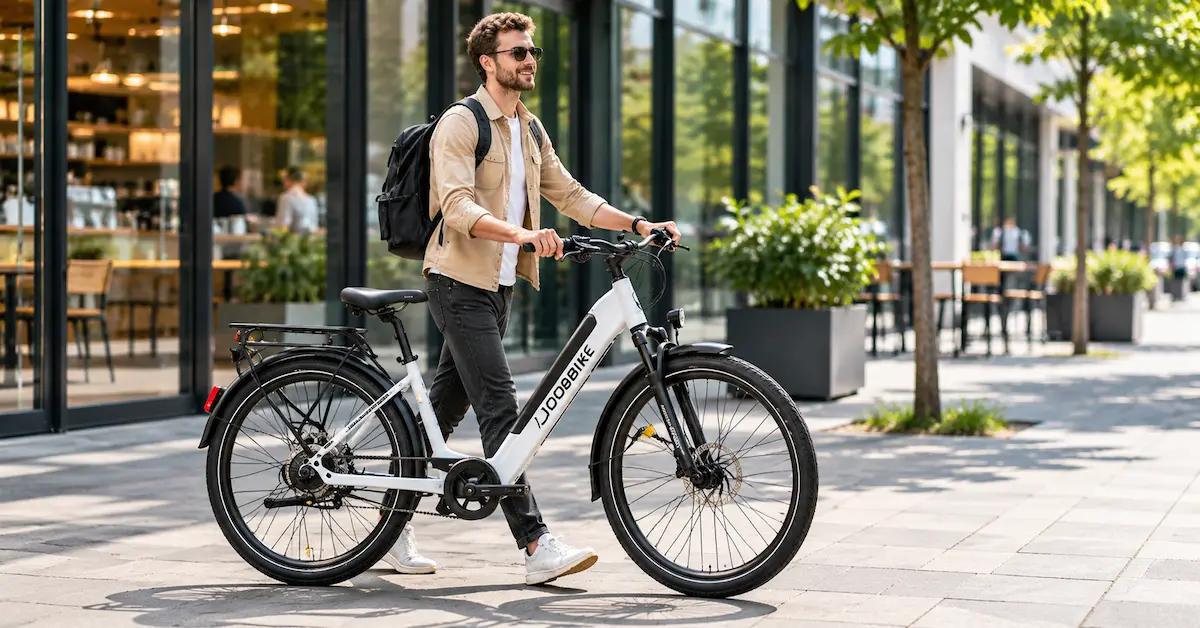
| Everyday urban riders | Comfort, easy mounting, intuitive assistance | Step-through commuter | Ergonomics, frame fit, battery access |
| Premium city customers | Quiet operation, refined design | Belt-drive city e-bike | Drivetrain integration and positioning |
| Technology-oriented riders | Connected features and responsive assistance | Smart city e-bike | Software compatibility and electronics |
| Bicycle retail chains | A clear range with understandable differences | Standardized three-tier product family | SKU control, replenishment and training |
| Private-label e-commerce brands | Distinct appearance and delivery reliability | Customized existing OEM platform | Packaging, assembly and returns |
| Urban rental operators | Repeatable operation and practical maintenance | Durable commuter platform | Fleet configuration and spare-parts planning |
A product designed for one segment may not be suitable for another.
For example, a premium single-speed belt-drive bicycle can provide a clean ownership experience in suitable urban conditions. However, it may not meet the gearing expectations of riders facing sustained hills unless the complete drivetrain is configured appropriately.
Similarly, a city bicycle with a wide battery and extensive accessories may offer a comfortable daily experience but may not satisfy customers who must regularly carry the bike upstairs.
These tradeoffs should be reflected in product positioning rather than hidden behind generic descriptions such as "suitable for every rider."
3. Build a Three-Tier OEM Urban Electric Bike Product Line
A practical starting point for many emerging brands is a three-tier range.
The tiers should have visibly different customer benefits rather than merely different model names.
Tier 1: Essential Urban Commuter
Positioning: accessible, dependable urban transportation.
The essential commuter should focus on the core functions a daily rider genuinely needs.
Priorities commonly include:
-
Comfortable and predictable pedal assistance.
-
Frame geometry suited to the target rider population.
-
Suitable braking performance.
-
Reliable battery and charger integration.
-
Practical lighting and basic commuter accessories.
-
A conventional drivetrain with accessible service parts.
-
A competitive finished-bike cost.
An essential model does not need every connected feature or premium drivetrain component.
It needs a clear price position and enough quality to support the brand's reputation.
A common mistake is removing valuable functional parts simply to reduce the advertised price.
For example, excluding required lights, suitable fenders, or reliable brakes may create a lower catalogue figure while leaving the distributor with additional configuration or compliance costs.
The correct entry-level specification should be defined around a complete, market-ready bicycle.
Tier 2: Comfort and Low-Maintenance Commuter
Positioning: improved ownership experience for frequent urban riding.
A mid-tier model should offer benefits that users experience repeatedly.
Depending on the platform, these may include:
-
A step-through or easy-access frame.
-
Responsive torque-sensing assistance.
-
Improved rider contact points.
-
A cleaner or lower-maintenance drivetrain.
-
More refined braking and accessory integration.
-
Practical battery access.
-
Improved aesthetic finishing.
The objective is to create meaningful reasons for customers to pay more.
It is not necessary to change every component from the entry-level bicycle.
Where compatible, keeping common batteries, chargers, tires, and service items can simplify the business.
Tier 3: Premium Smart City E-Bike
Positioning: refined urban mobility with distinctive technology and ride quality.
The premium platform can introduce advanced features where they genuinely improve the riding experience.
Examples include:
-
Mid-drive architecture.
-
Torque-sensing pedal assistance.
-
Integrated LCD and Bluetooth functions.
-
Belt-drive transmission.
-
Internal-gear hub options.
-
Premium frame styling and surface finish.
-
Additional display or connectivity integration where supported.
A premium model should not rely only on marketing claims such as "smart" or "high-tech."
Its technology should have a defined function, appropriate system compatibility, support documentation, and clear customer benefit.
For a B2B buyer, premium differentiation must also justify higher component cost, service complexity, and stocking requirements.
4. Compare JOBO Urban E-Bike Platforms for a Three-Tier Strategy
JOBO publicly offers several city-oriented electric bicycles that can serve as reference points for an OEM product-line discussion.
Rather than assuming these models must become three fixed retail products, importers can use them to compare engineering architectures and identify where a common product family may be practical.
Published JOBO city e-bike reference platforms
| JOBO model | Public reference specifications | Key positioning | OEM evaluation priority |
|---|---|---|---|
| JB-TDB29Z City Commuter | 36V 350W motor, 36V 15Ah battery, Shimano 8-speed, torque sensor | Versatile step-through commuting | Geometry, battery, motor and drivetrain configuration |
| JB-TDB30Z Belt Drive City | 36V 350W motor, 36V 15Ah battery, belt drive, single-speed configuration | Quiet, low-maintenance urban use | Belt system alignment and service support |
| JB-TDB30L Smart City | 36V 350W mid-drive, 36V 15Ah battery, NEUS 8 internal hub, belt drive | Technology-oriented premium commuting | Mid-drive, internal hub, software and electrical integration |
| JB-TDE10Z Belt Drive | 36V 250W motor, 36V 14Ah battery, belt drive, single-speed | Alternative commuter and low-maintenance reference | Finished configuration, drivetrain and target market |
Important specification note: these values are drawn from published JOBO product pages. They are reference configurations, not a single unified product family, current inventory guarantee, or confirmation that every configuration satisfies the same market regulations.
For example, a 36V 350W motor listing does not automatically qualify a bicycle for a market category requiring a maximum continuous rated motor power of 250W.
The precise regulatory version must be confirmed through appropriate specifications and documentation.
How should buyers use these models?
A brand entering the urban commuting segment could initially evaluate JB-TDB29Z as a conventional geared city platform.
The buyer could separately assess JB-TDB30Z for a product emphasizing clean belt-drive ownership.
JB-TDB30L provides another reference for more integrated electronic and drivetrain options.
However, the existence of similar battery voltage does not prove that the models share identical battery packs, mounting rails, chargers, controllers, or replacement parts.
That requires a manufacturer-supported compatibility matrix.
Similarly, the 36V rating does not mean the bicycles have identical electrical architectures.
The correct OEM question is not simply "Can we customize all three?"
It is:
"Which frame, battery, electrical, drivetrain, and service components can be shared across our proposed product family without creating unverified compatibility risks?"
That answer shapes long-term inventory and after-sales costs.
5. Develop a Standardized Component Architecture
Component standardization can be one of the most valuable outcomes of working closely with an urban e-bike manufacturer.
It allows a brand to create customer-facing differentiation without treating every bicycle as a completely independent engineering program.
However, standardization must be driven by verified compatibility.
Components that look similar are not necessarily interchangeable.
Recommended standardization priorities
| Component group | Potential standardization value | What must be verified |
|---|---|---|
| Battery system | Simplifies battery inventory and replacement | Pack chemistry, voltage, mounts, BMS, connectors |
| Charger | Reduces spare charger types | Charging protocol, electrical ratings, destination plugs |
| Brake wear parts | Improves workshop inventory efficiency | Caliper, rotor and pad compatibility |
| Tires and tubes | Simplifies replacement inventory | Wheel size, tire dimensions, load rating |
| Displays | Potentially reduces electronics variants | Controller protocol, connectors, firmware |
| Lighting | Common spare assemblies | Voltage, mounting, approval requirements |
| Fasteners | Streamlines assembly and service | Strength class, dimensions and torque values |
| Packaging | More consistent warehouse operations | Carton size, protection and assembly requirements |
Not every component should be standardized.
A premium mid-drive model may require different motor mounts and electrical interfaces from a basic hub-drive commuter.
A belt-drive frame may need specific rear-triangle and tension-adjustment provisions.
An internal-gear hub can create different wheel, axle, and gearing requirements from a conventional derailleur system.
Forcing these architectures to share inappropriate components can introduce more problems than it solves.
The goal is selective standardization based on engineering evidence.
Why battery compatibility requires special attention
Battery systems may appear to be an easy standardization opportunity.
Two models can share a nominal 36V rating while using different connectors, pack dimensions, current ratings, battery management systems, or chargers.
Therefore, battery commonality should not be assumed from voltage alone.
The buyer should obtain written confirmation of compatible part numbers and the approved configurations.
If a future battery supplier change is anticipated, the contract should define who validates the replacement and how existing product documentation is updated.
6. Choose Between Step-Through, Conventional and Integrated Urban Frames
Frame design affects customer accessibility, appearance, battery installation, accessory mounting, and manufacturing cost.
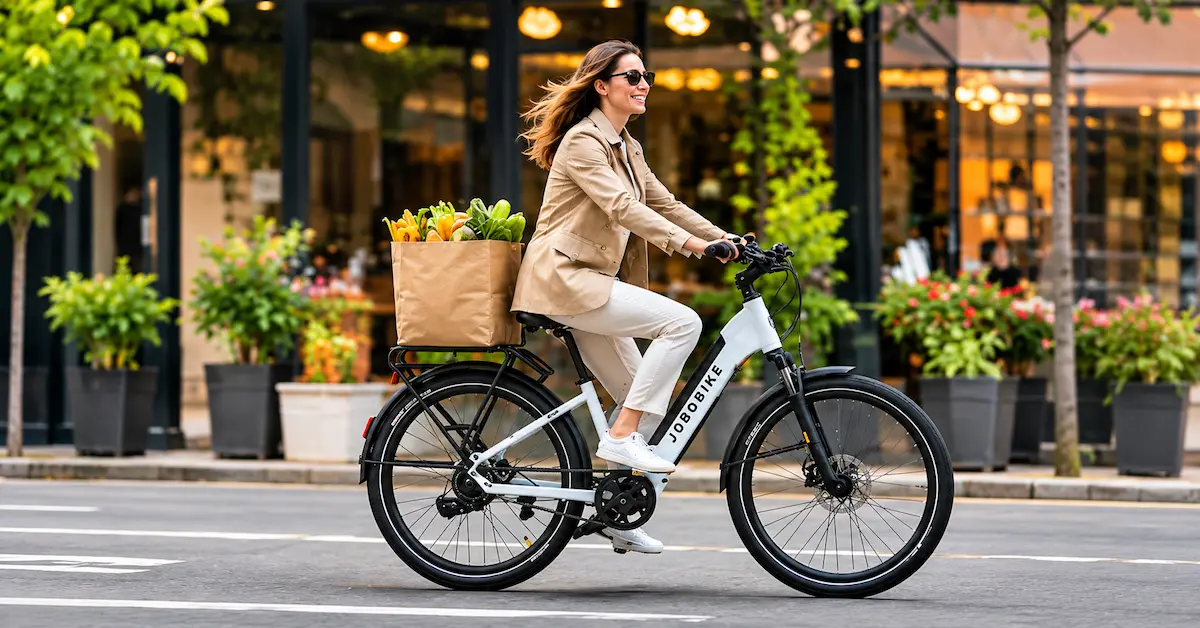
A step-through frame allows easier mounting and dismounting for many riders, which can be valuable in frequent-stop city use.
However, the structural design and load paths differ from those of a conventional diamond-style frame.
An integrated frame may offer cleaner battery packaging and distinctive visual identity, but it must also accommodate battery maintenance, routing, sealing, and assembly.
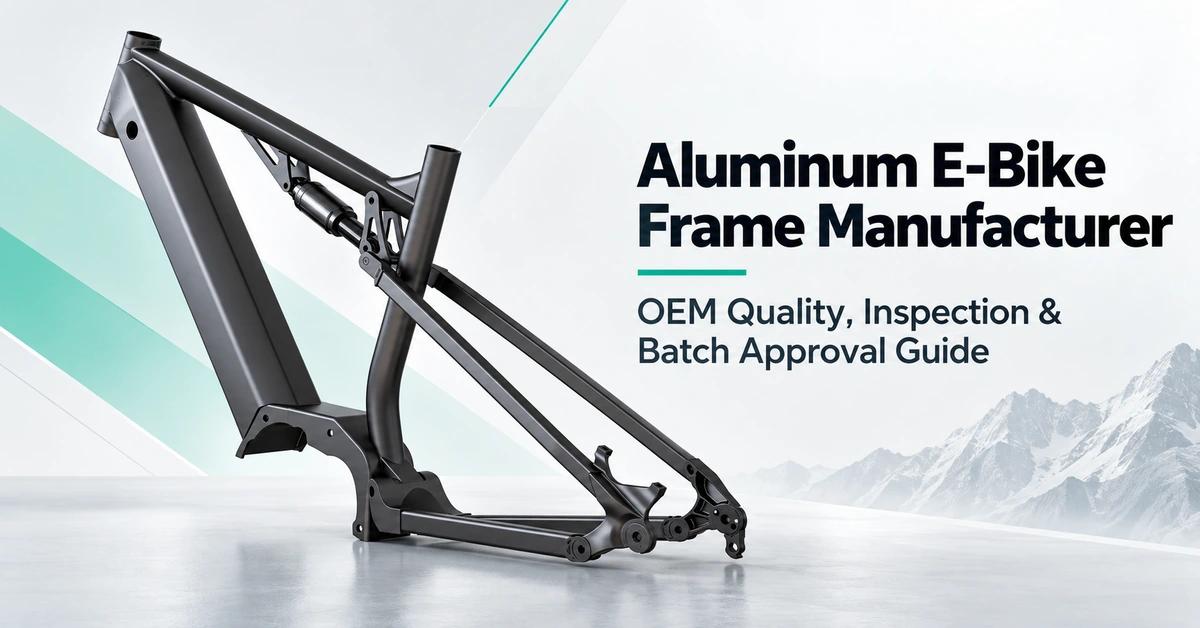
JOBO's frame manufacturing operation describes aluminum-frame fabrication, CNC tube processing, welding, measurement, and surface treatment.
Those capabilities are relevant to OEM customization, but buyers should confirm the exact material and manufacturing route for the selected frame.
Frame-design questions for OEM buyers
Before approving an urban frame, request:
-
Target rider height and inseam range.
-
Frame size and geometry documentation.
-
Permissible rider and accessory loads.
-
Battery installation and removal requirements.
-
Motor and controller mounting arrangements.
-
Cable and brake-hose routing.
-
Rack, fender, kickstand and light interfaces.
-
Coating and corrosion-protection specifications.
-
Applicable structural test evidence.
Avoid assuming that all frame configurations can use the same tooling.
Changing battery placement, frame geometry, or rear mounting features may require new engineering review, fixtures, structural testing, and production validation.
An important commercial distinction
A new frame design may help an established brand create recognizable product identity.
However, an emerging brand may achieve sufficient differentiation through approved colors, graphics, contact points, accessories, and carefully selected electrical components on an existing platform.
The right approach depends on project size, budget, expected sales volume, and the value customers place on proprietary geometry.
7. Match Motor Output and Assistance Behavior to the Destination Market
Urban e-bike buyers often focus on motor wattage because it is easy to compare.
However, wattage alone does not describe riding quality or regulatory suitability.
A commuter can be technically powerful yet poorly configured for smooth starts and low-speed control.
Conversely, a motor with a lower continuous rated output may deliver a more pleasant urban riding experience when its control system, gearing, and sensor behavior suit the application.
Important evaluation factors include:
-
Continuous rated motor output.
-
Assistance cut-off behavior.
-
Pedal torque or cadence sensing.
-
Controller response.
-
Applicable speed limits.
-
Hill-climbing requirements.
-
Thermal behavior.
-
Battery current capability.
-
Complete-bicycle legal classification.
For relevant European pedal-assist categories, the commonly referenced requirements include maximum continuous rated motor power of 250W and assistance that progressively reduces and stops before 25km/h, subject to the full applicable rules.
Different national requirements can apply to other product categories.
Therefore, published JOBO models with 350W motor listings should be evaluated as configuration references rather than automatically marketed as compliant 250W EPAC models.
An OEM buyer should request documentation for the precise destination-market variant.
A brand should never use software settings alone as proof of compliance without verifying the complete applicable technical requirements and evidence.
For a multinational distribution program, establish a separate version register identifying the legal product category, motor and controller configuration, labels, manuals, and relevant compliance records for each sales market.
8. Compare Chain Drive and Belt Drive From a Commercial Perspective
Chain and belt transmissions represent different ownership propositions.
Traditional chain drivetrains are widely understood by bicycle workshops and support multiple gearing arrangements.
They require appropriate cleaning, lubrication, adjustment, and replacement.
Belt systems can provide clean and quiet operation and avoid chain lubrication, but they still require correct tension, alignment, compatible sprockets, and suitable replacement components.
The correct choice depends on the target customer and complete drivetrain system.
| Evaluation factor | Chain drivetrain | Belt drivetrain |
|---|---|---|
| Typical appeal | Familiar service ecosystem and gearing flexibility | Clean, quiet urban ownership |
| Lubrication | Generally required | No conventional chain lubrication |
| Maintenance | Chain and drivetrain wear checks | Belt tension, alignment and wear checks |
| Component matching | Chain, sprocket, cassette/derailleur compatibility | Belt, pulley, frame and hub compatibility |
| Common customer benefit | Broad workshop familiarity | Reduced grease and potentially simplified routine care |
| OEM challenge | Correct drivetrain specification and adjustment | Correct frame, rear-hub and tension-system integration |
A common purchasing mistake is describing belt drive as completely maintenance-free.
That would overstate the technology.
A more accurate customer promise is that a suitable belt-drive system can reduce certain routine maintenance activities compared with a conventional chain.
For JOBO buyers, JB-TDB30Z and JB-TDB30L provide useful reference platforms for evaluating belt-drive product positioning.
The two models should still be compared individually because they describe different drivetrain and electrical configurations.
9. Design Battery Capacity Around Real Urban Use
Battery specifications influence range, weight, cost, packaging, charging, and replacement inventory.
For product-line planning, the buyer should avoid selecting the largest possible battery merely because it creates a more impressive specification sheet.
The correct capacity depends on the target journey and customer expectations.
Nominal battery energy is approximately:
Battery energy (Wh) = Nominal voltage (V) × Capacity (Ah)
For example:
36V × 15Ah = 540Wh
36V × 14Ah = 504Wh
These values describe nominal battery energy. They do not guarantee the distance the bicycle can travel.
Actual range depends on route conditions, rider mass, assistance level, tire pressure, temperature, battery condition, and other operating variables.
Should all three urban models share one battery?
Not necessarily.
A common battery may simplify procurement and warranty support, but the premium model might use a different motor, mounting system, or energy requirement.
The correct approach is to evaluate battery standardization as a design decision rather than a purchasing shortcut.
Ask JOBO which battery packs are already approved for each platform and what development would be required to introduce a shared pack.
If the brand intends to advertise a defined range, agree a repeatable test method and the exact tested configuration.
Do not combine the longest range claim from one model with the battery capacity or drivetrain of another.
10. Decide Which Smart Features Create Real Customer Value
The term "smart electric bike" can describe a wide range of functions.
It may refer to a Bluetooth-enabled display, riding data, connected diagnostics, navigation, GPS hardware, or integration with a third-party application.
These functions are not equivalent.
For example, JOBO's JB-TDB30L Smart City Electric Bike publicly describes an LCD display and Bluetooth connectivity.
This does not automatically establish that a specific customer application, cloud service, over-the-air update platform, or fleet-management API is included in every production unit.
An OEM brand should create a feature responsibility matrix identifying:
-
Which hardware is installed.
-
Which functions are enabled.
-
Which app or software provider is involved.
-
Whether connectivity requires a subscription.
-
Who maintains firmware and compatibility.
-
Who manages customer data.
-
Which functions remain available offline.
-
How replacement displays are configured.
Three levels of urban e-bike technology positioning
Basic: dependable electronic assistance and clear display information.
Enhanced: more refined sensor behavior, improved information display, and selected connected features.
Premium smart: explicitly defined connected services, application integration, and supporting software processes.
Not every urban commuter needs a complex connected product.
Introducing digital features without a customer-support plan can increase warranty complexity.
Instead, the product manager should identify the features that improve the buyer's daily experience and can be maintained throughout the product's expected life.
11. Use OEM Customization to Differentiate the Brand Without Fragmenting Production
OEM customization is commercially valuable when it helps the final customer recognize a clear product benefit.
It becomes inefficient when every individual request creates a new engineering variation.
A structured customization program should distinguish cosmetic changes, pre-approved component options, and design changes requiring fresh validation.
Recommended customization levels
| Customization level | Typical changes | Development impact |
|---|---|---|
| Level 1: Branding | Logo, color, decals, approved packaging | Mostly appearance and documentation |
| Level 2: Approved specification | Pre-validated battery, tires, accessories, drivetrain options | BOM and production configuration control |
| Level 3: Engineering modification | Frame geometry, motor interface, new electrical architecture | Design, prototype and test review |
| Level 4: New ODM platform | Proprietary frame or integrated system development | Full project engineering and release process |
A private-label brand entering the market may initially benefit from Level 1 and selected Level 2 options.
A company with an established distribution network and a clear technical requirement may justify deeper development.
JOBO's OEM/ODM services describe a process covering requirements, BOM evaluation, engineering, sample development, testing, production and delivery.
Buyers should ask which requested changes are supported on existing products and which require additional development.
For every option, the commercial quotation should identify its approval status and effects on pricing, MOQ, tooling, testing, and delivery.
12. Protect SKU Economics With a Configuration Matrix
One of the most useful documents in an urban electric bike OEM program is a master configuration matrix.
It defines each sellable SKU and links it to the exact approved components.
Rather than maintaining disconnected email discussions, the brand and manufacturer should share a single controlled configuration register.
Example three-tier urban e-bike matrix
| Configuration field | Essential | Comfort | Premium Smart |
|---|---|---|---|
| Target buyer | Value commuter | Frequent urban rider | Premium city customer |
| Frame architecture | Approved city platform | Comfort-oriented step-through | Premium integrated platform |
| Motor | Market-appropriate approved configuration | Refined commuter configuration | Approved premium drive system |
| Transmission | Conventional chain | Chain or validated belt option | Belt and compatible gear-hub options |
| Battery | Duty-cycle matched | Duty-cycle matched | Platform-specific approved pack |
| Assistance | Appropriate commuter control | Torque sensing where applicable | Refined torque-sensing system |
| Display | Essential riding information | Enhanced display | Defined connected functions |
| Main sales value | Practical affordability | Comfort and easy ownership | Ride refinement and technology |
| Release evidence | BOM and sample approval | BOM and accessory validation | BOM, electronic and integration validation |
This is a recommended assortment-planning model, not a claim that JOBO currently supplies these three exact factory packages.
Each row should ultimately reference approved model and part numbers.
Before purchase-order release, the supplier and buyer should sign off the matrix and record all exceptions.
This document becomes the basis for production, inspection, service parts, and future replenishment.
A practical SKU reduction strategy
Instead of immediately offering every model in every color and battery combination, consider launching a smaller validated assortment.
For example, a hypothetical brand might begin with:
-
One essential commuter in two approved colors.
-
One comfort commuter in two approved colors.
-
One premium model in one carefully chosen color.
If frame sizes and regional variants are needed, add them according to the target customer and sales plan rather than by multiplying all options automatically.
This controlled launch can help the brand gather actual demand data before expanding the range.
13. Evaluate Manufacturing and Quality Control Across the Product Family
A three-tier commuter range needs repeatable manufacturing processes.
The quality-control challenge is not merely to build each individual bicycle correctly.
It is also to prevent components intended for one model or market from being installed on another.
For example, different motor-controller or display configurations may look similar but require different firmware, wiring, labels, or test records.
Incoming quality control should identify approved components and their revisions.
In-process inspection should verify assembly, routing, fastener installation and configuration identity.
Final inspection should confirm the finished bicycle against the relevant SKU specification.
OEM production quality checkpoints
| Stage | Key check | Risk controlled |
|---|---|---|
| Incoming inspection | Motor, battery, brake, tire and display part identity | Unapproved components |
| Frame preparation | Geometry, coating, mounting interfaces | Poor assembly fit |
| Electrical assembly | Harness, controller, connectors and firmware | Wrong-market or incompatible setup |
| Mechanical assembly | Brakes, wheels, drivetrain and fasteners | Functional or safety defects |
| End-of-line testing | Assistance, braking, lights, displays | Incorrect finished-bike operation |
| Packaging | SKU label, battery/charger, instructions | Shipment and dealer errors |
| Repeat-order review | BOM revision, substitute approvals | Uncontrolled product changes |
JOBO's QC laboratory information describes capabilities relevant to mechanical and electrical evaluation.
However, buyers should request model-specific evidence rather than assuming the existence of testing equipment confirms every model has passed every applicable test.
For projects intended for European markets, obtain documentation appropriate to the exact legal bicycle category and final configuration.
For US markets, verify the applicable bicycle, electrical-system, battery, labeling, and local sales requirements separately.
A management-system certificate does not replace product-specific compliance evidence.
14. Plan the OEM Production Process Around Commercial Release Gates
A practical OEM development process should involve clear points at which the buyer can approve, reject, or request a change.
A useful sequence is:
Stage 1: Commercial Brief
Confirm the target customer, destination market, price range, planned sales channel, and estimated volume.
Stage 2: Platform Shortlisting
Compare existing city e-bike platforms against the intended three-tier positioning.
Avoid unnecessary new engineering if an approved platform already satisfies the customer requirement.
Stage 3: Configuration and BOM Review
Define components, market-specific requirements, branding, packaging, and the first SKU register.
Stage 4: Prototype Development
Build representative samples using the proposed components and appropriate production methods.
Stage 5: Sample Evaluation
Assess riding experience, component integration, comfort, electrical operation, braking, assembly and relevant test evidence.
Stage 6: Production Release
Approve the golden sample, drawing revisions, BOM, firmware identifiers and packaging requirements.
Stage 7: Controlled Mass Production
Monitor incoming parts, assembly consistency, and model-specific identification.
Stage 8: Final Inspection and Delivery
Verify the approved configuration and required documents before releasing the finished order.
The purpose of these release gates is to reduce ambiguity.
A brand should know exactly when a configuration has become the approved production standard.
A factory should know what changes require written buyer authorization.
15. Compare Suppliers Using Total Program Cost, Not Only Unit Price
An urban electric bike supplier may offer an attractive ex-factory price but exclude items that another quotation includes.
These differences may include:
-
Battery and charger.
-
Lighting and fenders.
-
Rear rack and kickstand.
-
Packaging customization.
-
Manuals and labels.
-
Prototype development.
-
Compliance testing.
-
Spare-parts kits.
-
Tooling costs.
-
Freight and applicable import costs.
Buyers should require quotations based on the same approved BOM and commercial terms.
Example product-line cost evaluation
Suppose a hypothetical private-label brand expects to purchase 600 city e-bikes in the first year.
One supplier offers a lower unit price but requires multiple uncommon battery and charger variants.
Another offers a somewhat higher unit price with better-supported common components.
The financially preferable option cannot be determined without actual prices and service data.
A useful comparison is:
Total program cost = Bicycle procurement + Development and validation + Logistics + Inventory carrying cost + Warranty and service costs
The calculation should also consider unsold units, product returns, component obsolescence and changes in demand.
A brand may achieve a stronger commercial outcome through a smaller number of carefully chosen configurations rather than by minimizing every individual component cost.
The essential point is to request full, comparable proposals.
16. Prepare a Clear OEM RFQ for the Three-Tier City E-Bike Range
An effective RFQ should allow JOBO or another shortlisted manufacturer to respond with a technical and commercial proposal.
It should not simply request the lowest price for a general urban bicycle.
Urban Electric Bike OEM RFQ Checklist
| RFQ information | What the buyer should provide |
|---|---|
| Target market | Countries, legal categories and product requirements |
| Brand positioning | Essential, comfort and premium customer segments |
| Product platforms | Preferred JOBO reference models or required architectures |
| Frame | Geometry, sizes, accessibility and accessory interfaces |
| Motor and assistance | Market-appropriate output, sensors and riding expectations |
| Battery | Capacity requirement, pack interface and charger |
| Drivetrain | Chain, belt, gear hub or approved alternatives |
| Display and smart functions | Required electronics, apps and support responsibilities |
| Appearance | Colors, logos, graphics and packaging |
| Product assortment | Model, size and color combinations |
| Quantity | Samples, pilot quantity, initial order and annual forecast |
| Quality requirements | Sample approval, inspection and relevant test evidence |
| Commercial terms | MOQ, lead time, tooling, Incoterms and warranty |
| After-sales planning | Spare parts, documentation and version control |
Suggested OEM inquiry
"We are developing a three-tier urban electric bicycle line for [target country or region], including an entry-level commuter, a comfort model and a premium smart city bicycle.
We would like to evaluate JOBO's existing city e-bike platforms and identify potential shared components across the range.
Please recommend suitable reference models and provide current specifications, available customization options, destination-market compliance documentation, sample development requirements, MOQ by configuration, lead-time assumptions and commercial quotation terms.
We would also like to discuss battery and charger compatibility, approved component substitutions, packaging requirements, and spare-parts support for future repeat orders."
An inquiry of this quality allows the manufacturer's engineering and purchasing teams to identify the real project scope.
Request a Custom Urban E-Bike OEM Quotation
17. Why Evaluate JOBO for an Urban Electric Bike Product-Line Project?
JOBO, operated by Jinhua JOBO Technology Co., Ltd., publishes a city electric bike range with different commuter architectures, including step-through models, belt-drive options, torque-sensing configurations, and smart city products.
Its manufacturing information describes in-house aluminum-frame fabrication, welding, surface finishing, bicycle assembly and quality-control facilities.
The company also promotes OEM/ODM support for branding, component selection, prototype development, sample approval and bulk production.
For an overseas B2B buyer, these are relevant capabilities when assessing whether a supplier can support a product-family development program.
However, factory capability should be evaluated alongside actual project documentation.
Buyers should confirm:
-
Which platforms are currently available for OEM projects.
-
Which shared components are technically approved.
-
Which motor and assistance configurations meet the target market requirements.
-
Which custom changes require development or testing.
-
What sample and production schedules are feasible.
-
Which quality reports apply to the selected configurations.
-
How replacement parts and repeat-order revisions are managed.
The value of selecting an established manufacturer comes from translating those answers into a repeatable commercial product program.
A large catalogue alone does not establish that outcome.
18. Ten Frequently Asked Questions About Urban Electric Bike OEM Manufacturing
1. What is an urban electric bike OEM manufacturer?
An urban electric bike OEM manufacturer produces commuter-focused electric bicycles using an agreed product specification, branding and component configuration. Depending on its capabilities, it may provide existing platforms, custom colors, accessory options, engineering support, samples and bulk manufacturing.
2. How many city e-bike models should a new private-label brand launch?
There is no universal number. A focused three-tier range can be a useful starting strategy when each model serves a distinct buyer group. The final assortment should reflect forecast demand, budget, inventory capacity and the level of technical variation the business can support.
3. Can the same battery be used across different urban electric bike models?
Possibly, but matching voltage is insufficient to prove compatibility. The battery enclosure, mounting system, connectors, BMS, charger and controller must be verified. Ask the manufacturer for written approval of shared battery part numbers.
4. Is a belt-drive commuter better than a chain-drive commuter?
Neither system is universally superior. A belt drive can offer clean and quiet operation with different maintenance needs, while a conventional chain system provides familiar service practices and gearing options. The correct choice depends on rider needs, compatible components and cost.
5. Can JOBO customize city e-bikes with a private-label logo and packaging?
JOBO describes OEM customization services covering frame colors, logos, graphics, packaging and selected component configurations. Buyers should confirm the options available for the chosen platform and whether additional engineering, MOQ or sample requirements apply.
6. Is a 350W urban e-bike automatically suitable for the European market?
No. Specific European pedal-assist categories have requirements concerning continuous rated motor power and assistance behavior. A published 350W configuration should not be described as a compliant 250W EPAC without confirming the actual market-specific variant and supporting documentation.
7. What is the difference between a city commuter and a smart city electric bike?
A conventional city commuter prioritizes daily riding functionality. A smart city model may include additional electronics, connected display features or integrated systems. Buyers should define the exact smart functions and support responsibilities rather than relying solely on the product label.
8. What specifications should be compared between urban e-bike suppliers?
Compare frame design, rider fit, motor and assistance behavior, battery system, brakes, drivetrain, accessories, quality evidence, compliance scope, service support and the full quoted configuration. Compare the finished product, not isolated headline numbers.
9. How can importers reduce unnecessary urban e-bike SKU complexity?
Begin with clear customer segments, limit the initial number of model and color combinations, standardize verified compatible components, and expand the range using real sales data. Maintain a controlled configuration matrix for each approved SKU.
10. What information should I send JOBO to request an urban e-bike OEM quotation?
Provide the target market, intended riders, preferred reference models, product tiers, frame and component requirements, branding, estimated order quantity, planned launch date and compliance expectations. JOBO can then review the project and discuss suitable existing platforms or development needs.
Conclusion
Choosing an urban electric bike OEM manufacturer is not simply about securing the lowest factory price or the longest list of available customizations. It is about developing a commuter product family that meets distinct customer needs while remaining manageable across engineering, procurement, inventory, quality control and after-sales support.
For many private-label brands and importers, a three-tier strategy provides a useful framework: an essential commuter focused on affordability, a comfort-oriented model offering improved daily usability, and a premium city bicycle differentiated by a more refined drivetrain and carefully selected technology.
The commercial advantage comes from controlling unnecessary variations, standardizing genuinely compatible components, and validating every destination-market configuration before volume production.
JOBO's City E-Bike product range, including the JB-TDB29Z commuter, JB-TDB30Z belt-drive model and JB-TDB30L smart city platform, provides useful references for brands evaluating different urban mobility architectures.
Combined with JOBO's OEM/ODM services, frame manufacturing and quality-control capabilities, these platforms can serve as starting points for a structured product development discussion.
Planning to launch or upgrade a private-label urban e-bike range? Contact JOBO for a technical review and OEM quotation. Share your target market, preferred model tiers, proposed specifications, branding requirements and purchasing forecast to begin building a more focused, scalable commuter product line.