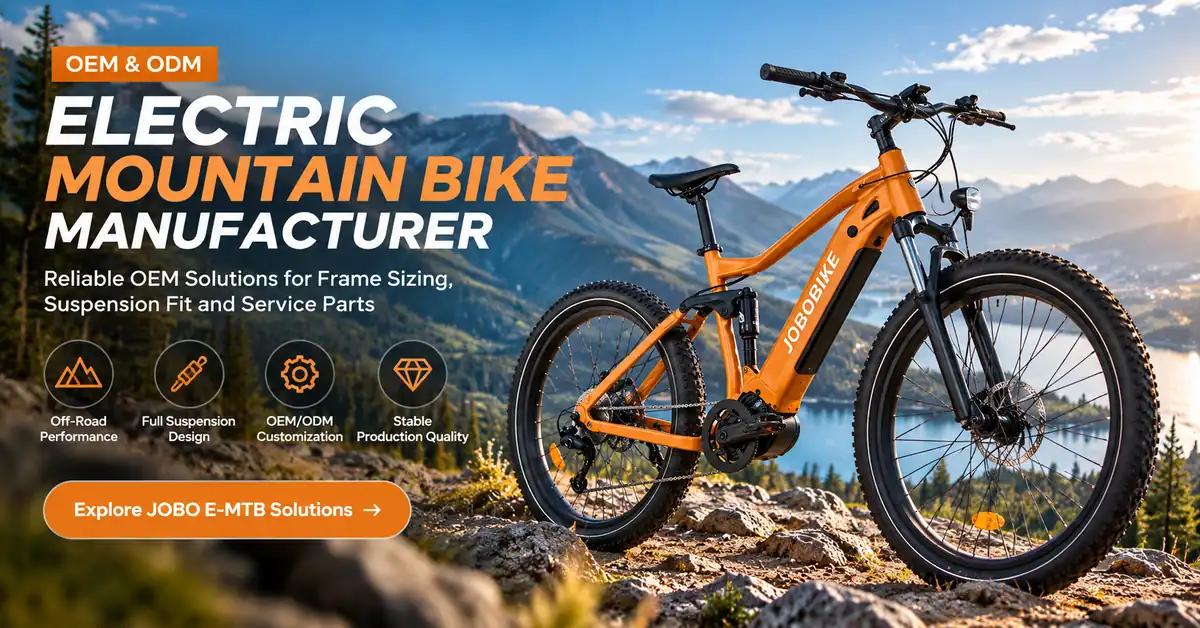
A buyer can find a powerful electric mountain bike in almost any product catalogue. The harder task is finding an electric mountain bike manufacturer that can deliver the correct fit across several rider sizes, integrate a complete suspension and electrical system, and support every configuration after the first shipment. A single impressive sample does not prove that a brand can safely launch three frame sizes, maintain interchangeable service parts, or reproduce its approved bicycle in a later production batch.
For OEM brands, importers, performance bicycle distributors and adventure-rental operators, those questions directly affect stock planning, warranty exposure, workshop labor and customer confidence. This guide explains how to translate them into engineering documents, supplier questions and testable purchasing decisions. JOBO's published mountain e-bike models and frame-manufacturing services provide examples; the exact configuration and documentation for an order must still be confirmed in writing.
Quick Answer: What Makes an Electric Mountain Bike Manufacturer Suitable for an OEM Program?
A capable electric mountain bike manufacturer should supply more than a motor and battery specification. It should identify the intended terrain and rider population, define an approved frame-size range, prove suspension and tire clearance, document motor and battery interfaces, test critical frame and brake structures, and provide a reproducible bill of materials (BOM). Before purchasing, ask for dimensioned geometry drawings, a size chart, a compatibility matrix, an agreed sample test plan, model-specific compliance evidence, and an initial spare-parts list. Then confirm how any component substitution will be approved before production.
An OEM program becomes commercially stronger when a buyer can answer three questions: Will each bike fit the intended rider? Can local technicians repair it? Will the next production batch match the approved sample? These are more valuable questions than asking which catalogue model claims the highest torque.
Start with JOBO: Explore electric bike platforms · Review OEM/ODM manufacturing · Request a technical quotation
1. Identify the Buyer, Riding Mission and Product That Is Not a Fit
An e-MTB designed for a specialist trail retailer is not necessarily appropriate for a resort rental fleet. A retail customer may prioritize suspension adjustability, component specification and a detailed size range. A rental operator may prioritize a durable finish, standardized batteries, easily replaced brake pads and availability of common wear parts. A distributor entering several markets must additionally consider legal vehicle classification, labeling, packaging and import documentation.
Begin the project with a market brief that defines where the bicycle will be sold and where it will be ridden. Distinguish recreational forest paths, managed bike-park trails, mixed gravel and paved routes, and technically demanding descents. Record rider height and inseam distribution, skill level, expected use frequency, climate and desired price position. If the proposed model includes a high-power motor, confirm whether its intended use and sales claims are legal in the destination jurisdiction rather than assuming it qualifies as a conventional pedal-assist bicycle.
| B2B buyer | Intended use | Primary procurement question | Configuration risk |
|---|---|---|---|
| Private-label e-MTB brand | Branded trail model for specialist retail | Can the platform support a coherent size range and repeatable ride quality? | One frame size marketed as suitable for all riders |
| Bicycle importer or distributor | Regional retail network | Can dealers obtain accurate documentation and service parts? | Discontinued or substituted components after launch |
| Adventure resort or rental fleet | Multiple riders using the same bikes daily | Can staff adjust fit and complete routine repairs quickly? | Nonstandard batteries, brakes or fasteners |
| All-terrain lifestyle brand | Gravel, rural roads and recreational trails | Is a fat-tire bike being correctly presented for its actual use? | Calling every fat-tire bike an enduro e-MTB |
| Performance product developer | New frame or suspension project | Which geometry and interfaces require fresh engineering validation? | Treating CAD compatibility as physical validation |
The not-for decision matters too. A 26 × 4.0-inch fat-tire recreational electric bicycle should not automatically be marketed as a lightweight competition mountain bike. A front-suspension bike should not be advertised as a verified enduro platform without evidence for its frame, fork, braking, tires and intended use. Riders needing a certified public-road pedelec may not be able to use a high-power configuration unchanged. Honest positioning protects the purchaser and reduces downstream complaints.
2. Build a Frame Size Run Before Choosing Motor Power
A size run is the set of frame sizes a brand plans to sell, with defined rider-fit targets and consistent handling intentions. A manufacturer may be able to deliver one sample quickly but still need meaningful development work to produce a balanced small, medium and large range. Merely changing the seat tube length does not establish a proper e-MTB size system.
The buyer should request a geometry chart for every proposed size, not a single drawing carrying the words “adjustable frame.” At a minimum, it should describe reach, stack, effective top tube, seat-tube angle, head-tube angle, chainstay length, wheelbase, bottom-bracket height, standover and seat-tube length. Published geometry numbers must state the measurement convention and the fork or shock configuration used. Suspension sag can change the bicycle's effective geometry while riding.
A reasonable development sequence starts by measuring the intended customer population and setting target fit windows. The brand then chooses whether to use two existing frame sizes, develop additional sizes, or narrow the marketed rider range. The design team checks full saddle-height adjustment, pedal clearance and appropriate handlebar positions. Finally, riders representing the target sizes evaluate handling and fit using a consistent test procedure.
The size-run data buyers should request
| Frame parameter | What it tells the buyer | Verification question |
|---|---|---|
| Reach and stack | Standing position and handlebar relationship | Are figures provided for every frame size? |
| Effective seat-tube angle | Seated climbing position | Is the angle stated consistently at the intended saddle height? |
| Standover and seat-tube length | Fit, dismount space and dropper-post compatibility | Can short-inseam riders use the proposed frame safely? |
| Wheelbase and chainstay | Stability, turning and weight distribution | How do dimensions change across the size run? |
| Head angle and fork offset | Steering behavior | Are the figures based on the approved fork? |
| Bottom-bracket height | Ground and pedal clearance | Is clearance checked at the intended suspension sag? |
| Tire and battery clearance | Mechanical interference avoidance | Has each size been checked under maximum suspension movement? |
For example, JOBO's TDA46 all-mountain electric bike frame publicly lists a 6061 aluminum structure, 27.5-inch wheel compatibility, and 17-inch and 19-inch frame sizes. Those are useful initial references, but they do not substitute for complete reach, stack, standover, shock and motor-interface drawings. Ask JOBO which dimensions and approved assemblies apply to the exact proposed TDA46 configuration.
Buyer takeaway: request one geometry drawing per size, one fit matrix covering the intended riders, and one change-controlled revision number for the approved platform.
3. Validate Suspension Compatibility as a System, Not a Marketing Label
“Full suspension” is a category description, not a complete engineering specification. The fork, rear shock, frame pivots, wheel travel and braking system must work together. A component might physically bolt onto a frame yet still create clearance problems, undesirable suspension behavior or maintenance difficulties.
First, confirm fork axle-to-crown dimensions, steerer specification, travel, axle standard, tire clearance and brake mounting. A longer fork can change head angle, bottom-bracket height and frame loading. A different shock length or stroke can alter rear-wheel travel and the available clearance at full compression. These are not harmless substitutions. If the proposed replacement changes suspension motion or forces, require engineering approval and suitable revalidation.
Next, review rear linkage and pivot design where a full-suspension frame is proposed. Buyers should ask for the approved shock dimensions, mounting hardware, bearing types, pivot torque specifications, maintenance access, and replacement hardware identification. Where appropriate, test the bike with the suspension fully compressed to check tire-to-frame, chainring-to-chainstay, battery-to-linkage and cable-to-moving-part clearance.
The simplest OEM request is a suspension interface sheet, signed by the engineering team, that names the exact approved fork and shock assemblies and lists any alternatives that have actually been evaluated. It should also indicate whether a change of rider size or tire width modifies those approvals.
Hardtail, full-suspension and fat-tire designs are not interchangeable
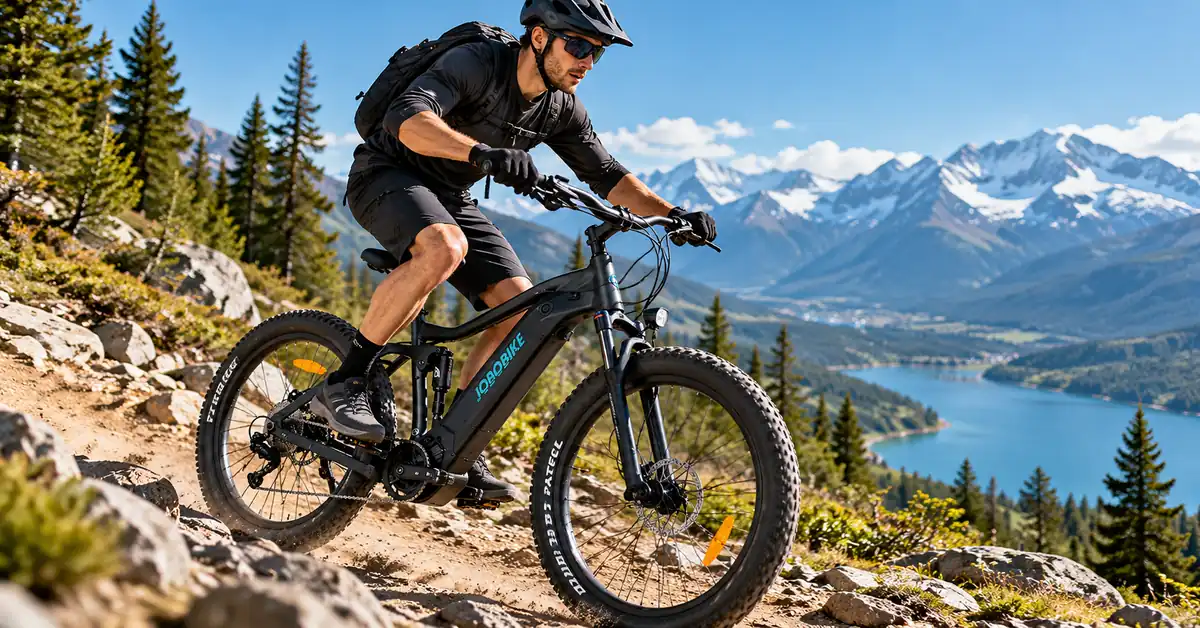
A hardtail usually has a front suspension fork and a rigid rear triangle. It may be attractive where price, weight and mechanical simplicity matter. A full-suspension configuration adds a rear shock and moving pivots, potentially helping the rear wheel track uneven terrain but increasing complexity and service needs. Wide fat tires can provide flotation and comfort in some loose-surface conditions; they do not automatically replace suitable suspension engineering or make a bicycle safe for technical descents.
JOBO's JB-TDE43L-F full-suspension mountain e-bike and JB-TDE33Z-F all-terrain electric bike illustrate why those distinctions matter. Their public descriptions differ in drive and suspension architecture. A buyer should validate the relevant interfaces for each rather than assume that similar battery voltage or tire width means equal performance.
Explore JOBO frame manufacturing and engineering →
4. Match Motor and Transmission Interfaces to the Riding Mission
Motor wattage alone does not describe how an electric mountain bike climbs, accelerates or handles. A mid-drive system can transmit power through the bicycle's gearing and changes the loads experienced by the chain and drivetrain. A hub drive uses a different torque path and places mass at the wheel. The correct choice depends on intended terrain, rider expectations, wheel and frame design, applicable law, and the service network.
Ask for the precise motor model, continuous rated output where relevant, maximum torque only with its test context, controller version, assistance behavior, mounting specification and diagnostic procedure. A claimed peak torque figure without matching conditions is insufficient for comparing platforms. Check crank clearance, chainline, ground clearance and the system's interaction with shifting, especially under repeated uphill starts.
The Bafang M600 mid-drive configuration described for JOBO's JB-TDE43L-F is a different engineering proposal from the hub-drive layout on the JB-TDE33Z-F. Both deserve a ride evaluation, but they should not be ranked on wattage alone. For high-power options, JOBO also lists the JB-TDE58L-F 1000W electric bicycle; that published configuration requires separate market classification and use-case review rather than being assumed suitable for an EU-style 250 W EPAC program.
Make the interface part of the contract
Record the motor mounting drawing, compatible crankset, drivetrain, sprocket/cassette limits, display and controls, wiring harness, connectors, firmware revision and diagnostic access. Ask who is authorized to update firmware and how field technicians obtain compatible replacement units. If a supplier proposes an alternative motor during production, reassess geometry, harness, battery current capability, compliance and test scope before approving it.
This level of documentation is valuable to a growing OEM brand because it separates an interchangeable commercial part from a change that alters the bicycle's safety or riding behavior.
5. Specify Battery Packaging, Electrical Protection and Trail Service Access
An e-MTB battery is both a source of propulsion energy and a mechanical assembly exposed to vibration, water, temperature changes and repeated removal. Choose the pack as a defined system: cells, enclosure, battery management system, charger, mounting rail or hardware, seals, electrical contacts and service instructions.
A battery's nominal energy can be estimated in watt-hours as nominal voltage × amp-hour capacity. For comparison, 48 V × 14 Ah is approximately 672 Wh, while 48 V × 20 Ah is approximately 960 Wh. These calculations describe nominal stored energy, not independently verified usable energy or expected trail range. Actual range varies with rider mass, gradients, temperature, motor control, tire pressure and assistance level.
For OEM design, ask whether the battery can be removed without disturbing critical frame or suspension hardware, whether contacts remain protected when the pack is removed, and whether the latch can resist intended riding vibration. Confirm the approved charger, connector, pack marking and replacement-pack availability. Do not infer a specific IP rating from a generic statement about weather protection: request the test evidence for the exact assembly.
A service-friendly design helps a rental operator replace a damaged unit, a distributor process warranty returns and a retailer explain storage and charging to customers. The battery installation should also be reviewed at full fork and shock movement so the enclosure, hoses and cables cannot interfere with moving components.
Battery RFQ data fields
| Battery field | Supplier response required |
|---|---|
| Nominal voltage / Ah / Wh | Declared pack values for the exact SKU |
| Cell and BMS identification | Approved component identity and traceability method |
| Charger | Compatible charger model, input range and destination plug |
| Mounting | Retention mechanism, fastening details, removal instructions |
| Protection evidence | Applicable environmental, electrical and transport documentation |
| Warranty support | Replacement process, diagnostic steps and spare availability |
6. Tires, Wheels and Brakes Must Be Approved Together
A wheel is not simply a tire size. Axle spacing, hub, rim width, tire casing, spokes, brake rotor, caliper and fork clearance form a matched assembly. The manufacturer should identify the permitted wheel and tire combinations and explain whether they affect the frame's intended usage category.
For example, JOBO publishes multiple 26 × 4.0-inch fat-tire platforms, including the JB-TDE06Z-F MTB electric bike, JB-TDE53Z-F fat-tire mountain bike, and JB-TDE58L-F. The repeated tire dimension does not mean the wheels, axles, frames, brakes or motor systems are interchangeable. Request exact brand and part references in the BOM.
Review rotor diameter, brake mount type, lever specifications, hose routing or cable routing, pad compound, heat management and service tools. Downhill braking may impose very different thermal loads from flat commuting, so the test route and use case matter. An OEM buyer should document loaded braking performance and repeatability under an agreed protocol rather than relying on a statement that a bicycle has “disc brakes.”
Published specification discrepancy to resolve: JOBO's JB-TDE33Z-F page uses both hydraulic and mechanical disc-brake descriptions in different sections. The RFQ must select one approved brake build and identify the actual installed parts. The JB-TDE53Z-F product description likewise should be read alongside its specification table before an order is approved. These inconsistencies are reasons for disciplined BOM review, not a basis for guessing the final configuration.
7. Compare Real JOBO E-MTB Platforms Before Designing a New Model
A commercially sensible development plan considers an existing platform before commissioning a new frame. Using a proven architecture may reduce engineering work, but a private-label buyer still needs to validate fit, components, market classification and product claims. JOBO's public range covers fat-tire recreation, high-power off-road and all-mountain frame development.
The following table reproduces selected published configuration references. It is not a price list, independently tested performance comparison or guarantee of stock. Where a page describes optional or inconsistent components, the latest signed product specification takes precedence.
| JOBO model / product | Public configuration reference | Platform distinction | Priority OEM checks |
|---|---|---|---|
| JB-TDE33Z-F All Terrain | 48 V / 750 W listing; 48 V / 14 Ah; 26 × 4.0-inch tires; Shimano 7-speed | Hub-drive fat-tire all-terrain platform | Brake BOM discrepancy; motor/legal category; suspension and tire clearance |
| JB-TDE43L-F Full Suspension MTB | Bafang M600 48 V / 500 W mid-drive; 48 V / 14 Ah; Shimano 9-speed; 26 × 4.0-inch tires | Mid-drive full-suspension starting point | Shock, pivot, geometry and battery interface records |
| JB-TDE58L-F 1000W | 48 V / 1000 W; 48 V / 20 Ah; Shimano 8-speed; 26 × 4.0-inch tires | Higher-power off-road-oriented build | Market classification, brake specification, thermal and drive-system validation |
| JB-TDE06Z-F MTB | 48 V / 1000 W; 48 V / 20 Ah; Shimano 7-speed; 26 × 4.0-inch tires | High-power platform with front suspension listed | Intended-use claim, brake and fork configuration, electrical matching |
| TDA46 All-Mountain Frame | 6061 aluminum; 27.5-inch wheel; 17-inch/19-inch listed sizes | Frame-level OEM/ODM project | Detailed geometry, approved mid-drive mount, shock interfaces and drawing revision |
The table deliberately does not compare advertised range as if it came from a single controlled test. It also does not imply that the TDA46 frame works with every motor named in promotional copy: confirm actual mounting drawings and the approved battery and motor package for the precise revision being quoted.
Choosing a platform by commercial position
A distributor planning mixed-surface leisure products might begin by evaluating a front-suspension fat-tire model. A specialist performance brand may place greater weight on a full-suspension platform and its kinematic documentation. A company developing proprietary frame geometry may consider the TDA46 as a starting reference for a deeper ODM conversation. None of those choices is automatically superior; each follows a different end-customer need and service promise.
Compare JOBO electric bike models → · Discuss an OEM mountain bike project →
8. Create an Engineering Release Package Before Sample Approval
The most valuable deliverable from an electric mountain bike manufacturer is not a glossy catalogue. It is an engineering release package that states exactly what the supplier intends to build and how the buyer will know whether it is correct. This is particularly important when one model will be sold in multiple sizes or markets.
For a manageable OEM project, ask for the following controlled files: frame geometry by size, assembly drawings, wheel and suspension interfaces, motor and battery installation documents, exact component BOM, approved substitutes, color and graphics references, labeling and manuals, required test matrix and packaging instructions. Each item should have an owner and revision identifier. If the project uses a proprietary frame, establish drawing and tooling rights in the commercial agreement.
Set a change-control rule before ordering samples: changes affecting frame dimensions, load path, suspension travel, brake performance, wiring, motor or battery systems require documented buyer approval and an engineering decision on retesting. Minor cosmetic changes can follow a separate approval path, but even they should remain traceable where labels and finish quality are involved.
Minimum release gate: no production order should rely solely on a photographed sample and a general parts list. The signed BOM, drawing set, configuration code, approval sample and applicable evidence should identify the same bicycle.
9. Evaluate JOBO's Manufacturing and Quality-Control Evidence
JOBO describes a China manufacturing operation with an in-house frame factory, welding, painting and assembly, alongside OEM/ODM project services and a Poland operation for selected regional activities. The company publishes a 50,000 m² manufacturing footprint and overall capacity figures on its website. Those are company-level claims rather than reserved output for a specific e-MTB order; obtain a project-specific production schedule before committing to a launch date.
The JOBO frame factory outlines cutting, frame fabrication, welding and dimensional-quality processes. Buyers should ask which processes apply to their actual aluminum-frame design, which critical dimensions are inspected, and which welding, heat-treatment or surface-finishing records can be shared. Not every process mentioned on a factory page necessarily applies to every frame SKU.
JOBO's QC laboratory publicly identifies horizontal and vertical frame-fatigue equipment, frame vibration testing, brake-mount fatigue equipment, complete-bike testing, battery testing and a motor dynamometer, plus IQC, IPQC and FQC stages. These capabilities are relevant to mountain-bike development, but the existence of equipment is not itself proof that a specific bike passed a specified test.
Practical evidence checklist for OEM mountain bikes
| Quality stage | Evidence to request | Why it matters |
|---|---|---|
| Incoming components (IQC) | Identification and acceptance criteria for forks, shocks, brakes, batteries and motors | Prevents unapproved component changes |
| Frame manufacture | Geometry measurements, weld inspections and applicable frame test records | Supports structural consistency |
| Process control (IPQC) | Torque-control records, routing checks and assembly work instructions | Reduces assembly variation |
| Complete-bike evaluation | Electrical function, braking, fit and clearance checks | Tests interfaces rather than isolated parts |
| Final quality control (FQC) | Serial identification, inspection sheet and configuration reconciliation | Connects shipped units to approved BOM |
| Packaging check | Protection plan, carton identification and handling instructions | Reduces shipping damage and field assembly issues |
A strong quality agreement defines pass/fail criteria and how nonconforming units are corrected and rechecked. Do not invent a factory defect rate or an inspection sample size; agree the appropriate sampling plan and any 100% safety-critical checks as part of the purchase contract.
10. Validate the Entire Size Run With a Practical Pilot Plan
A well-designed pilot should include the smallest and largest planned sizes, not merely the easiest medium sample. The evaluation team should combine workshop inspection with controlled riding by qualified riders on routes authorized for the intended vehicle category. Each result should be tied to the actual frame size, product serial reference, installed components and software revision.
Stage A: Static fit. Confirm saddle and handlebar adjustment, safe standover, toe and pedal clearance, dropper insertion depth, and the rider's ability to operate controls. If a proposed frame serves riders at the extremes of its size chart, test those riders deliberately rather than relying on an average-height tester.
Stage B: Mechanical clearance. Inspect full steering lock, full fork compression and full rear-suspension compression where applicable. Verify tire-to-frame and tire-to-cable gaps, battery and motor clearance, crank interference and routing protection. Record the tested tire model and pressure. This evaluation must remain within the manufacturer's specified procedures and safe test controls.
Stage C: Ride and system behavior. Evaluate low-speed starts, controlled climbing, shifting under appropriate load, braking, suspension response and motor-assist transitions. Use a repeatable route and record rider weight, assist mode, temperature and tire pressure. Do not compare the distance achieved by two different bikes unless the test conditions are controlled.
Stage D: Workshop serviceability. Ask a technician to remove and reinstall the battery, replace a brake pad, remove a wheel and inspect a pivot using the proposed service manual. Track unusual tools, awkward fastener access and connector confusion. These observations often predict dealership labor costs better than a short showroom ride.
Example pilot acceptance matrix (buyer-defined, not an official standard)
| Test item | Evidence | Acceptance basis |
|---|---|---|
| Fit across sizes | Rider observations and recorded geometry | Approved fit envelope for each SKU |
| Tire and linkage clearance | Photographs and documented checks | No interference under the approved assembly procedure |
| Brake function | Repeatable controlled test results | Project's documented safety and performance criteria |
| Battery retention | Inspection and approved vibration evaluation | No unintended movement or release within the defined test |
| Electrical diagnostics | Display, controls and fault records | Expected functions and service process verified |
| Workshop maintenance | Timed service tasks and tool checklist | Dealer-service requirement agreed in advance |
| Configuration identity | BOM and sample serial record | No unauthorized substitutions |
Where a test fails, identify the root cause and issue a revision; do not quietly repair one sample and proceed as if the underlying design has been validated. If the frame or safety-relevant components change, reassess the affected tests.
11. Confirm Destination-Market Classification and Evidence
Buyers cannot assume that every mountain e-bike is a road-legal electric bicycle in every region. For certain EU pedal-assist categories, important criteria include maximum continuous rated power of 250 W and progressive assistance cut-off before 25 km/h, alongside other applicable conditions. High-power or throttle-operated configurations may fall into different categories. Intended off-road use also does not automatically remove every relevant product or import obligation.
For mechanical bicycle safety, ISO 4210-2:2023 includes requirements related to mountain bicycles within its scope. IN 15194 concerns electrically power-assisted cycles within its applicable scope. In the United States, the U.S. Consumer Product Safety Commission's 16 CFR Part 1512 addresses bicycle safety requirements, and federal low-speed e-bike definitions differ from EU EPAC rules. State and local trail-access rules may add separate restrictions.
This is a procurement framework, not legal advice or a claim that the listed JOBO mountain models are all certified to these standards. Before import or sale, identify the exact country and vehicle class and request the declaration, test reports, labeling, manuals and battery-related documents appropriate to the approved configuration. A certificate for another powertrain, battery, frame size or model should not be assumed to cover the proposed product.
JOBO maintains a certification and patents information page, which buyers can use to start a document request. Verify issuing body, document number, validity, model identity and included configurations with the supplier and relevant compliance professional.
12. Plan OEM/ODM Customization Without Losing Production Control
Private-label customization can include logos, paint, decals, manuals and packaging; deeper ODM work can affect frame design, component interfaces and tooling. The two should not be quoted or scheduled as if they were identical. A simple branding exercise may use an existing approved platform, whereas new geometry or shock kinematics can require drawings, fixtures, prototypes and a more extensive test program.
JOBO's OEM and ODM services describe support from market requirements and platform choice through development, production, testing and delivery. For a mountain e-bike brand, the procurement sequence should be documented as: market brief → platform and size-run decision → interface/BOM agreement → engineering review → sample build → pilot results → buyer approval → controlled production → final inspection and shipping.
Ask which options are already supported on the base platform and which require custom engineering. A change from mechanical to hydraulic brakes, for example, may involve levers, calipers, mounts, hose routing, labels and service parts. A motor change may affect electrical systems and vehicle classification. A larger battery may change mount geometry, mass distribution and transport documentation. Each choice should be assessed as an integrated product decision, not an isolated parts upgrade.
Protect design ownership and repeat-order consistency
If the buyer is funding proprietary geometry, confirm confidentiality arrangements, drawing access, tooling ownership, replacement-tooling arrangements and permitted use of the design. Define how approved substitutes will be recorded and who pays for revalidation. Preserve one agreed reference sample and a controlled digital record so later batches are measured against the actual approved product, not against a marketing photograph.
13. Compare Total Landed Cost and Service Risk Instead of Unit Price Alone
An attractive ex-factory unit price can become expensive if the product needs unusual service tools, has short-lived proprietary parts, suffers shipping damage or requires repeated post-sale technical support. For OEM brands, the better question is the expected cost per sellable, supportable bicycle over the program's first years.
Request a quotation that separates complete-bike cost, customization and tooling, sample and test expenses, packaging, spare parts, shipping terms, destination taxes and any regional service support. A size run also creates inventory exposure: three sizes may increase stock availability for customers but require separate forecasts and spare-parts planning. Ask for price breaks by configuration without assuming all frame sizes have identical component costs.
| Cost element | Buyer should request | Hidden risk if ignored |
|---|---|---|
| Frames by size | Price and tooling allocation per size | Unplanned minimum volumes for a slow-selling size |
| Fork/shock/motor assemblies | Exact approved models and alternatives | Costly replacements or unvalidated substitutions |
| Battery and charger | Separate replacement pricing and documentation | Long workshop delays and warranty complexity |
| Paint and private label | Color, decal and approval reference | Inconsistent retail appearance |
| Testing and compliance | Scope, responsibility, document ownership | Rework before launch or customs delays |
| Export packaging | Carton dimensions, assembly state and protection | Transport damage and difficult consumer setup |
| Warranty/spares | Stock policy and response process | Higher dealer labor and customer dissatisfaction |
A useful commercial comparison is not “Factory A costs $100 less.” It is whether both offers cover the same frame size, drive system, suspension parts, test responsibilities and service commitments. If they do not, the price difference may reflect unequal products.
14. Include Spare Parts in the Product Design Decision
Field service should be specified before the first batch ships. Mountain e-bikes experience wear in brakes, drivetrains, wheels, bearings and suspension assemblies. Electrical faults can also require trained diagnosis. A distributor whose technicians cannot identify a replacement component may end up replacing a complete assembly unnecessarily or immobilizing a bicycle while waiting for a small part.
Ask for a serviceable-parts catalogue with component IDs, photographs, compatibility by frame size and model revision, required tools, recommended service procedures and parts lead-time assumptions. At minimum, review brake pads and rotors, derailleur hanger, spokes or wheel assemblies, pivot bearings and hardware for full-suspension models, battery retention parts, charging components, display and motor-interface components.
For a rental fleet, standardizing parts across sizes may be especially valuable. For a specialist retail brand, performance-specific parts may be justified, but the dealer network should know exactly which parts are interchangeable. A common-looking pivot bolt is not automatically interchangeable if diameter, material, thread, head form or tightening requirements differ.
Ask three questions about regional after-sales support
- Where are the replacement parts physically stocked? A promised European support program does not prove that a particular e-MTB component is currently in Poland.
- Who performs diagnosis and warranty decisions? Define the process for photographs, error codes, serial numbers and faulty-part return.
- What happens after a model revision? Require a compatibility and supersession record for parts that may replace older versions.
JOBO describes China and Poland operations, but the availability of a particular mountain-bike size, battery, fork or service part must be confirmed for the proposed contract.
15. Build a Quotation-Ready Mountain E-Bike RFQ
The strongest RFQ helps a supplier respond with a useful technical proposal instead of a generic product catalogue. It also makes comparisons between factories fairer. Buyers can use the following structure when contacting an electric mountain bike manufacturer or asking JOBO to recommend a platform.
| RFQ section | Information to include |
|---|---|
| Company and sales market | Brand/distributor name, destination countries, intended legal vehicle category |
| Riding profile | Trail type, gradients, rider ability, use frequency, climate and storage conditions |
| Rider sizing | Target height/inseam groups, number of frame sizes, proposed size mix |
| Platform choice | Hardtail, full suspension, fat tire, existing OEM platform or new frame design |
| Geometry | Desired fit, preferred wheel size, clearance requirements and design priorities |
| Motor and drivetrain | Proposed drive type, assist behavior, gearing and diagnostic expectations |
| Battery | Pack specification, removable/installed design, charger and service plan |
| Suspension and brakes | Approved component direction, adjustable settings and spare parts |
| Appearance | Color, logo, labels, carton, manual and local languages |
| Order plan | Sample quantity, pilot decision, forecast, target shipment and repeat-order scenario |
| Verification | Required drawings, tests, reports, inspection records and change-control rules |
| Commercial terms | Quote breakdown, MOQ by size, lead time, warranty and parts terms |
Suggested inquiry message: “We are evaluating an OEM e-MTB range for [market] and [target riders], with [two/three] frame sizes, [trail/rental/retail] use and an estimated first order of [quantity]. Please recommend the closest JOBO platform and provide model-specific geometry, suspension and motor interface documents, an itemized configuration/BOM, sample options, applicable test evidence, MOQ by size and a spare-parts proposal.”
16. Confirm Capacity, Samples and Delivery Milestones Separately
Company-wide annual capacity and a project's available production slot are different facts. Ask JOBO which production processes and assembly capacity are available for the exact proposed model, especially if new frame fixtures, sizes, paint colors or imported components are involved. The delivery plan should distinguish engineering time, procurement time, sample lead time, testing, corrective changes, pilot approval, mass production, final inspection and international transport.
Do not use a published general lead-time claim as a guaranteed schedule for a customized full-suspension project. A revised motor mount or shock arrangement may require new drawings or testing; a special battery may have a different component lead time from a stocked pack. Ensure every quote states when the clock starts—upon deposit, drawing approval, final sample approval or component availability—and what triggers a revision to the schedule.
For repeat orders, require a confirmation of the unchanged BOM and a notification procedure for end-of-life components. Buyers should also agree how finished units are identified by size, serial number, market configuration and packaging label. Those apparently administrative details become crucial when service departments are asked to find a compatible replacement years after launch.
17. Ten FAQ for OEM Mountain E-Bike Buyers
1. What should an OEM buyer check first when choosing an electric mountain bike manufacturer?
Start with intended terrain, target customers and destination-market vehicle classification. Then request frame geometry for every proposed size, a complete BOM, documented suspension and electrical interfaces, model-specific testing and a warranty/spare-parts process. A cheap sample cannot compensate for an unverified production plan.
2. Does one frame size work for every rider in a rental fleet?
No. Saddle height is only one dimension of fit. Reach, stack, standover, handlebar position and safe adjustment ranges matter. A rental operator should define its rider population and test the proposed sizes with representative riders rather than relying on a universal sizing claim.
3. Is a full-suspension electric mountain bike always better than a hardtail?
Not for every purpose. Full suspension can be advantageous on demanding terrain but adds pivots, bearings, shocks and maintenance tasks. A hardtail may fit easier routes, a lower target price or maintenance-focused rental work. Choose according to intended riding conditions and the buyer's service capability.
4. Can I change the motor after approving an OEM frame?
Possibly, but only after checking the motor mount, chainline, clearance, wiring, controller, battery and applicable regulatory classification. A different motor model may require engineering changes, new testing and revised documentation. Never assume that similar wattage means plug-and-play compatibility.
5. What is the difference between a fat-tire all-terrain e-bike and a performance e-MTB?
A fat-tire product often emphasizes flotation, comfort and mixed surfaces; a performance e-MTB normally requires more specific attention to mountain-bike geometry, suspension behavior, descending control and component performance. Actual suitability depends on the complete bicycle and the conditions for which it has been validated, not the width of its tires alone.
6. How should I compare battery range between two mountain e-bike models?
Start by comparing nominal watt-hours, but do not equate energy capacity with measured range. Ask for the test route, rider mass, ascent, tire setup, assistance level, temperature and battery condition. Request similar test conditions for both models before drawing commercial conclusions.
7. Which certifications should be requested for OEM electric mountain bikes?
Ask for documents appropriate to the exact market, bicycle classification, frame, electrical configuration and battery. Depending on the project, ISO 4210, EN 15194, U.S. bicycle rules and other electrical or battery requirements may be relevant. Do not accept a company-wide certificate as proof that every customized model is covered.
8. Can JOBO provide custom e-MTB frames and branding?
JOBO advertises an in-house frame factory and OEM/ODM support, including frame development and brand customization. The TDA46 frame page identifies an all-mountain reference platform. Engineering changes, new size runs, component options, tooling, MOQ and testing must be confirmed for the particular project.
9. What spare parts should a distributor buy with the first shipment?
The answer depends on fleet size, expected riding intensity and parts availability. Common planning categories include brake wear parts, derailleur hangers, wheels and tires, suspension pivot parts, display and cable parts, and approved battery/charger replacements. Request model- and revision-specific compatibility lists rather than guessing an inventory quantity.
10. What should be included in a first RFQ to JOBO?
Provide the sales region, user profile, terrain, size-range targets, estimated quantity, motor/battery direction, preferred suspension, price segment, logo and color requirements, documentation needs, planned launch date and warranty expectations. Ask JOBO to identify an existing platform or ODM development path and to specify what needs to be verified in a sample.
Conclusion
Choosing an electric mountain bike manufacturer is a product-system decision, not a contest to find the biggest motor or the shortest feature list. For a successful OEM launch, brands need a size range that genuinely fits their customers, suspension and drivetrain interfaces that have been checked as a complete assembly, documentation that identifies the approved configuration, and service parts that dealers can actually obtain.
The practical buying sequence is straightforward: define the market and riding task; select a suitable platform; request size-specific geometry and compatibility drawings; agree on the BOM and required testing; evaluate representative samples; and approve a production and after-sales plan before placing a bulk order. JOBO offers published mountain and all-terrain bicycle models, an in-house frame-manufacturing operation, QC facilities and OEM/ODM project support that can be assessed against these requirements.
Ready to develop a brand-specific e-MTB range? Review JOBO's electric bike products, explore its frame-manufacturing capabilities, and contact the JOBO team for a tailored technical quotation. Share your rider-size targets, riding conditions, preferred drive system, forecast order quantity and destination market so the discussion begins with a buildable, testable specification—not a generic price list.