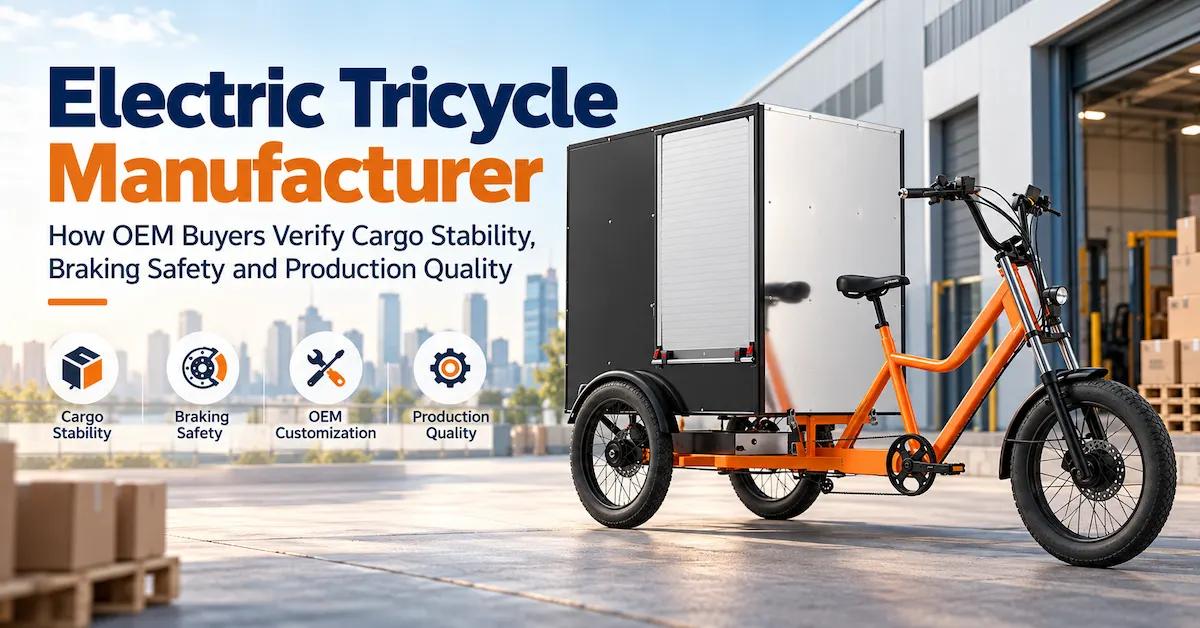
Choosing an electric tricycle manufacturer is fundamentally an engineering and procurement decision, not simply a search for a three-wheeled vehicle at an attractive wholesale price. A tricycle that stands upright at a loading bay may still behave poorly in a fast turn, on a cross-slope, during hard braking or with cargo placed too high. Those differences matter to importers, private-label brands, commercial fleet managers and distributors whose success depends on consistent products, defensible safety claims and dependable spare-parts support.
The right procurement process starts with an intended use and a target-market vehicle classification. Buyers should then compare chassis architecture, drive systems, load distribution, braking, battery capacity, service access and the evidence supporting each published specification. Finally, they should approve a defined sample and make that exact configuration the reference for production acceptance. This guide uses published JOBO tricycle platforms to demonstrate how to approach those decisions without confusing a catalogue description with a certified production specification.
Quick Answer: What Should Buyers Ask an Electric Tricycle Manufacturer?
A reliable electric tricycle manufacturer should explain what the tricycle is designed to carry, how it turns and stops under load, which configuration has been tested, and how identical units will be reproduced for the buyer's market. Before an OEM or wholesale order, request a model-specific specification and bill of materials (BOM), documented gross vehicle weight limits, brake and stability validation, applicable compliance evidence, a sample approval procedure, an inspection plan and a spare-parts proposal. Do not assume that three wheels automatically prevent rollover or that a general e-bike certificate covers a cargo or passenger tricycle.
For a practical starting point, examine the JOBO electric tricycle product category, compare the relevant vehicle platforms, and discuss your intended mission with the JOBO OEM and ODM team.
Explore Electric Tricycle Models → · Request an OEM Manufacturing Quote →
1. Define the Buyer, Mission and Operating Environment First
An electric tricycle factory may supply several vehicles that look related but serve different jobs. A neighborhood utility model carrying groceries is not automatically suitable for courier fleets; a heavy cargo machine is not automatically legal on a city bicycle path; and a passenger pedicab requires a different safety, access and regulatory assessment from a goods-only platform. The product should be selected by mission before it is selected by appearance.
Which B2B buyers benefit most?
Importers and wholesale distributors need repeatable specifications, a clear import classification, a predictable landed cost and a maintainable model range. Private-label electric mobility brands need visual identity, product differentiation, documented design control and compatible replacement parts. Delivery and logistics operators need a tricycle that can safely complete repeated loading, stopping and maneuvering over a defined shift. Campus, facility and municipal procurement teams need service access, operator training and reliable operation on controlled routes. Tourism operators considering passenger pedicabs must address occupant protection, intended passenger count and local commercial transport requirements.
These buyers should provide the intended destination country, the permitted roads or sites, average and maximum load, rider dimensions, route profile, typical stopping frequency, storage space, charging availability and annual order forecast. A specification written around an actual route provides more value than an isolated request such as “1000 W motor, biggest battery, lowest price.”
The program may be unsuitable if the target route is narrower than the tricycle's track width, the cargo requires an unapproved restraint or mounting system, the vehicle exceeds local speed or vehicle-class limits, or the fleet has no practical way to store and maintain batteries. An honest supplier should identify these conflicts before manufacturing a prototype.
2. Three-Wheel Layout Is Not a Universal Stability Guarantee
Stability is one of the strongest selling points of a commercial electric tricycle, but it must be described precisely. A conventional upright three-wheeler can remain supported at rest without the rider balancing it like a two-wheel bicycle. That does not mean it cannot tip during a turn, on a ramp, while traversing an inclined surface or when cargo shifts. The dynamics change as speed, corner radius, track width, center-of-gravity height, tire grip and load position change.
For an upright delta tricycle with one front wheel and two rear wheels, the support triangle is defined by the three tire contact patches. Loading a high, narrow cargo box above the rear axle may move the combined center of gravity upward. As the trike corners, lateral acceleration creates a roll-over tendency. Keeping the load low and centered generally reduces that tendency, but the real result still needs testing with the approved configuration.
A wider rear track may improve certain static stability measures, yet it can increase the width that must pass through gates, bicycle routes or warehouse aisles. A lower center of gravity can help handling but may affect ground clearance or mounting design. These are engineering trade-offs, not reasons to advertise that one arrangement is universally safe.
Ask for stability evidence, not just a description
- Static stability: How does the loaded tricycle behave when parked, loaded and unloaded on the intended site gradients?
- Turning response: Has the sample been driven through prescribed low-speed turns, circles and avoidance maneuvers with a representative load?
- Cross-slope behavior: What occurs on crowned roads, uneven site entrances and inclined loading surfaces?
- Cargo retention: Can parcels, tools or passengers move during steering or emergency stopping?
- Operator fit: Can riders use the brakes, steering and controls without awkward posture across the specified height range?
An engineering review should define repeatable test conditions and objective approval criteria. It should never rely on an unsupported statement that a tricycle is “100% anti-tip.”
3. Compare JOBO Electric Tricycle Platforms Before Requesting a Custom Build
JOBO presents four electric tricycle product directions on its official category page: an adult utility trike, a heavy-duty cargo tricycle, an electric pedicab and a fat-tire electric tricycle. The published models offer useful reference points for an initial RFQ, but their power systems and duty profiles are not interchangeable. The following details are based on the listed product pages and should be confirmed against the latest configuration sheet for your market.
| JOBO model | Published reference configuration | Best preliminary fit | Confirm before quotation |
|---|---|---|---|
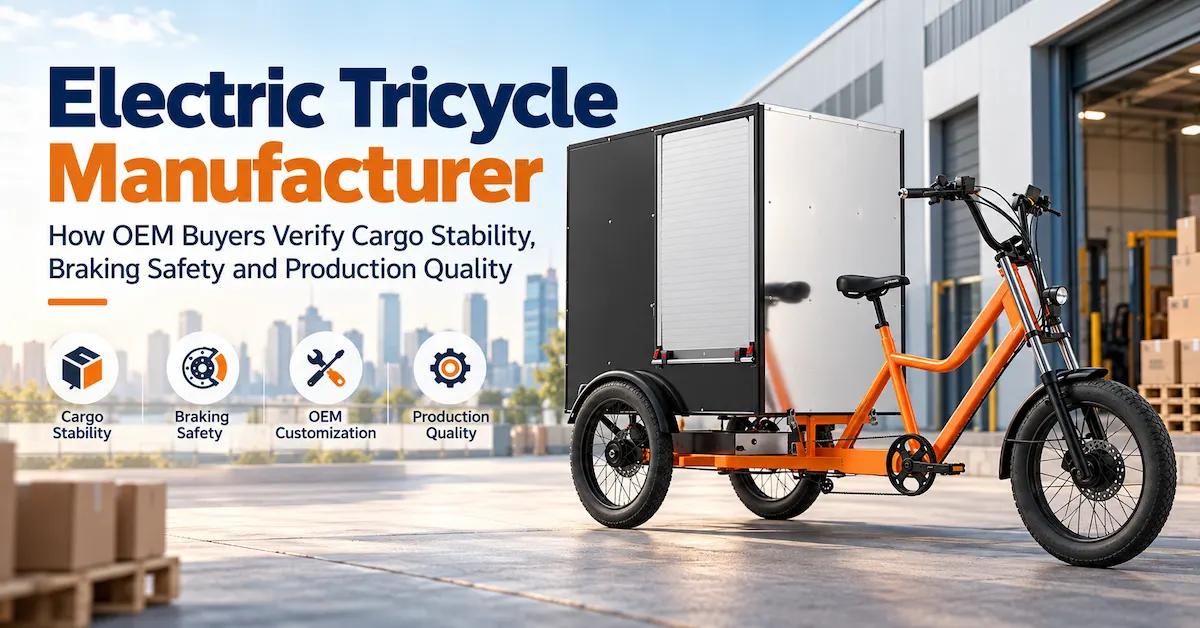
| JB-TDT18L Cargo Electric Tricycle | 48 V 1000 W brushless motor; 48 V 52.5 Ah lithium battery; hydraulic disc brakes; modular cargo formats | Goods transport, commercial utility and site logistics | Actual GVW, cargo-module ratings, differential specification, road classification and tested loaded braking |
| JB-TDN39Z-F Adult E Trike | Annada M81 500 W mid-motor; 48 V 15 Ah LG battery; 20 × 3.0 in tires; mechanical disc brakes | Adult utility and lighter cargo use | Rider/cargo ratings, frame fit, turning behavior and final brake build |
| JB-TDN38Z-F Fat Tire Electric Tricycle | Bafang 500 W motor; 48 V 15 Ah LG battery; 20 × 3.0 in tires; mechanical disc brakes | Utility riding and mixed-surface applications where permitted | Tire pressure/load rating, incline use, motor identity and applicable compliance |
| 300K-06 Electric Pedicab | 48 V 1000 W brushless motor; four 12 V 45 Ah batteries; published three-seat layout | Passenger transport or tourism where legally authorized | Battery chemistry/weight, passenger restraints, commercial licensing, braking and permitted roads |
Published 48 V and power figures describe configurations shown by JOBO; they are not proof that the complete vehicle qualifies as a bicycle in every jurisdiction. The manufacturer should provide a signed specification identifying the frame revision, powertrain, controller, braking system, battery, wheels, tires, cargo body and legal vehicle category for the exact order.
The JB-TDT18L cargo model is the main product reference for heavier goods applications in this article. The adult e-trike and fat-tire tricycle are different platform discussions, not evidence that every JOBO tricycle has the same load or equipment ratings. The passenger-oriented electric pedicab warrants its own approval pathway.
View the JOBO Cargo Electric Tricycle →
4. Build a Technical Specification That Can Actually Be Inspected
One way to distinguish a serious electric tricycle supplier from a generic catalogue seller is to ask whether every quotation line can be matched to a tangible component, drawing, test or inspection record. An unqualified word such as “heavy duty” is not a procurement specification. Neither are “long range,” “premium brakes” or “strong frame.”
| Specification field | Required definition | Evidence or acceptance method |
|---|---|---|
| Intended vehicle category | Market, riding location, permitted speed, passenger/goods use | Written regulatory review for target territory |
| Chassis and geometry | Wheel arrangement, track width, wheelbase, unloaded dimensions | Approved drawing and measured sample |
| Mass and cargo rating | Vehicle mass, rider mass, permitted gross vehicle weight, cargo body limit | Signed rating calculation and test evidence |
| Motor and controller | Manufacturer, model, rated output, torque behavior, speed limiting | BOM, label and functional verification |
| Battery and charger | Chemistry, nominal voltage, Ah/Wh, protection, charger model | Battery specification, transport and safety documents |
| Brakes and parking | Brake model, actuation, wheel coverage, holding method | Component specification and loaded acceptance tests |
| Tires and wheels | Size, construction, load index/limit, recommended inflation | Sidewall markings and wheel-load evaluation |
| Cargo attachment | Mounting points, box dimensions, restraints, fasteners | Approved drawing, installation method, loaded inspection |
| Electrical protection | Wiring layout, connectors, fusing, exposure protection | Inspection and relevant electrical tests |
| Service items | Wear components, tools, replacement procedures | Spare-parts list and service instructions |
Demand a revision-controlled BOM with supplier identities and approved alternatives. If a component is substituted after sample approval, the buyer should receive a documented change notice and determine whether re-testing is required. Otherwise a perfectly acceptable prototype may be followed by a production batch with different brakes, tires, controllers or structural fasteners.
A useful technical annex also includes photographs of safety labels, torque settings for critical fasteners, assembly procedures and the scope of any third-party test reports. These documents are especially valuable to distributors managing their own warranty and repair networks.
5. Distinguish Cargo Payload From Total Permissible Vehicle Weight
For cargo projects, buyers should never rely on a single unqualified “loading capacity” number. Payload, rear platform capacity and gross vehicle weight (GVW) are different limits. The permissible gross vehicle weight must account for vehicle mass, rider, battery, accessories and cargo. A rear platform may have its own smaller rating based on its mounting points and how cargo is distributed.
Imagine a hypothetical tricycle program in which the finished vehicle, battery and equipment weigh 75 kg, the rider and personal equipment total 90 kg and the intended delivery load is 100 kg. The operating mass would be 265 kg. This arithmetic is an illustrative RFQ example; it is not a rating for any JOBO model. The approved vehicle rating would need to cover that combination, and the individual tire, wheel, axle, brake and cargo-module limits would also need to be satisfied.
Ask the supplier to evaluate loads in different positions: centered on the platform, to the left or right of center, at maximum intended height and with plausible restraint forces. The approved cargo module should state whether its limit assumes evenly distributed goods or a concentrated load. Boxes containing liquid or loose goods add another consideration: moving mass can alter handling during cornering and braking.
For passenger configurations, do not replace “cargo” with “people” in the same calculation. Seating, restraint, boarding stability, occupant positioning and local passenger transport rules may require a separate design and approval process. The existence of a three-seat layout on a JOBO pedicab product page should not be treated as permission to operate a passenger taxi everywhere.
6. Verify Braking Under Real Load and Real Route Conditions
Loaded braking deserves more attention than marketing claims about motor power. A tricycle's gross operating mass, tire grip, brake distribution, wheel loads and road surface all affect stopping behavior. The critical questions are not merely whether the brake is hydraulic or mechanical, but whether the complete system can be controlled and stopped with its authorized payload.
A robust pilot plan includes straight-line braking with a lightly loaded and fully loaded vehicle, controlled turns during slowing, repeated stops that reveal brake fade, and a functional check of the parking brake on intended loading gradients. If the tricycle is designed for wet operation, include the relevant wet-surface testing appropriate to the vehicle category and validated test procedure.
Proposed pilot braking test matrix
| Test condition | Why it matters | What to record |
|---|---|---|
| Unloaded baseline | Establishes reference performance | Initial speed, stopping distance, stability, brake control |
| Maximum approved operating mass | Exposes worst-case load demands | Repeatability, directional control, thermal behavior |
| Left/right uneven cargo load | Reveals asymmetry | Pull, wheel unloading, control effort |
| Repeated stop-and-go route | Checks sustained braking | Brake feel, temperature trend, component condition |
| Approved parking gradient | Checks hold during loading | Vehicle movement, brake engagement, release behavior |
| Wet or contaminated environment, if in scope | Tests intended weather conditions | Traction and brake consistency |
No universal stopping distance is claimed here. The permitted threshold and test method must be agreed for the exact vehicle class, market and application, using relevant standards or a qualified engineering protocol. Importers should request the recorded results rather than relying only on a “passed QC” box.
A parking brake helps during loading, but it is not a substitute for wheel chocks or site controls where operating procedures require them. Likewise, hydraulic brakes may offer certain control and maintenance characteristics but cannot be declared categorically safer without evaluating the entire design. A specification that states “hydraulic disc brakes” should still identify the actual parts and verified performance.
7. Understand Rear-Axle Differential Drive and Cornering Behavior
A cargo electric tricycle often places two wheels at the rear. When a vehicle turns, the outside rear wheel follows a longer path than the inside wheel. A differential allows driven wheels to rotate at different speeds, helping to reduce tire scrub in an appropriate axle arrangement. JOBO describes a brushless differential-drive system in its cargo tricycle architecture discussion, and the JB-TDT18L is the relevant commercial platform to evaluate.
However, a differential is not an automatic rollover-prevention device. It addresses rotational speed differences across a driven axle; it does not remove the lateral forces created when a heavy tricycle turns. Nor is every three-wheeler equipped with the same axle, suspension or drivetrain.
A buyer evaluating differential-drive electric tricycles should request confirmation of the gearbox or axle supplier, drive layout, wheel torque distribution, lubrication and sealing requirements, service intervals and replacement-part availability. The approved prototype should be assessed through tight turns, reversing, low-speed maneuvers and uneven loading conditions. Gear noise, binding, traction behavior and maintainability matter to a fleet that may operate hundreds of turns per day.
Where a differential-equipped drive is offered as an OEM option, document it as its own BOM version. The pilot test for that version should not be assumed to validate a simpler hub-drive or mechanically different chassis.
8. Select Motor and Battery Systems Around the Actual Duty Cycle
Higher motor wattage does not automatically deliver the longest range or the best fleet outcome. Motor and controller performance must be matched to vehicle mass, gradient, starting frequency, expected speed and legal limits. The same battery can deliver different practical range on a flat route, a steep service road or a start-stop delivery route in cold weather.
For preliminary energy comparisons, nominal battery energy in watt-hours can be estimated by multiplying nominal voltage by rated amp-hours: Wh = V × Ah. The JB-TDT18L's publicly listed 48 V × 52.5 Ah pack corresponds to approximately 2,520 Wh nominal. A 48 V × 15 Ah pack corresponds to about 720 Wh nominal. These figures compare nominal stored energy; they are not guarantees of usable capacity or distance traveled.
Consider a hypothetical loaded route consuming 40 Wh/km. A 2,520 Wh pack would produce 63 km if all nominal energy were usable. If the planning policy reserves 20% of nominal capacity, the simple estimate falls to roughly 50 km. These values are examples for RFQ planning, not JOBO range-test results; real performance must account for usable discharge limits, motor efficiency, rider input, battery condition, temperature, surface, speed and actual consumption.
Battery and charging questions for a purchasing team
- What battery model, chemistry, protection design and cell specification will the approved build use?
- Is the charger approved for the exact pack and electrical supply in the destination market?
- What documents support safe handling, shipment and applicable compliance?
- Can operators remove the battery without unsafe lifting, damaged connectors or exposed wiring?
- What is the replacement policy for packs that reach the end of service life?
- How are battery and controller versions recorded for warranty troubleshooting?
For some fleets, a smaller replaceable battery and managed charging schedule may be more practical than one large integrated pack. For others, keeping a heavy cargo tricycle on a fixed route with depot charging favors a larger energy reserve. The correct choice comes from duty-cycle data and a pilot, not from the biggest capacity displayed in a catalogue.
9. Frame Materials, Welding and Fatigue Resistance Matter More Under Repeated Loads
Cargo and utility tricycles experience braking, twisting, vibration and repeated loading throughout their service life. Structural durability therefore depends on more than the nominal frame material. Weld geometry, load paths, axle mounts, cargo-platform fasteners, heat treatment, alignment and quality controls all influence the finished assembly.
JOBO describes a dedicated in-house frame manufacturing operation covering CNC tube processing, robotic welding, surface preparation and coating. Its China factory overview also describes integrated frame manufacturing and assembly processes. These are relevant manufacturing capabilities to discuss with an OEM buyer, but the buyer should ask which steps, drawings and test reports apply to the specific tricycle under consideration.
A cargo platform may introduce bending and torsional loads at the rear frame that a two-wheeled commuter frame does not experience in the same way. Mounting a taller or larger cargo box can change the stress path through the rack and fasteners. A passenger body, canopy or powered refrigeration module adds further engineering concerns. If the chassis or cargo interface changes after a successful prototype test, the previous fatigue evidence may no longer represent the final product.
Ask for weld inspection criteria, drawing revisions, critical dimensions, frame or chassis fatigue test scope, inspection frequencies and production traceability. The purpose is not to collect impressive pictures of machinery. It is to establish whether the supplier can reliably reproduce the verified geometry and structure after moving from prototype to mass production.
10. Cargo Modules Must Be Engineered, Not Merely Added
An attractive cargo box can improve the product's commercial presentation, but it may also raise the center of gravity, create aerodynamic drag, interfere with turning clearance and increase exposure to vibration. Buyers should develop the chassis and cargo module as one approved system.
For parcel operations, ask about lockable access, interior separators, water resistance, theft exposure and repeatable attachment. For groceries, consider stacking geometry and how to prevent crush damage. For tools and industrial supplies, evaluate concentrated mass, restraint anchorages and abrasion resistance. For temperature-sensitive goods, remember that an insulated enclosure and an actively controlled refrigeration system are fundamentally different solutions.
Cargo-body configurations and verification priorities
| Configuration | Typical application | Mandatory procurement review |
|---|---|---|
| Open flatbed | Tools, crates, site supplies | Concentrated load rating, tie-down points, edge protection |
| Enclosed parcel box | Courier operations | Locking, weather protection, door clearance, load restraint |
| Grocery crate carrier | Local retail distribution | Load height, cleanability, handling space, securing crates |
| Specialized insulated box | Food or temperature-sensitive deliveries | Insulation performance, hygienic cleaning, verified temperature needs |
| Passenger body / pedicab | Tourism or shuttle service | Occupant seating, protection, licensing and separate legal assessment |
Before accepting an OEM body, ask whether added mounting holes, welded brackets or altered battery placement change the approved chassis. Determine which accessories ship assembled and which the importer must install. Loose parts or unclear installation instructions can create inconsistent field builds and increase warranty risk.
The JOBO cargo electric tricycle is described as supporting modular cargo configurations. The exact body options, drawings and allowable load ratings need to be confirmed as part of each project quotation rather than inferred from the category name.
11. What Evidence Should an Electric Tricycle Factory Provide for Quality Control?
Manufacturing credibility should be demonstrated through processes and records. JOBO's published quality-control laboratory describes incoming inspection (IQC), in-process inspection (IPQC), final quality control (FQC), frame fatigue equipment, brake mount testing, battery tests and full-vehicle evaluation. These capabilities provide useful topics for supplier audits; they do not prove that every listed tricycle already completed every applicable test.
A tricycle procurement team should define a control plan linking each important failure mode to a measurable checkpoint. Incoming tires and brakes can be checked against approved part numbers. Frames can be reviewed for critical dimensions and weld condition. Assembly checks can confirm wiring routing, brake adjustment and critical torque settings. A final functional inspection can evaluate steering, motor cut-off, display faults, lights, braking and parking functionality. The precise inspection level and sampling method belong in the purchasing agreement.
Evidence package to request before shipment
| Document or record | Purpose |
|---|---|
| Approved BOM and technical drawing revision | Prevents unapproved component substitution |
| First-article inspection | Confirms production setup matches the approved sample |
| Relevant structural and brake test reports | Connects safety claims to the tested configuration |
| Battery and charger specifications | Supports safe service and import review |
| Incoming component and in-process inspection records | Provides evidence of manufacturing controls |
| Finished-unit functional test results | Demonstrates end-of-line checks |
| Batch/serial traceability record | Supports warranty investigations and targeted actions |
| Packing list and packaging validation | Reduces logistics disputes and transit damage |
Never confuse an ISO 9001 management-system certificate with certification of a particular tricycle. Similarly, testing a frame alone does not validate a complete vehicle fitted with a new cargo box, motor or passenger body. Request exact document references, test dates, covered variants and the responsible test organization wherever applicable.
Review JOBO Quality-Control Capabilities →
12. Compliance Begins With the Vehicle Category, Not a CE Logo
The legal status of an electric tricycle depends on the destination market, propulsion characteristics, intended use and whether it carries goods or passengers. Some three-wheel cycles may fall within pedal-assist cycle rules; others can be treated as mopeds, motorcycles, powered transport devices or additional local categories. A nominal 500 W or 1000 W motor may require an approval route very different from a compliant 250 W European electrically power-assisted cycle.
For EU projects, distinguish the scope of EN 15194 for relevant EPACs from applicable type-approval and other product requirements. Do not assume a high-power cargo tricycle or passenger pedicab is covered by the same process as a conventional 250 W pedal-assist bicycle. Requirements for lighting, braking, vehicle identification, battery safety and documentation may differ. For US projects, federal consumer-product definitions and state or local road-use rules must also be evaluated independently.
When an electric tricycle manufacturer presents “CE,” “EN” or “UL” claims, the purchasing team should ask which standard, which model, which technical configuration, which test organization and which version of the report are involved. An unrelated or generic document is not a substitute for conformity evidence of the ordered vehicle.
A practical compliance matrix should list target markets, vehicle classification, applicable rules, required tests, labels, instructions, responsible legal entity and current document status. Compliance assessment should be performed with qualified specialists for the intended territory. JOBO's certifications and patents information can be part of a supplier review, but no article can certify the buyer's final customized vehicle.
13. Organize OEM and ODM Customization Around a Frozen Production Standard
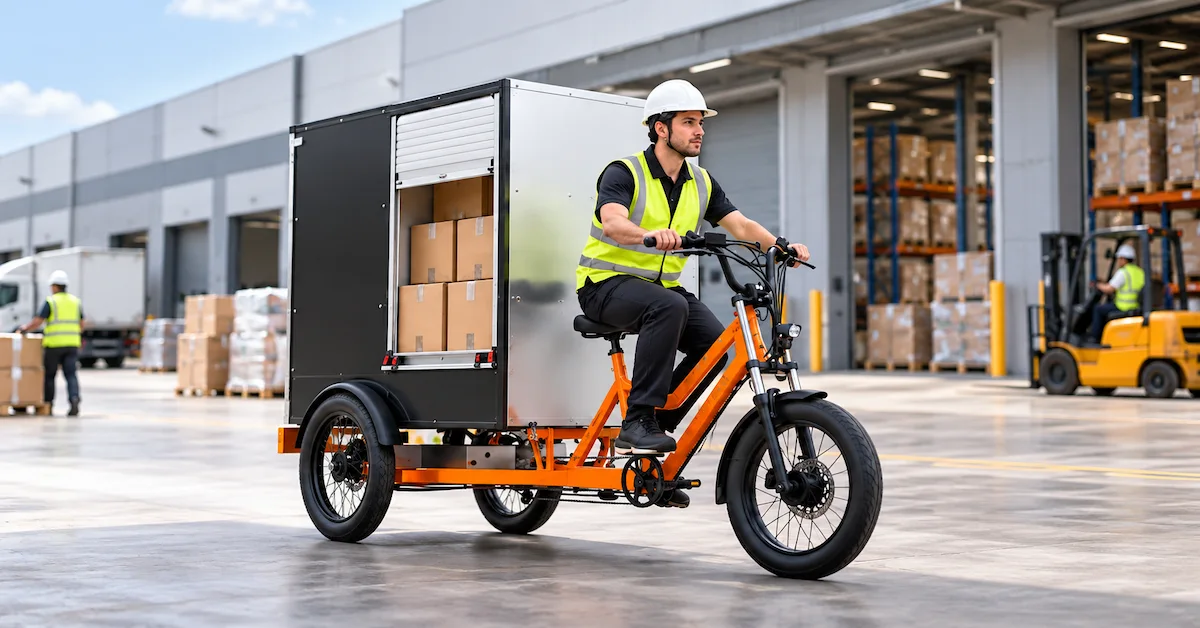
A capable OEM electric tricycle manufacturer may support private labels, coatings, cargo bodies, accessories, motor choices, battery systems and certain frame changes. The engineering effort differs greatly between putting a brand mark on an existing configuration and designing an entirely different wheelbase or passenger-carrying chassis.
A practical OEM process has eight controlled gates:
- Market and mission brief: Confirm territory, vehicle class, users, route, loads and commercial target.
- Platform feasibility: Compare current chassis options and flag required redesign or retesting.
- BOM and drawings: Specify approved component brands, part numbers, interfaces and cargo arrangements.
- Prototype build: Assemble the exact proposed electrical and mechanical configuration.
- Verification tests: Assess the agreed braking, handling, durability, electrical and environmental requirements.
- Sample sign-off: Record the approved vehicle, drawings, labels, packaging, manuals and test evidence.
- Controlled production: Apply agreed inspection and formal engineering-change procedures.
- Pre-shipment acceptance: Review batch records, finished samples, documents and packaging against the frozen specification.
The buyer should own a written process for changes. A different tire, controller, rear axle, cargo box or brake may affect performance or legal classification, even if the product looks nearly identical. Keep revision identifiers visible on the signed BOM and acceptance documents.
JOBO describes integrated engineering, manufacturing and OEM/ODM support on its OEM and ODM page. That makes it reasonable to request a feasibility review for a custom project. However, the availability, minimum order quantity, tooling cost and schedule for any particular modification must be agreed in a project-specific quotation.
Discuss a Private-Label Tricycle Project →
14. Evaluate Lead Time, Production Scale and Supplier Resilience
A quoted delivery date matters only when it is tied to a defined scope. Standard-product production may follow a different schedule from a new frame design, custom cargo body, specialized battery or market-specific approval. Sample timing also depends on whether a buyer requests physical changes to tooling and assembly processes.
JOBO's China manufacturing overview states company-level factory capacity and equipment capabilities. These figures demonstrate the scale described by the company, but they should not be interpreted as a promised quantity of a specific electric tricycle model in a given month. Tricycle chassis, axles and custom cargo bodies may have their own materials, tooling, line allocation or subcontracted component constraints.
Ask suppliers for an estimated timeline divided into engineering confirmation, sample preparation, testing, sample approval, component procurement, batch assembly, inspection, packing and shipping. Each stage should state its dependency and the person responsible for approval. Build a buffer for approvals, redesign and sea-freight uncertainty rather than presenting optimistic factory days as a guaranteed arrival date.
Supplier resilience is also a technical issue. Evaluate component availability, second-source approval procedures, spare battery continuity, controller firmware version control and how replacement parts will be identified after two or three years. A cheaper configuration becomes costly if a proprietary axle or display fails and no compatible replacement is available.
15. Compare Total Cost of Ownership, Not Only Factory Unit Price
The initial price of a commercial electric tricycle is only one part of its lifetime expense. Buyers should model purchase cost, freight, import charges, local inspection, assembly, operator training, energy, tires, brake parts, battery replacement, unscheduled repairs, downtime and residual value. For fleet operations, the cost of a vehicle being unavailable can exceed the cost of an individual component.
Simple TCO framework:
TCO per vehicle = landed purchase cost + planned service + unexpected repairs + energy + battery replacement + downtime cost − estimated residual value.
Then divide the result by expected service kilometers or productive operating hours. Use consistent assumptions for all suppliers. A higher-priced machine with more accessible wear parts may outperform a cheaper one if it can be repaired quickly; the reverse may be true when a complex component is expensive to service locally.
As an illustrative calculation only, suppose a buyer saves $180 per tricycle on an order of 80 units. That creates $14,400 in initial savings. If a component problem later costs an additional $250 per unit in repair labor, replacement parts and business interruption, the fleet incurs $20,000 in added cost. The scenario does not describe JOBO pricing or failure rates; it shows why warranty conditions and spare-parts commitments belong in the RFQ.
Ask for spare-parts pricing together with the complete-bike quotation. Include rear-axle components, brake consumables, controllers, chargers, displays, cables, locks, lights and model-specific cargo body hardware. A well-designed maintenance kit can reduce fleet repair time and protect a distributor's brand reputation.
16. Write an RFQ That Produces Comparable Electric Tricycle Quotations
A vague message asking for “best wholesale electric tricycle price” encourages suppliers to quote different configurations. A structured request for quotation makes engineering and commercial offers easier to compare. It also reduces time lost to clarification after the buyer has already paid for samples.
Electric tricycle OEM RFQ checklist
| RFQ item | Information buyers should supply |
|---|---|
| Buyer profile | Company name, importer/distributor/fleet role, territory |
| Intended application | Cargo, adult utility, property mobility or passenger use |
| Road and regulatory environment | Countries, public-road or closed-site routes, speed restrictions |
| Planned quantities | Pilot quantity, first batch and estimated annual demand |
| Rider and cargo profile | Rider dimensions, average/max operating load, goods dimensions |
| Required geometry | Wheel arrangement, width constraints, turning space, storage |
| Electrical package | Motor limits, battery energy, charging policy, controller features |
| Safety requirements | Brakes, parking, stability trials, visibility, required tests |
| Customization | Color, logo, body module, labels, manuals, packaging |
| Inspection plan | Prototype sign-off, batch acceptance, test documentation |
| Logistics | Delivery destination, Incoterms, packing and battery shipment arrangements |
| Service and warranty | Spare parts, diagnostic access, service training and response process |
Attach a route profile and photographs of representative loading locations where possible. For a fleet application, a short video of a typical unloading operation can expose ergonomic problems that a spreadsheet misses. Explain whether your employees use ramps, elevators, narrow entrances or uneven surfaces, and whether the cargo is secured by straps, boxes or removable modules.
When sending the RFQ through JOBO's contact page, identify whether you want an existing product platform or an engineering feasibility discussion. That lets the manufacturing team review the appropriate model, BOM and development route instead of providing a generic product catalogue response.
Send Your Tricycle Specifications to JOBO →
17. Approve a Representative Pilot Before a Large Order
A successful showroom demonstration is not enough to validate a fleet product. Pilot vehicles should match the intended production BOM and be used under conditions representative of the final project. Define the test plan before the sample arrives so acceptance decisions do not depend on impressions after the fact.
A sensible pilot can include a measured route with the target operating mass, repeated loading and unloading, controlled cornering at defined speeds, stops on relevant surfaces, battery-use recording and a maintenance inspection at agreed intervals. The team should also evaluate operator comfort, parking behavior, access to cargo, battery handling and error reporting. The testing must be conducted safely by qualified personnel on permitted facilities and at appropriate speeds.
Example pilot acceptance scorecard
| Area | Observation | Proposed evidence |
|---|---|---|
| Handling | Steering effort and loaded turn behavior | Standardized route and rider feedback |
| Stability | Response on agreed slopes and maneuvers | Recorded results against engineering criteria |
| Braking | Control and repeatability with representative load | Documented test series |
| Powertrain | Startup, hill response, heat and noise | Operating log and diagnostic review |
| Battery | Energy use and charging workflow | Logged Wh/km and charging observations |
| Frame/cargo body | Loosening, cracks, deformation, attachment wear | Pre/post inspection photographs |
| Daily service | Ability to access consumables and replace parts | Timed service simulation |
| Documentation | Labels, manuals, compliance file completeness | Document checklist with revision numbers |
Pass/fail thresholds must be approved for the specific application. This table is a planning framework, not a substitute for a recognized vehicle test standard or a formal product-safety assessment.
Once the pilot passes, photograph and serialize the approved sample. Save its controller settings, firmware version, cargo-body drawings, critical fastener torque values and packing specification. Buyers should compare mass-production samples to these approved records rather than relying on visual similarity alone.
18. Establish Batch Acceptance and a Long-Term Service Agreement
Even an excellent prototype can lose its value if later batches contain substitutions or inconsistent assembly. Before the first production order, agree which features are inspected on every unit, which are sampled, how defects are categorized and what happens when a batch does not meet the contracted acceptance criteria.
Critical checks commonly include structural damage, brake operation, throttle or assist cut-off where relevant, electrical faults, wheel attachment, steering, cargo fasteners and correct battery/charger matching. Other checks address finish, packaging appearance and optional accessories. Defect severity should reflect realistic safety and functional consequences, with the actual acceptance standard agreed contractually.
Define who approves rework and how it is recorded. If the factory changes a component, request an engineering-change notice identifying the affected serial numbers and the evidence that the new part is acceptable. Set a clear channel for field failures, spare-parts requests and technical escalation.
A good distributor agreement also clarifies parts availability, recommended stocking levels, warranty exclusions, repair documentation, battery shipping limitations and the process for technical bulletins. This is especially important for electric tricycles, where a unique rear axle, suspension component or cargo structure may not be available through ordinary bicycle shops.
19. Why JOBO Is Worth Evaluating for a Custom Electric Tricycle Project
JOBO presents itself as a China-based electric mobility OEM/ODM manufacturer with in-house frame production, assembly operations, engineering support and quality-control facilities. Its official electric tricycle category includes cargo, adult utility, fat-tire and passenger-oriented variants. This is useful for brands that want to assess more than one three-wheel product direction before committing to tooling or a single model family.
For a commercial cargo project, the JB-TDT18L provides a published reference for a 48 V 1000 W powertrain, 48 V 52.5 Ah battery and hydraulic braking with modular cargo formats. For a different duty profile, the JB-TDN39Z-F adult trike and JB-TDN38Z-F fat-tire trike offer separate specifications to evaluate. The 300K-06 pedicab should be treated as a passenger vehicle project with its own engineering and compliance requirements.
JOBO also describes frame production, QC laboratory capabilities and an OEM/ODM development service. These are meaningful questions to discuss in a supplier audit: Which production steps apply to the selected tricycle? Which test reports are available for its current revision? Which parts are standard, and which need redesign? What is the production and inspection plan for the buyer's intended volume?
The most productive first contact is not “Send your lowest price.” It is a request for a specific platform recommendation and a technical quotation that states the market, load, operating route, desired customization, inspection requirements and expected order quantity. That allows both parties to identify potential feasibility or compliance issues before significant development expense is committed.
Frequently Asked Questions About Electric Tricycle Manufacturing
1. What should I look for in an electric tricycle manufacturer?
Look for relevant tricycle platforms, transparent engineering specifications, documented production control, appropriate test evidence, OEM/ODM capabilities and spare-parts support. Ask for a signed BOM, specific gross vehicle weight and cargo limits, brake and stability validation, applicable compliance documents and a defined sample acceptance process. A factory brochure alone cannot establish fitness for your project.
2. Are three-wheel electric tricycles safer than two-wheel e-bikes?
Three wheels can provide standing support at rest, but safety depends on the complete design and operating conditions. Tricycles may tip when cornering or crossing slopes, especially with elevated or off-center loads. Compare intended use, stability test results, braking, operator training and legal requirements rather than assuming a three-wheel vehicle is categorically safer.
3. How much cargo can an electric tricycle carry?
There is no reliable universal payload limit. It depends on the exact frame, wheels, tires, rear axle, brakes, cargo body and approved gross vehicle weight. Ask for a model-specific cargo rating that distinguishes carried goods from rider mass and vehicle mass. Do not interpret a rack rating as certification of the entire tricycle.
4. Can JOBO customize electric cargo tricycles for a private label?
JOBO advertises OEM/ODM manufacturing and modular cargo solutions. Potential project discussions include branding, paint, equipment, cargo-body options and engineering modifications. The feasibility, minimum order quantity, tooling, schedule and testing consequences of any change need confirmation in a formal quotation and approved specification.
5. Why does a cargo electric tricycle need a differential?
For a driven rear axle with two wheels, a differential can allow left and right wheels to rotate at different speeds in a turn, reducing tire scrub in the appropriate configuration. It does not prevent rollover. Confirm the actual axle design and service requirements of the specific model before assuming this equipment is included.
6. Is a 1000 W electric tricycle legal on public roads?
Not automatically. Vehicle classification and road-use permission depend on country or state rules, speed, control system, assisted propulsion and intended use. Some 1000 W tricycles may be treated differently from pedal-assist bicycles. Obtain an applicable legal and compliance review for your market before importing or advertising the vehicle for public-road use.
7. Which battery is better for commercial electric tricycles?
The best battery is the one that meets the duty cycle, charging schedule, vehicle mass and applicable safety requirements. Compare verified watt-hours, serviceability, battery chemistry, charger matching, weight and documentation. A larger nominal capacity does not by itself guarantee a particular range or a lower lifetime cost.
8. What tests should I request before a bulk order?
Agree on braking, turning and static stability evaluation at representative loads, relevant frame or chassis durability testing, electrical safety checks, complete-bike function tests and packaging inspection. The actual test procedure and limits should match the vehicle class, destination market and intended use. Require reports for the exact configuration being purchased.
9. What information is required for an accurate OEM electric tricycle quote?
Send your destination country, product application, rider and cargo mass, route conditions, preferred product model, electrical requirements, desired branding or body modifications, trial quantity, planned bulk quantity, inspection requirements and delivery location. A clear RFQ makes offers easier to compare and reduces costly sample changes.
10. How do I contact JOBO for electric tricycle wholesale or OEM production?
Start with the electric tricycle product category to identify a relevant platform. Then use the JOBO contact form to submit your market, intended use, preferred model, estimated quantity, customization requirements and target schedule. Request a current specification and written quotation before committing to a sample or bulk order.
Conclusion
The best electric tricycle manufacturer is not simply the supplier with the highest advertised motor power, largest battery or lowest unit price. It is the manufacturing partner that can explain and document how an approved three-wheel vehicle carries its intended load, behaves during turning and braking, meets relevant market requirements, and remains consistent from prototype to repeat production. For B2B buyers, the essential sequence is straightforward: define the route and vehicle class, compare suitable platforms, verify critical engineering claims, approve a representative sample, freeze the BOM and establish measurable batch and after-sales requirements.
JOBO offers distinct electric tricycle product platforms along with OEM/ODM manufacturing support, frame production capabilities and quality-control facilities. Importers, private-label brands, distributors and fleet operators can use those capabilities as the basis for a project-specific technical discussion.and include your destination market, permitted vehicle class, load profile, preferred platform and estimated order volume so the team can assess the appropriate next steps.