A drawing of an attractive electric bike is not yet a product specification. A supplier quotation is not yet proof that the same bicycle can be built 500 times. For a brand launching a commuter range—or an operator buying delivery bikes for demanding daily shifts—the hard part is getting the intended rider, hardware, legal classification, test evidence and production instructions to agree with one another.
That is why choosing a custom electric bike manufacturer should begin with the route and the rider, not with a catalog photograph or an unusually low unit price. A useful factory relationship turns commercial requirements into a controlled bill of materials (BOM), an approved sample, evidence appropriate to the destination market and a repeatable supply program.
This article follows the practical decisions a buyer makes from the first brief to the first production shipment. It also explains where JOBO's published manufacturing capabilities may fit, which details still require project-specific confirmation, and exactly what to include when requesting an OEM quotation.
Quick Answer: What Should You Look for in a Custom Electric Bike Manufacturer?
A capable custom e-bike manufacturer should help you select an appropriate platform, adapt the frame and components for real use, validate the prototype, document safety and compliance requirements, and reproduce the approved specification during bulk manufacturing. Prioritize suppliers that can show how their frame production, electronics integration, incoming inspection, finished-bike testing and spare-parts arrangements work. For a first launch, customizing a proven city, folding or cargo platform is often less risky than commissioning a completely new frame. Deep ODM development becomes more attractive when distinctive geometry or specialized fleet requirements justify the engineering time, tooling and additional testing.
The right choice is not automatically the factory with the most models, the highest claimed capacity or the cheapest quote. It is the manufacturer that can demonstrate a credible route from your market brief to a bike that dealers or technicians can maintain after delivery.
1. Start With the Buyer, the Use Case and the Commercial Risk
An established European distributor, a US direct-to-consumer startup and a food-delivery fleet may all request "custom electric bikes," but they are buying different outcomes. The distributor needs stable repeat orders and dealer-ready documentation. The startup needs a differentiated product without tying up excessive cash in tooling. The fleet needs predictable uptime, replaceable components and a reasonable operating cost per kilometer.
Write a one-page project brief before you contact factories. Identify the country of sale, target consumer price band, expected order volume, target rider dimensions, typical journey, terrain, weather exposure, storage constraints and intended service model. Separate essential features from attractive options. A rear rack that safely handles your planned cargo is essential for delivery; a particular display animation probably is not.
An effective brief also names the decision-makers. The purchasing team considers unit price and shipping. Product management considers ride feel and market differentiation. Engineering reviews component compatibility. Compliance staff request model-specific evidence. After-sales teams need replacement parts and diagnostic procedures. If a supplier talks only to procurement, expensive problems can remain invisible until the first container arrives.
Best-fit buyer groups: private-label e-bike brands, international importers, wholesale distributors, specialist bicycle retailers, delivery operators, bicycle-sharing platforms, tourism businesses and product developers seeking custom frames. For companies needing only a few consumer bicycles with no branding or service responsibilities, a retail purchasing channel is usually more appropriate than OEM manufacturing.
2. Choose the Right Customization Level: Private Label, OEM or ODM
Not every project needs a new frame. In fact, requesting a ground-up design before validating demand can increase cost and extend development without making the product more valuable to a customer. Distinguish the three practical routes below.
| Development route | Typical changes | Advantages | Important constraints | Best fit |
|---|---|---|---|---|
| Private label on an existing platform | Logo, frame color, decals, packaging, manuals and a limited accessory package | Faster sampling, less engineering exposure, easier product validation | Similar frame may be sold in other channels; component change options may be limited | New brands, market tests and distributors |
| Configured OEM platform | Existing frame with agreed battery, motor, controls, brakes, wheels, rack and finishing options | More specific performance and brand positioning without fully new geometry | Changed combinations can require new validation, sourcing minimums and updated documents | Growing brands, market-specific products and fleets |
| Deeper ODM / new platform | New geometry, frame tooling, integrated mounting solutions, electronics interfaces or distinctive industrial design | Stronger differentiation and task-specific engineering | Higher development investment, more prototype cycles, intellectual-property and tooling decisions | Established brands or specialized commercial programs |
Ask the manufacturer to place each requested change into one of three categories: already proven, feasible but requiring validation, or requiring fresh engineering and tooling. That single classification often tells you more about project risk than a generic promise of "full customization."
JOBO describes both platform-based OEM and product-development-oriented ODM work on its OEM and ODM service page.Before confirming scope, buyers should agree on drawings, ownership of custom tooling, confidentiality provisions, change-control procedures and what happens if a nominated component becomes unavailable.
3. Match the Bike Platform to the Work It Must Do
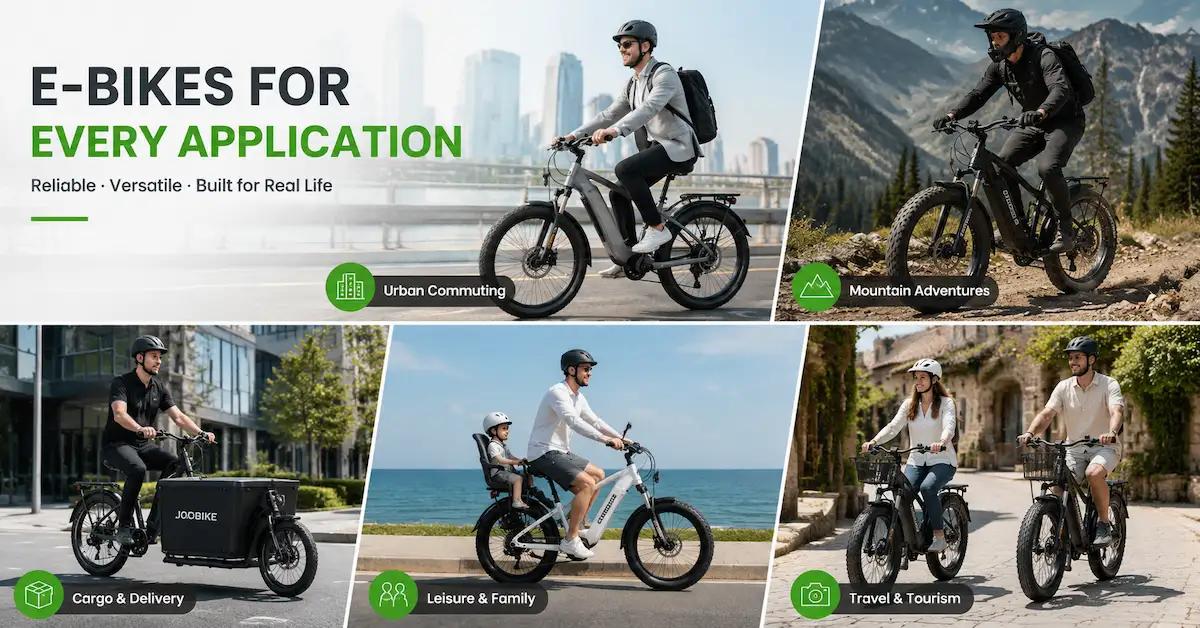
A catalog category should represent a practical riding task. Two bikes using the same motor rating can perform very differently because of tire width, rider position, gearing, battery placement, cargo load and assistance control. Compare platforms on application first; compare individual model specifications second.
| Platform | Typical buyers and environments | Specification priorities | Common mistake |
|---|---|---|---|
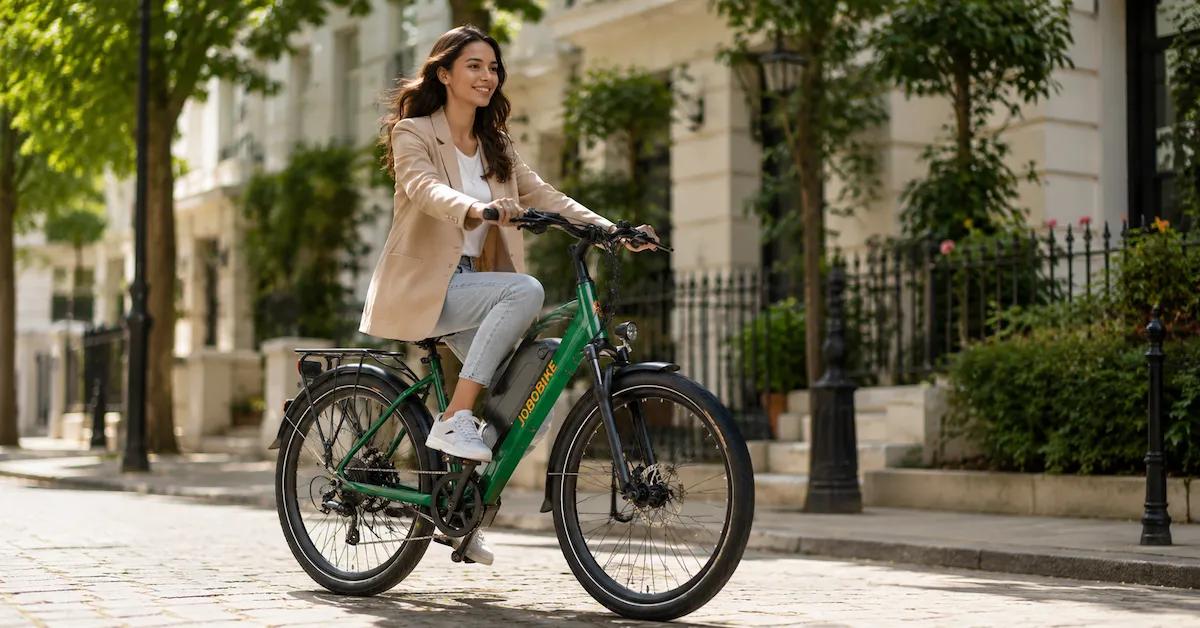
| City and commuter e-bikes | Urban brands, daily commuters, corporate programs; paved streets and mixed-weather routes | Comfort, step-through access, lighting, fenders, serviceable drivetrain, local power limit | Choosing an attractive frame without testing rider fit or wet-weather maintenance |
| Cargo and delivery e-bikes | Courier companies, food delivery, parcel services; stop-start city operation | Verified load rating, braking, rack structure, puncture resistance, battery logistics | Estimating carrying ability from the appearance of a rack |
| Folding e-bikes | Apartment commuters, RV retailers, travelers; compact storage and transport | Folded envelope, hinge security, complete mass, carrying points, cable routing | Marketing portability without measuring weight or folded dimensions |
| Mountain and off-road e-bikes | Outdoor dealers, farm and resort operators; rough or unpaved surfaces | Geometry, suspension, traction, impact protection, brake capacity, appropriate classification | Assuming high power or fat tires automatically mean safe or road-legal operation |
| Shared electric bikes | Bike-sharing, tourism and campus fleet integrators; multiple daily users | Robust locks, service access, battery swapping, IoT integration and traceability | Specifying app functions before deciding who maintains batteries and locks |
| Electric tricycles | Utility operators and specialized distributors; lower-speed functional transport | Stability, parking width, turning behavior, load distribution, legal vehicle category | Treating a three-wheel layout as automatically safer in every maneuver |
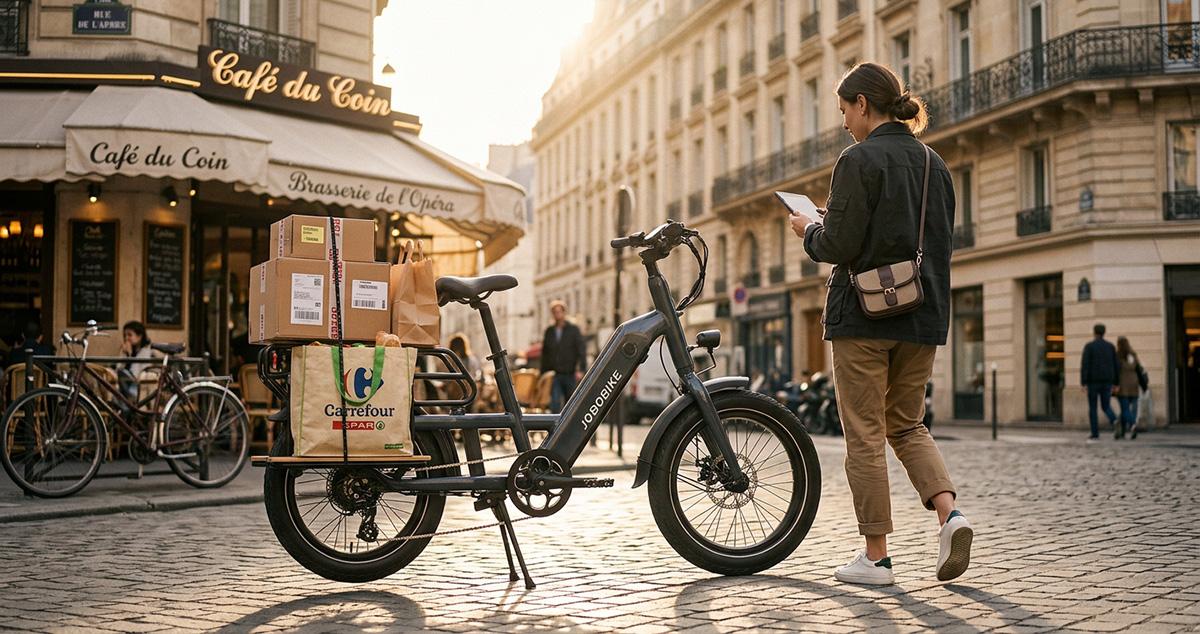
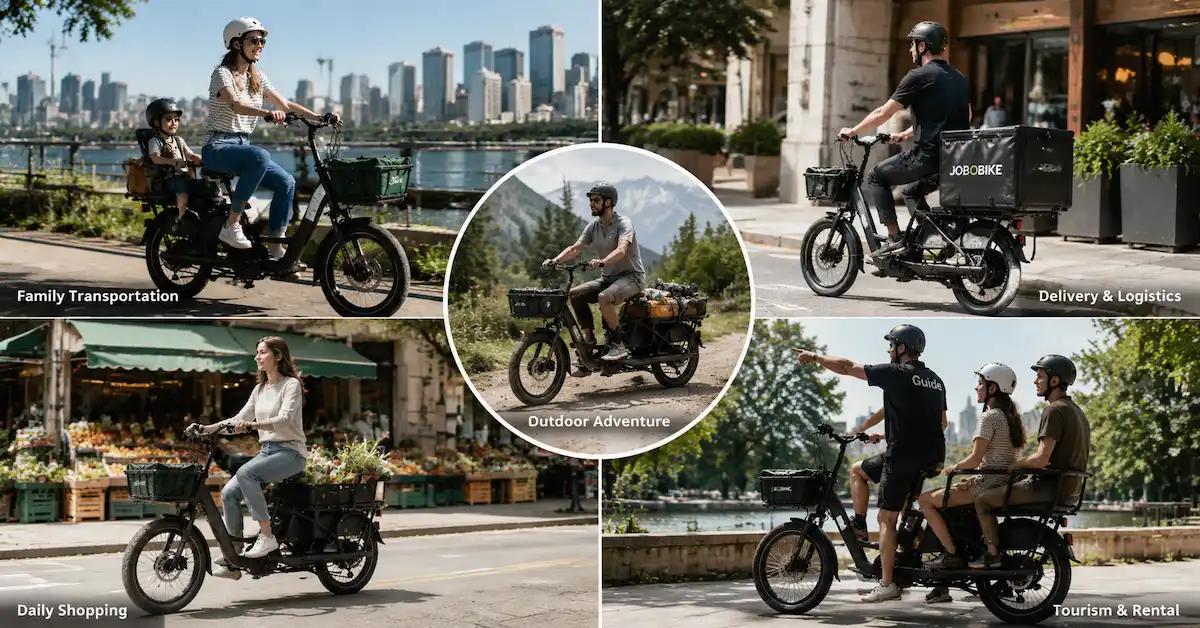
City and delivery programs are particularly different. A city customer notices comfort and clean appearance. A delivery operator notices the minutes lost replacing a tire, unloading a battery or repairing a brake. A cargo frame that is convenient when empty may handle poorly under a full operational load. Test with the actual intended payload, not just a showroom demonstration.
Beyond complete bicycles, JOBO lists road-oriented bikes, kids' models, electric motorcycles and custom e-bike frames. Those categories can involve materially different product-safety or road-use classifications. Do not copy a commuter-bike compliance statement into a motorcycle or child-oriented product listing.
For the full range of available platforms, start with JOBO's electric bike product catalog, then request a configuration sheet for the exact model and destination market.
4. Define the Destination Market Before You Choose Motor Power
A product can look perfect, ride well and still be unsaleable in its intended category. Vehicle classification, electrical safety, labeling and permitted public-road use depend on where the bike will be offered and how the assist system operates. Regulatory planning must happen before the factory freezes the BOM.
European Union: A commonly used pedal-assist bicycle boundary is an auxiliary electric motor rated at no more than 250 W continuous power with assistance cutting off when pedaling stops and before 25 km/h. This describes a relevant EPAC exemption in Regulation (EU) No 168/2013; it does not mean every 250 W e-bike is automatically compliant with every other applicable requirement. EN 15194 and applicable EU conformity rules must be considered for the specific product, including the documents supporting any CE marking. Ask for the correct edition, report scope, technical file and market-specific instructions.
United States: The federal consumer-product definition in 15 U.S.C. § 2085 covers certain two- or three-wheel bicycles with fully operable pedals, motors of less than 750 W and a motor-only speed below 20 mph under specified conditions. Bicycle mechanical requirements under 16 CFR Part 1512 are relevant. State and local rules for classes, throttles, trails, age restrictions and public-road use can differ. UL 2849 addresses the electrical system, while related battery and transport documentation address different risks; no single mark substitutes for all requirements.
Other markets: Requirements for Australia, the United Kingdom, Canada and other destinations may diverge. Create a country-by-country approval list when selling across borders. Do not assume that changing a speed limit in software will fully resolve motor, labeling, battery or vehicle-category issues.
Critical verification rule: Request certificates and test reports that identify the exact model, electrical configuration, battery, controller and relevant revision. A company-wide statement about certifications does not validate an altered SKU. Equally, a 350 W or 1000 W sample is not automatically a road-compliant version of an EU EPAC. Treat high-power or electric-motorcycle proposals as separate classification decisions.
5. Build a Specification Sheet That Can Survive Mass Production
The most useful OEM RFQ is not the longest list of attractive features. It is a specification whose requirements are measurable, negotiable and traceable through sample approval. The table below shows what a buyer should define and what evidence should be requested in return.
| Specification item | Define before quotation | Evidence or acceptance check |
|---|---|---|
| Target market and vehicle class | Countries, intended public-road/off-road use, pedal-assist or throttle behavior | Applicable standards matrix and intended legal classification |
| Rider and duty cycle | Height/fit range, journey length, gradients, stops, operating hours | Geometry drawing and representative loaded ride test |
| Frame and load | Geometry, material, mounting points, rider/payload limits | Dimension drawing, stated load limit and relevant test summary |
| Motor and sensor | Continuous rating, peak/torque disclosure, drive layout, cadence or torque sensor | Actual motor and controller part numbers, calibrated settings |
| Battery and charger | Nominal V, Ah and Wh, cells, BMS, charge interface, spare pack needs | Pack drawings, identifiers, electrical safety and shipping records |
| Brakes, tires and wheels | Rotor size/type, braking under load, puncture resistance, service parts | Approved component list and acceptance test conditions |
| Software and display | Assistance modes, cutoff rules, error codes, localization, optional IoT | Firmware version, functional checks and update procedure |
| Finish and brand assets | Color reference, decals, logo placements, retail carton and labels | Signed artwork proof and golden sample photographs |
| Spares and after-sales | Wear parts, battery replacements, warranty handling, service manuals | Parts list, traceability method and agreed supply terms |
| Commercial terms | Trial quantity, scaling forecast, Incoterms, packaging, inspection | Itemized quotation, milestone plan and approved BOM revision |
An OEM specification is stronger when it uses tolerances and acceptance methods. Instead of saying "long range," define a representative loop, target load, surface, ambient conditions, tire pressure and assistance mode. Instead of saying "premium paint," agree on a color reference and a practical visual-inspection standard. Rather than writing "strong rack," request a declared loading limit and the verification basis.
A signed golden sample plus an approved BOM is particularly valuable: together they describe the physical bike and its underlying component content. Neither should be replaced by a marketing image once production starts.
6. Motor, Battery and Drivetrain: Optimize for the Rider, Not the Headline Number
The easiest way to make a poor purchasing decision is to compare two e-bikes by motor wattage alone. The rider feels starting assistance, climbing behavior, cadence response, noise and controllability; the fleet owner feels maintenance time and replacement cost. Wheel size, gearing, controller tuning and load can change the result even if the motor data sheets appear similar.
Hub drive versus mid-drive: A hub motor may provide a straightforward, cost-conscious architecture for many city platforms. A mid-drive uses the bicycle drivetrain and can be attractive for varying gradients or higher-utilization applications, but it adds integration and drivetrain-wear considerations. Ask how each candidate behaves on your steepest expected route, at your expected load, and under local power/speed rules. A well-matched lower-rated system may be more useful than a poorly controlled higher-rated one.
Cadence sensor versus torque sensor: Cadence systems typically detect pedal rotation, while torque sensors measure rider input. Torque-sensitive assistance can provide more proportional control, which some commuter and cargo users prefer. However, the implementation matters: calibration, response delay and controller software should be checked on the actual sample. Sensor names alone do not predict riding quality.
Battery energy and realistic range: Battery energy in watt-hours is approximately nominal voltage multiplied by capacity in amp-hours. A nominal 48 V, 15 Ah pack contains about 720 Wh of labeled energy. It does not mean a fixed number of kilometers. Real range depends on rider mass, cargo, acceleration frequency, gradients, temperature, tire pressure, assistance level and usable battery capacity. For fleet planning, estimate energy consumption from representative routes and retain a margin for aging and operational variation.
Electrical integration: Check battery mounting, connector sealing, charger compatibility, BMS fault behavior, cable strain relief, thermal exposure and access for diagnostics. If a brand wants an alternate cell source or higher-capacity pack, confirm fit, current handling, shipping paperwork and whether the change affects previously issued test evidence.
A useful comparison therefore includes Wh, motor and controller identification, estimated service intervals, parts availability and repeatable ride tests—not merely "powerful motor" and "up to" range claims.
7. Frame Engineering, Geometry and Finish Determine Long-Term Usability
Custom frame manufacturing matters when a buyer needs something a standard platform cannot provide: lower step-over height, a stable front-load arrangement, a different battery location, folding geometry or reinforced attachment points. Design work must account for more than appearance. Frame geometry affects handling, comfort, load distribution, ground clearance and whether wires or accessories can be serviced.
JOBO describes dedicated frame manufacturing that includes CNC precision cutting, robotic welding, heat treatment, dimensional checking and coating processes on its frame factory page. That is relevant because custom projects require the factory to coordinate frame geometry with wheel, brake, motor, battery and rack interfaces. However, buyers should request documentation for their specific frame design rather than assume a published facility capability proves performance of every new design.
For an aluminum frame, discuss material grade, joined-tube geometry, weld quality, appropriate heat-treatment steps where used, and the conditions of structural testing. Ask for drawings showing critical mounting dimensions and tolerances. A heavier-looking tube is not necessarily a stronger design, and claims about fatigue resistance require test context. For painted frames, confirm surface preparation, film finish, color consistency and how cosmetic defects will be assessed at incoming or final inspection.
On folding platforms, the hinge and locking system deserve their own validation plan. On cargo platforms, rack attachment, load path and loaded braking deserve attention. On shared bikes, the routing and protection of cables, locks and connectors may matter more than an unusual frame silhouette. Each frame should be evaluated according to its use case, not a universal one-size-fits-all test assumption.
8. Factory Due Diligence: Ask for Production Evidence, Not Adjectives
A manufacturer's website is a useful starting point; it should not be the last step of supplier verification. Factory scale, patents and certifications can help you shortlist candidates, but a competent buyer also checks the production route for the exact proposed model.
Ask who owns the frame drawings, who manufactures the frame, where the final assembly occurs and which major components come from nominated suppliers. Request a sample BOM with manufacturer and part number for the battery, controller, display, motor, brakes and drivetrain. Check whether the factory has a controlled procedure for changing any of those parts. If an equivalent replacement is proposed, an engineering review is more credible than "same quality" written in an email.
JOBO's China manufacturing page publicly describes a 50,000-square-meter facility, three assembly lines, an annual capacity exceeding 300,000 units and an engineering team of more than 35 people. Its OEM/ODM overview also lists China and Poland operations and more than 40 patents. Those are company-reported capabilities, useful for initial assessment but not substitutes for the capacity allocation, specification approval or supplier records associated with your order.
For companies selling into Europe, JOBO's Poland operation may be relevant to assembly planning, local service or stock availability. However, production or assembly in Poland does not automatically establish customs origin or eliminate any particular duty. Tariff treatment depends on the specific product, manufacturing processes, applicable origin rules and current trade measures; obtain qualified customs advice for the transaction.
9. Turn Quality Control Into a Buyer-Approved Test Plan
Quality should be visible before shipment. A useful control plan separates incoming parts inspection, in-process checks and completed-bike release tests. It also defines which tests are routine and which are sample-based, because destructive structural testing cannot realistically be performed on every saleable unit.
Incoming quality control (IQC) should identify major components and confirm that critical parts match approved suppliers, versions and visible condition. Batteries and chargers should be checked against their identifiers; frames should have relevant dimensional and finish checks; tires and brakes should match the BOM.
In-process quality control (IPQC) can verify torque-controlled fastening, correct cable routing, brake alignment, firmware settings and assembly records at defined points. Engineering changes should be traceable so that the importer knows which hardware configuration shipped in which batch.
Final quality control (FQC) should confirm functional assistance and cutoff behavior, braking, lights, display faults, noise, appearance, labeling, accessories and packing against agreed acceptance criteria. For batches, discuss sampling methods and escalation rules for defects, plus whether pre-shipment inspection may be performed by the buyer or an agreed third party.
JOBO's QC laboratory description includes equipment for frame fatigue, brake-mount fatigue, complete-bike evaluations, battery thermal shock and motor dynamometer testing. These are relevant capabilities to ask about. For each requested test, obtain its protocol, sample quantity, acceptance criteria and report—not simply a photo of a machine.
Most importantly, request a corrective-action process. When a defect appears during a pilot, who investigates it? Who approves the countermeasure? How is the change documented before scale-up? A factory's response to one discovered problem can be more revealing than a brochure listing dozens of inspection stations.
10. The Eight-Stage OEM Production Route, From Brief to Shipment
A predictable project has decision gates. The following sequence combines JOBO's published OEM flow with procurement controls that buyers should insist on documenting.
Stage 1 — Requirements and market brief. Agree on rider, environment, price position, destination regulations, initial quantity and growth forecast. Deliverable: an approved project brief and responsibility matrix. If the brief is still vague, do not commission a new frame.
Stage 2 — Platform and BOM review. Shortlist an existing city, cargo or folding model, then identify proposed motor, battery, controls, brakes, lighting, tires, accessories and packaging. Deliverable: a revision-controlled preliminary BOM and a list of items requiring new testing.
Stage 3 — Engineering and industrial design. Confirm frame interfaces, geometry, color, graphics, battery location, cable routing and manufacturability. Deliverable: approved drawings and design-change log. Determine who owns tooling and CAD data before making substantial development payments.
Stage 4 — Frame and finish preparation. The supplier develops any required frame work, coatings and fixtures. Deliverable: pilot parts meeting dimensional and finish requirements. For existing platforms, this stage may be simpler than for a completely new geometry.
Stage 5 — Prototype and validation. Test a complete bike under representative load and riding conditions. Check mechanical, electrical and interface issues; record every change request. Deliverable: a test summary, an issue list and evidence supporting relevant compliance decisions.
Stage 6 — Golden sample and specification lock. Sign off the bike, BOM, firmware, display settings, accessories, labels, manuals and packing. Deliverable: a golden sample or controlled sample record, final BOM, acceptance plan and written change procedure. No uncontrolled substitutions after this gate.
Stage 7 — Controlled bulk manufacturing. Execute incoming, line and final inspections according to the approved control plan. Deliverable: production and batch traceability, defect reporting and any agreed inspection records. Initial pilot output should be checked before accelerating the line.
Stage 8 — Shipment and after-sales support. Agree on shipping terms, dangerous-goods documents, serial-number records, packing inspection and spare-part kits. Deliverable: complete shipping set and named after-sales escalation contacts. The program is not finished when a container departs; it succeeds when the first customer repairs are manageable.
JOBO publishes a comparable sequence on its custom delivery e-bike product page. The stages are useful as a planning baseline; exact sample lead times, approval gates and production dates need confirmation for the actual project.
11. How to Compare a Custom Electric Bike Manufacturer's Price and MOQ
A quote only becomes comparable when two manufacturers price the same agreed specification and commercial scope. One vendor may include a branded carton, battery test documentation and spare parts; another may quote the bike alone. A cheap headline unit price can become expensive after compliance work, late component changes, freight, import charges and early warranty returns.
Use an itemized quote that separates bike BOM, finishing and branding, engineering or tooling, prototype samples, testing/documentation, packaging, freight and after-sales provisions. Confirm the Incoterm, currency, payment milestones, validity period and whether substitution of a nominated component requires written approval.
Minimum order quantity (MOQ) depends on what is being customized. Logo and packaging changes on a mature model may need a different quantity from unique frame tooling, custom battery housings or special paint processes. Some JOBO individual product pages mention a standard customized-order MOQ, but it should not be generalized to every bike or region. Request the MOQ against the exact SKU, component combination and shipment plan.
Also distinguish three timelines: engineering/sample lead time, component procurement lead time and actual assembly/shipping lead time. Ask for a dated milestone schedule with dependencies, rather than accepting an unconditional "fast delivery" claim. Inventory held in Europe can shorten certain fulfillment scenarios, but only for models, quantities and configurations actually available.
For fleets and distributors, consider total landed and ownership cost: purchase price plus duties, freight, storage, commissioning, batteries, routine wear parts, technician labor, expected downtime, returns and warranty support. This is often a better business metric than factory gate price alone. When reporting any percentage savings, use your own verified project numbers—not assumptions taken from promotional material.
12. A Reality Check Using Published JOBO Model Specifications
Product-page specifications are useful reference points, but they are not promises that every customized variant will share identical hardware or test results. Use the examples below to start technical discussions, then request the latest spec sheet.
City commuter example: JOBO's City Commuter Electric Bike page lists a 6061 aluminum frame, 27.5 × 2.35-inch tires, hydraulic disc brakes, a nominal 36 V/15 Ah battery and a 36 V/350 W motor for a published configuration. That is a starting design reference, not evidence that the same motor configuration meets the EU 250 W EPAC threshold. A market-specific build may need different hardware and supporting documents.
Commercial delivery example: The custom delivery e-bike platform is presented with a 48 V/350 W Bafang mid-drive, 48 V/15 Ah battery, 20 × 3.0-inch tires and a delivery-oriented rear rack. The product page discusses options such as dual batteries and IoT-ready integrations. Before purchasing for a fleet, request an actual load rating, defined battery configuration, repair-access review and range test with your route conditions. The page's published range figure should not be treated as a guaranteed fleet result.
Compact travel example: JOBO's long-range folding e-bike illustrates a folding category. A range estimate is not enough to approve a travel SKU: measure the folded volume and complete weight, inspect hinge operation repeatedly and confirm safe battery removal and packaging for the intended channel.
These examples show the practical value of working from documented platform specifications. They also show why the purchasing decision should remain conditional until an exact sample is tested.
13. Design a Pilot That Produces Useful Data
Launching directly into a large shipment can hide defects behind attractive early samples. A controlled pilot should answer a limited number of important questions before the brand commits to scale. Choose representative riders, realistic loads and routes, and the service team that will actually maintain the bikes. Record energy consumption, charging behavior, brake adjustment frequency, handling concerns, component faults, cosmetic problems and packaging damage.
For city bikes, prioritize rider fit, wet-weather practicality and consistency of assist behavior. For cargo bikes, log stop-start duty cycles, braking under load, rack/accessory movement and puncture-related downtime. For folding products, add hinge/lock inspection, repeated folded handling and storage compatibility. For shared bikes, include lock and connectivity failures, abuse resistance and maintenance access.
Agree on thresholds before the pilot starts: what is a critical safety failure, which issues require design revision, and which cosmetic deviations are acceptable? A useful pilot report distinguishes isolated user preference from a repeatable defect. It should also record the tested hardware and firmware revisions so that the bulk order reproduces the improved version, not an earlier prototype.
No supplier can credibly promise zero field failures.What matters is whether a failure is detected, understood, corrected and prevented from silently recurring in the next batch.
14. Prepare an RFQ That Makes a Manufacturer's Reply Actionable
Many sourcing inquiries ask, "Please send your best price for 500 electric bikes." That message leaves critical variables unresolved, so the buyer receives numbers that are difficult to compare. A serious request for quotation should give the factory enough information to recommend a platform and identify any outstanding technical risks.
Copy-ready OEM RFQ brief:
Project: Private-label city commuter / delivery fleet / folding retail bicycle (select one). Destination market: country and target vehicle category. User and route: rider height range, expected total system load, gradients, daily kilometers, road surface and operating temperature. Preferred platform: JOBO reference model or required geometry. Target configuration: motor and assistance behavior, battery Wh, charger, brake type, tire format, display, lighting, rack and accessory requirements. Branding: logo artwork, finish, carton, manual and labels. Order plan: sample quantity, pilot quantity, expected 12-month volume and target launch date. Documentation: requested standard reports, battery transport papers, product labeling, quality records and inspection access. Commercial scope: desired Incoterm, spare-parts support, warranty expectations, tooling ownership and quotation breakdown.
Ask the manufacturer to return a compliance assumptions list and a proposed milestone plan together with pricing. Encourage it to mark requirements as confirmed, requires a sample, requires separate testing or not currently feasible. Honest feasibility flags are valuable; vague blanket approvals are not.
When contacting JOBO, the official sales and project inquiry page is the appropriate place to send that brief. If you do not yet have a completed specification, share the target use case and destination market and request the closest starting platform. This creates a productive technical conversation without implying that all configurations are immediately available.
15. Five Sourcing Mistakes That Create Expensive Rework
Mistake 1: Treating every high-power bicycle as road legal. Some off-road, cargo and sporty models advertise greater output than the common EU EPAC boundary. Confirm vehicle class first; discuss hardware restrictions, testing and labeling before adopting sales claims.
Mistake 2: Comparing claimed range without matching conditions. A light test rider on flat pavement is not a courier carrying a heavy load in cold weather. Convert advertised numbers into a verified duty-cycle plan and check how battery aging affects available reserve.
Mistake 3: Approving a sample without freezing the BOM. A sample with one brake or battery pack is not an acceptable reference if production changes to another part without disclosure. Require revision numbers and written approval for substitutions that could affect performance or compliance.
Mistake 4: Ignoring service costs. An uncommon display, battery connector or proprietary rack may look impressive on a launch page but become a bottleneck for repairs. Confirm dealer tools, spare-part lead times, troubleshooting information and component continuity.
Mistake 5: Treating local assembly as an automatic tariff solution. Factory location, customs origin and anti-circumvention rules are not interchangeable. Assess each import route with the relevant documentation and qualified customs expertise rather than relying on a generic claimed percentage saving.
A disciplined supplier qualification does not remove every risk, but it reduces the likelihood that ordinary engineering questions become emergency service and cash-flow problems after launch.
16. Frequently Asked Questions for Custom Electric Bike Buyers
What does a custom electric bike manufacturer actually do?
A custom electric bike manufacturer helps a buyer develop and manufacture an electric bicycle to an agreed market and product specification. Work may include an existing platform with private-label branding, selected component changes, frame engineering, prototypes, tests, production, packaging and delivery planning. The value is not just putting a logo on a bicycle; it is managing a defined product through an accountable manufacturing process.
What is the difference between OEM and ODM electric bikes?
OEM typically emphasizes manufacturing a product to an agreed customer specification, often using a proven factory platform. ODM involves deeper design or engineering contributions from the manufacturer, such as geometry changes or a new integrated bike concept. Contractual definitions vary, so clarify deliverables, tooling, intellectual-property rights and approval responsibilities before placing an order. The distinction matters most when something changes after sample approval.
Can I launch a private-label e-bike brand without designing a new frame?
Yes. For many launches, an existing city, folding or cargo frame with selected components, branding and packaging is a sensible starting point. It allows the buyer to gather customer and service feedback before paying for bespoke frame engineering. Ask which changes are already validated and which require fresh tests or additional parts procurement. Differentiation can come from configuration, service experience and honest market positioning as well as frame appearance.
What is the MOQ for a custom electric bike order?
There is no universal MOQ across all custom e-bikes. The required quantity depends on the base model, branding process, paint choice, special components and whether new tooling is involved. An individual product page may quote a standard minimum for that configuration, but your actual terms should appear in a model-specific written quotation. Ask separately about sample orders, pilot quantities, color minimums, ongoing reorder volumes and spare-parts commitments.
How do I estimate custom e-bike manufacturing costs?
Start with a controlled BOM, then add frame finishing, assembly, accessories, branding, engineering or tooling, samples, compliance testing, packaging and logistics. Compare quotations on matching Incoterms and include import costs, inventory exposure, replacement parts and expected warranty work. Without a confirmed specification, price ranges are often misleading. A transparent itemized quotation is more useful than a single attractive number that omits important commercial responsibilities.
How long does custom electric bike development take?
Timing depends on the platform, engineering changes, component availability, tooling, sample iterations, testing, production allocation and shipping method. A branded mature model may take a different path from a wholly new cargo frame. Ask for separate milestones for design, prototypes, validation, golden-sample approval, parts procurement and assembly. Do not treat an advertised warehouse delivery window as the timeline for a newly engineered OEM program.
Can a 350 W or 1000 W JOBO electric bike be sold as an EU EPAC?
Not automatically. The relevant common EU EPAC exemption refers to a motor of no more than 250 W maximum continuous rated power and assistance that ends before 25 km/h, subject to additional product obligations. A model advertised with 350 W or 1000 W may need another configuration or another legal classification. Request market-specific engineering, testing and compliance documentation for the exact version to be supplied, rather than relying on the category name or a software setting alone.
What documents should an importer request for the battery and electrical system?
Request the battery model and supplier identification, electrical safety evidence appropriate to the market, charger specifications, battery-management information and the applicable lithium battery UN 38.3 test summary for transport. For US projects, ask whether relevant UL 2849 electrical-system documentation is available for the particular configuration when needed. For EU projects, ask for the appropriate conformity documentation. Review document scope and version; a test on a different battery or controller is not automatically transferable.
How do I know the mass-produced bikes will match the approved sample?
Approve a physical golden sample or equivalent controlled reference together with a signed BOM, drawings, firmware version, finish reference, labels and packing instructions. Agree on incoming, in-process and final inspection checkpoints, plus defect definitions and a documented change-approval process. During the first production lot, verify key components and operating behavior against those records. Consistency is a management system, not a promise printed on a quotation.
Does JOBO's Poland operation mean zero import duties or guaranteed rapid delivery?
No universal conclusion follows from the location alone. JOBO publicly describes Poland-based assembly, local support and distribution capabilities, which may be relevant to some EU supply arrangements.Actual availability depends on model and stock. Import duties, origin status and any anti-dumping implications depend on the exact goods, manufacturing operations and applicable customs law. Obtain a transaction-specific assessment and a written delivery commitment before budgeting savings or promising dates to customers.
Conclusion
Selecting a custom electric bike manufacturer is ultimately about controlling the gap between the bike your customers need and the bike that arrives in each shipment. A strong OEM program starts with a precise use case, chooses the least risky development route, locks the technical specification, validates a real prototype, checks the destination-market evidence and gives the production team unambiguous instructions.
For brands, distributors and fleet operators, JOBO offers a relevant combination of electric bike product platforms, OEM/ODM development support, in-house frame capabilities and documented QC resources. The best next step is not to request a generic catalog price. It is to send a clear brief identifying your country, platform, operating conditions, intended configuration, volume and validation requirements so the team can confirm a realistic engineering and production plan.