Behind every market-ready electric bicycle is a coordinated manufacturing network that connects engineering, frame production, electrical systems, mechanical components, assembly, testing, branding, packaging, and international delivery.
An experienced electric bike manufacturer does more than purchase parts and assemble complete bikes. It controls how different systems work together, how specifications remain consistent between production batches, and how the finished product meets the commercial requirements of brands, distributors, importers, and mobility operators.
In 2026, this coordinated structure is becoming increasingly important. Buyers are paying closer attention to electrical-system safety, battery documentation, component traceability, OEM confidentiality, product consistency, and regional compliance—not only the appearance or unit price of the bicycle. UL 2849, for example, evaluates the electrical drivetrain, battery, and charger as a combined e-bike system rather than treating them as unrelated parts.
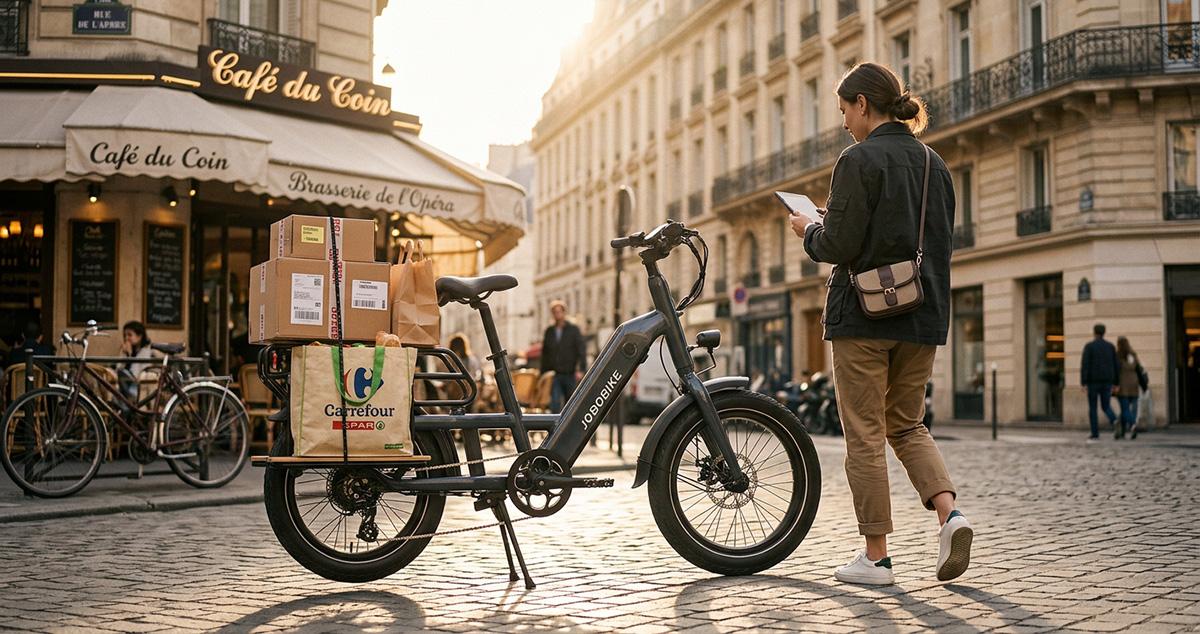
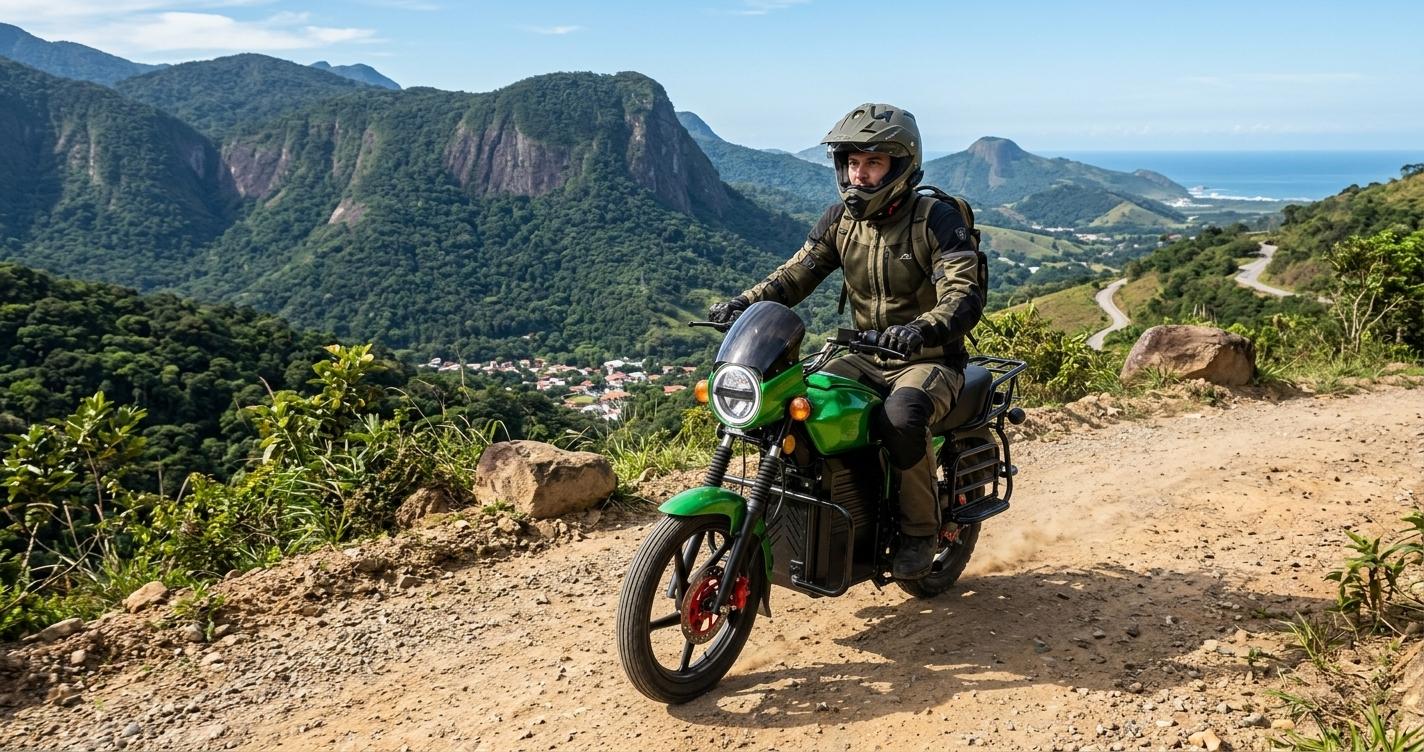
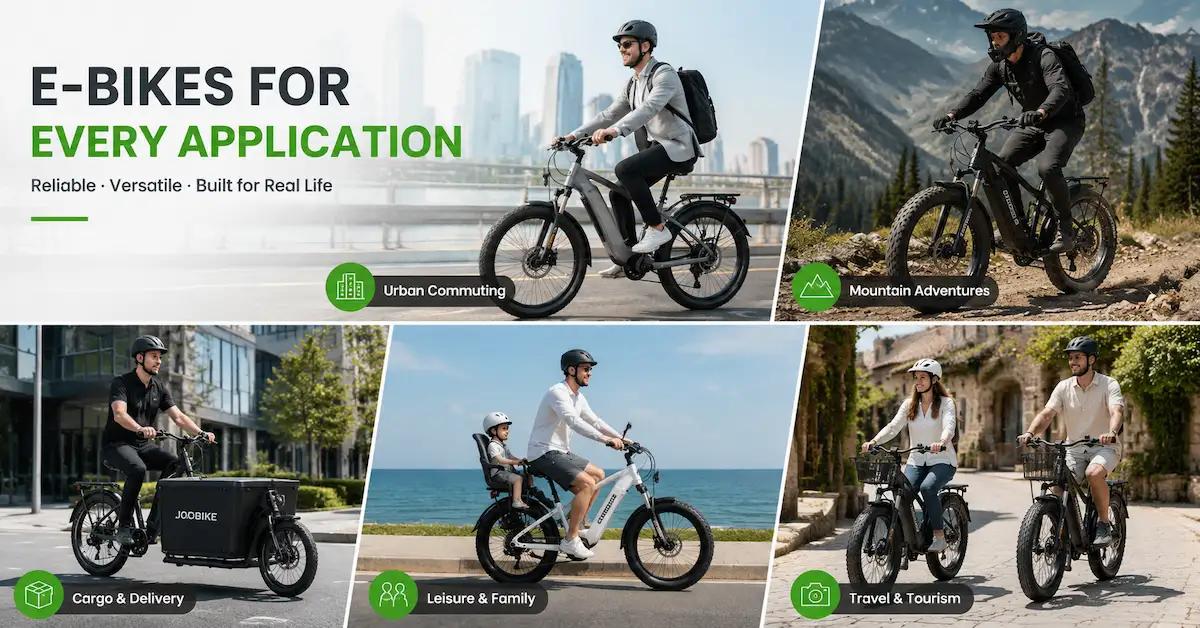
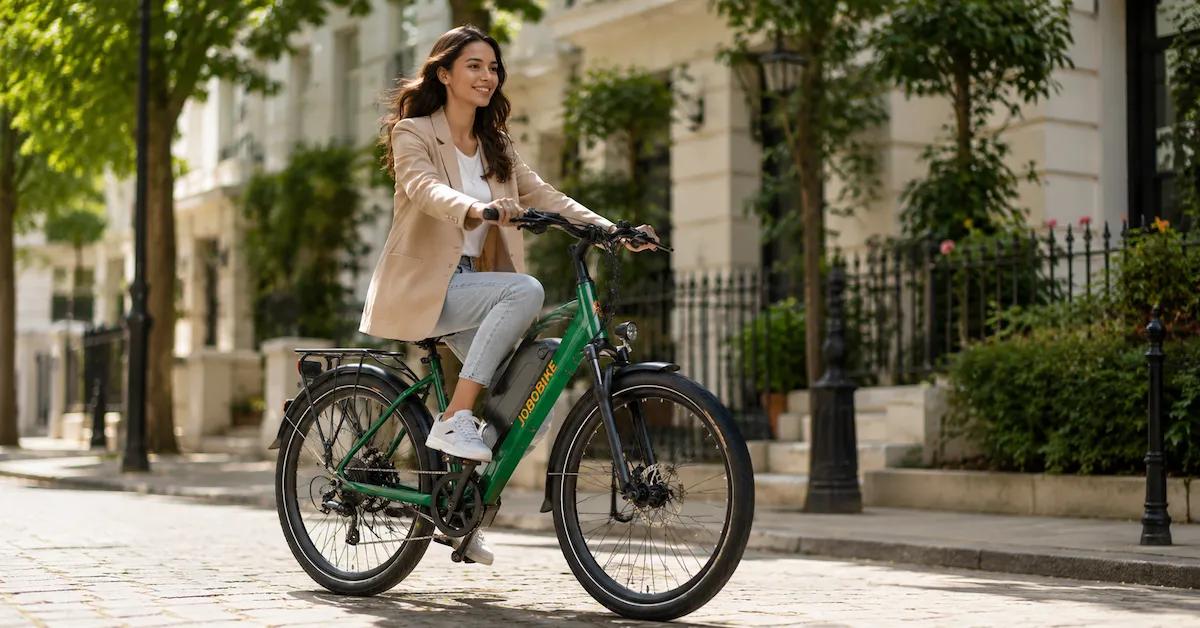
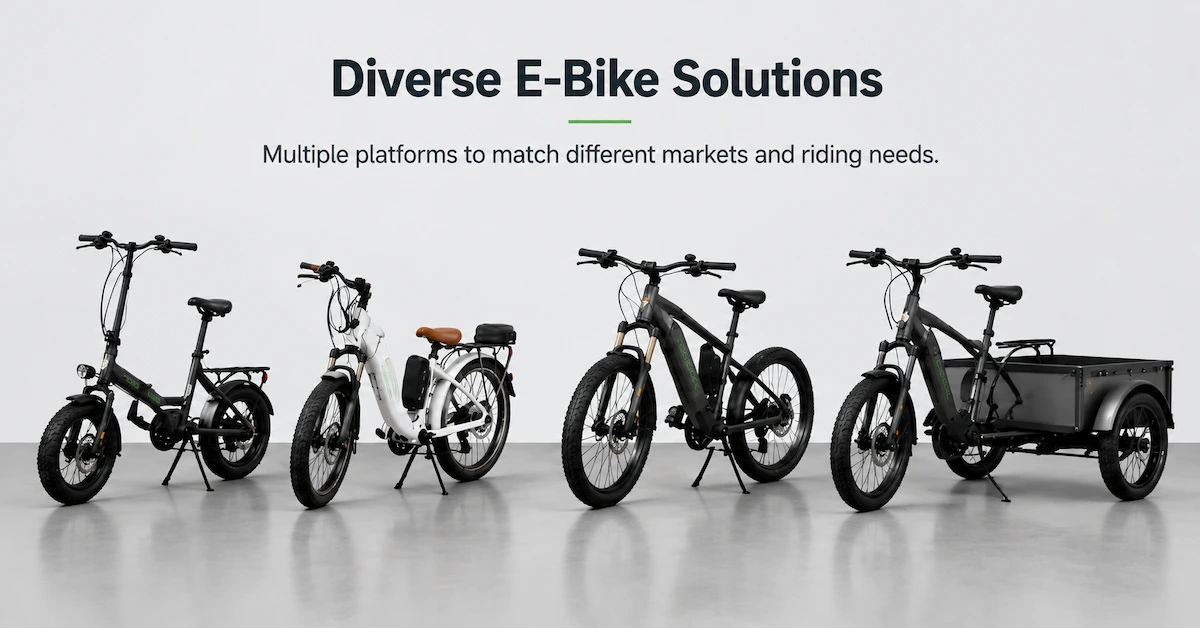
JOBO supplies multiple electric mobility platforms, including city, folding, cargo, mountain, road, off-road, shared, tricycle, motorcycle-style, children’s e-bikes, and custom e-bike frames. This variety allows buyers to begin with an established platform and configure it for a specific market or business model.
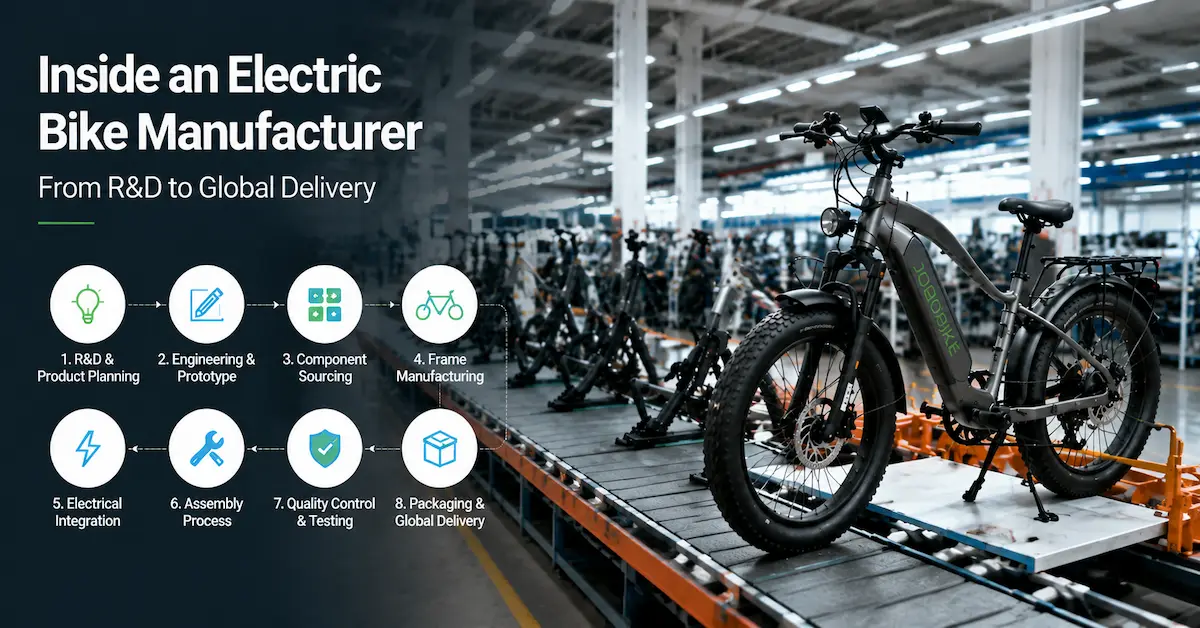
Quick Answer: What Departments Make Up an Electric Bike Manufacturer?
A complete electric bike manufacturing operation usually includes eight connected areas:
- Market research and product planning
- Engineering and prototype development
- Component sourcing and BOM management
- Frame manufacturing and surface finishing
- Motor, battery, controller, and electrical integration
- Complete-bike assembly
- Quality control, testing, and compliance
- OEM branding, packaging, export, and after-sales support
A company may not manufacture every battery cell, motor, brake, tire, or drivetrain component internally. Its value lies in selecting suitable components, integrating them correctly, controlling quality, and reproducing the approved specification consistently.
Product Strategy Comes Before Production
Every successful electric bicycle project should begin with a defined market position.
Before engineering starts, the manufacturer and buyer should clarify:
- Who will use the bicycle?
- Where will it be ridden?
- What retail price should it support?
- Is it intended for commuting, delivery, leisure, rental, or off-road use?
- Which motor and battery configuration suits the destination market?
- What servicing capability does the buyer have?
- Is the project standard wholesale, private label, OEM, or ODM?
This stage prevents a common sourcing mistake: choosing components individually without considering how they affect the complete product.
A high-capacity battery may increase range, but it also changes weight, price, charging time, frame integration, and shipping considerations. Wider tires may improve stability on rough surfaces, but they can increase rolling resistance and carton dimensions. More powerful motors may support hills or cargo loads, but the final configuration must still match local market requirements.
A professional electric bike manufacturer should therefore recommend a balanced system rather than automatically selecting the most expensive components.
R&D, Engineering, and Prototype Development
Once the product brief is defined, the engineering team translates it into a manufacturable solution.
This stage may include:
- Frame geometry planning
- Component compatibility review
- Battery-position design
- Cable-routing design
- Motor and controller matching
- Load and riding-condition analysis
- Accessory integration
- Color and branding preparation
- Prototype assembly
- Functional and road testing
The prototype is more than a visual sample. It confirms whether the bicycle can be assembled efficiently, whether components fit correctly, and whether the riding experience matches the intended application.
JOBO states that its China manufacturing operation includes an R&D team of more than 35 engineers and provides concept-to-prototype verification, complete-bike system validation, frame engineering, and customized OEM/ODM development.
For buyers, the final approved prototype should become the reference for mass production. All later component, appearance, and packaging decisions should be documented against this reference.
Supply Chain and Bill of Materials Management
An electric bicycle combines mechanical and electrical components sourced from multiple specialist supply chains.
A typical bill of materials may include:
| System | Main Components |
|---|---|
| Frame system | Main frame, fork, rack, fenders, kickstand |
| Drive system | Motor, controller, torque or cadence sensor |
| Battery system | Cells, BMS, enclosure, connector, charger |
| Control system | Display, buttons, wiring harness |
| Braking system | Levers, calipers, discs, hoses or cables |
| Drivetrain | Crank, chain or belt, cassette, derailleur |
| Wheel system | Rims, hubs, spokes, tires, tubes |
| Accessories | Lights, basket, rack, locks, tools |
| Brand materials | Logos, labels, manuals, cartons |
The manufacturer must control more than component availability. It should also control component identity.
Before bulk production, buyers should approve:
- Component model or reference number
- Technical specification
- Color and finish
- Approved alternative components
- Warranty implications
- Future spare-parts availability
Unapproved substitutions are one of the biggest causes of sample-to-bulk inconsistency. A reliable manufacturer should notify the buyer before changing any approved component.
Frame Manufacturing: The Structural Foundation
The frame determines the e-bike’s geometry, load capacity, battery position, riding comfort, appearance, and long-term structural integrity.
A controlled frame-production process may include:
- CNC tube cutting
- Drilling and bending
- Grinding and surface preparation
- Washing and drying
- Welding
- Heat treatment
- Alignment correction and measurement
- Coating and curing
- Structural and dimensional inspection
JOBO operates a dedicated aluminum frame facility that publicly lists CNC cutting, drilling and bending, robotic welding, T4 and T6 heat treatment, correction, automated coating, and final testing as part of its in-house process.
Keeping critical frame operations under direct control can help an electric bike manufacturer improve:
- Dimensional consistency
- Weld repeatability
- Battery-fit accuracy
- Production confidentiality
- Color consistency
- Repeat-order stability
- New-frame development efficiency
For deeper ODM projects, the frame factory is especially important because it allows geometry, battery integration, tube shape, mounting points, racks, and accessories to be developed together.
Motor and Drive-System Integration
The motor cannot be selected independently from the rest of the bicycle.
The correct drive system depends on:
- Intended terrain
- Bike weight
- Expected rider or cargo load
- Wheel size
- Gear ratio
- Battery voltage
- Controller settings
- Local market requirements
- Required riding feel
Hub motors can offer straightforward integration and cost control, while mid-drive systems can support different performance and handling objectives. The right choice depends on the commercial application rather than one motor type being universally better.
The manufacturer should confirm that the motor, controller, sensor, display, battery, and charger operate as one compatible electrical system.
This system-level approach is also reflected in modern safety evaluation. UL 2849 considers the electrical drivetrain, battery, and charger combination, while UL 2271 addresses batteries used in light electric vehicle applications.
Battery Pack and BMS Integration
The battery is one of the highest-value and highest-risk components in an electric bicycle.
Battery-system planning should cover:
- Voltage and capacity
- Cell specification
- Battery management system
- Enclosure design
- Connector type
- Charging system
- Frame mounting
- Removal method
- Water and dust protection
- Replacement availability
- Transport documentation
The BMS helps supervise charging, discharging, temperature, voltage balance, and other operating conditions. However, safety depends on the complete battery design, including the cells, enclosure, connections, charger, and integration with the bicycle.
For buyers targeting Europe, battery planning is also becoming more closely connected to lifecycle responsibilities. The EU Battery Regulation covers areas including sustainability, collection, reuse, recycling, and extended producer responsibility. This means manufacturers and importers should think beyond initial battery performance and consider documentation, traceability, service, and end-of-life planning.
Mechanical Components and Riding Performance
While the electrical system receives much attention, the mechanical platform determines how safely and comfortably the bicycle handles.
The manufacturer must coordinate:
- Fork and suspension
- Brake system
- Wheel strength
- Tire width and tread
- Drivetrain
- Handlebar and stem
- Saddle and seatpost
- Rack and cargo accessories
- Fenders and lighting mounts
Component selection should reflect the real application.
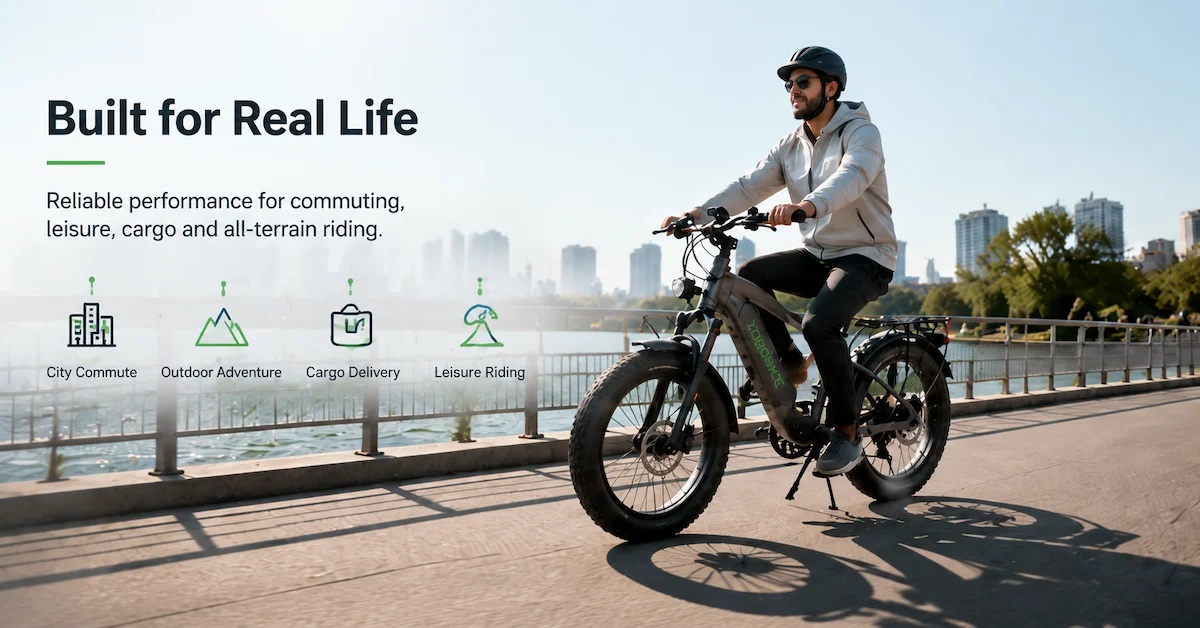
A city model may prioritize low maintenance, comfort, fenders, lights, and a rear rack. A cargo model may require stronger wheels, dependable braking, reinforced mounting points, and practical battery access. A mountain model may prioritize suspension travel, traction, frame control, and impact resistance.
The manufacturer’s responsibility is to ensure that these parts create a coherent bicycle rather than a collection of unrelated specifications.
Assembly-Line Structure
Mass production begins after the prototype, bill of materials, branding, and packaging have been approved.
A process-controlled assembly line normally divides work into repeatable stations.
Frame and Electrical Preparation
Technicians install or prepare:
- Wiring harness
- Battery mounting system
- Controller
- motor connections
- Sensors and cables
Mechanical Assembly
The team installs:
- Fork
- Handlebar
- Wheels
- Brakes
- Drivetrain
- Crank and pedals
System Connection and Adjustment
Technicians connect and adjust:
- Display
- Controls
- Lights
- Sensor settings
- Brake alignment
- Gear shifting
Final Accessories
The final stations install:
- Saddle
- Rack
- Fenders
- Kickstand
- Basket
- Locks or other accessories
JOBO’s China facility describes three assembly lines, integrated frame production, automated painting, and annual manufacturing capacity of up to 300,000 electric bikes.
For buyers, factory capacity should not be judged only by the maximum number of units. The more important questions are whether the manufacturer can maintain quality during peak production and reproduce the approved specification during repeat orders.
Quality Control Should Cover the Entire Process
Final inspection alone cannot correct every manufacturing problem. Quality control should begin when components arrive and continue through production.
A complete QC structure may include:
Incoming Inspection
- Frame and fork condition
- Battery and charger verification
- Motor and controller confirmation
- Brake and drivetrain inspection
- Label and packaging-material checks
Process Inspection
- Weld and frame alignment
- Coating appearance
- Cable routing
- Connector installation
- Fastener tightening
- Wheel alignment
- Brake and gear adjustment
Finished-Bike Inspection
- Battery charging
- Motor assistance
- Display operation
- Sensor response
- Braking
- Lighting
- Riding stability
- Noise and vibration
- Logo and color accuracy
Packaging Inspection
- Correct bike model
- Charger and manual
- Accessories and tools
- Protective materials
- Carton labels
- Shipping marks
JOBO describes a multi-stage quality system covering frame welding, electronic integration, and final assembly, supported by 16 testing instruments. Its company materials also state that more than 35 models have received EN certification through TÜV.
For buyers entering European or North American markets, applicable requirements should be confirmed before production. UL describes EN 15194 and UL 2849 as two important standards to consider when planning for these markets, although their scopes and requirements are not identical.
OEM and ODM Manufacturing Models
The structure of an electric bike manufacturer also depends on the cooperation model.
| Cooperation Model | Buyer Contribution | Manufacturer Contribution | Suitable Buyer |
|---|---|---|---|
| Standard wholesale | Selects an existing model | Supplies standard product | Distributors testing demand |
| Private label | Provides brand artwork | Applies logo, color, packaging | New e-bike brands |
| OEM | Defines detailed requirements | Manufactures to approved specification | Established brands |
| ODM | Provides market objectives | Supports design and development | Buyers needing exclusive products |
Private label projects usually require less development time because they begin with an existing platform.
OEM projects may involve deeper configuration changes, such as battery, motor, brakes, tires, accessories, and packaging.
ODM projects may involve frame design, unique geometry, integrated components, dedicated tooling, and stronger intellectual-property protection.
The correct model depends on budget, timeline, order quantity, market maturity, and the level of product exclusivity required.
Painting, Branding, and Product Identity
A market-ready e-bike must perform reliably, but it must also communicate the buyer’s brand clearly.
Brand customization may include:
- Frame color
- Logo position
- Battery graphics
- Model name
- Display startup graphics
- Warning labels
- User manual
- Carton design
- Warranty card
- Accessory packaging
The painting process should include proper surface preparation, controlled coating, curing, and appearance inspection. JOBO’s China and frame-factory pages describe automated painting and powder-coating processes managed in-house.
Before mass production, buyers should approve:
- Color sample
- Logo size and position
- Artwork files
- Label language
- Packaging layout
- Manual version
These details directly affect brand consistency across distributors, dealers, and e-commerce channels.
Export Packaging and Delivery
An export-focused electric bike manufacturer must understand that the product is not finished when it leaves the assembly line. It must arrive without frame scratches, bent brake discs, damaged displays, loose accessories, or missing documentation.
Export packaging should protect:
- Frame and fork
- Handlebar and controls
- Wheels and brake discs
- Battery and charger
- Display
- Rack and fenders
- Loose accessories
The buyer should confirm:
- Carton size and gross weight
- Degree of pre-assembly
- Internal protective materials
- Included installation tools
- Pallet requirements
- Container-loading quantity
- Battery-shipping documents
- Shipping marks
Better packaging may slightly increase unit cost, but it can significantly reduce transport damage, customer complaints, and replacement expenses.
The Electric Bike Manufacturer of 2026
Several priorities are reshaping manufacturing structures in 2026.
Greater System-Level Safety
Manufacturers must evaluate the relationship between the battery, charger, controller, motor, wiring, and complete bicycle rather than treating each component separately.
Better Traceability
Digital bills of materials, component records, inspection data, and serial-number systems help factories manage product changes and warranty investigations.
More Flexible Production
Brands increasingly need smaller initial orders, quicker model validation, and scalable repeat production. This encourages manufacturers to use modular platforms and more flexible assembly planning.
Regional Manufacturing Support
Regional assembly can help buyers improve delivery responsiveness, local service, and supply-chain flexibility. JOBO operates manufacturing operations in China and an assembly base in Poland, alongside its dedicated frame facility.
Battery Lifecycle Planning
Battery regulation and sustainability requirements are placing more attention on traceability, recycling, replacement, and end-of-life responsibilities. This is particularly relevant for brands and importers serving the European market.
How Should Buyers Evaluate an Electric Bike Manufacturer?
Before choosing a factory, use a structured evaluation rather than comparing quotations alone.
| Evaluation Area | Questions to Ask |
|---|---|
| Product development | Can the team recommend a market-appropriate configuration? |
| Frame capability | Is frame production controlled internally or outsourced? |
| BOM control | Are approved components documented? |
| OEM/ODM | What level of customization is supported? |
| Sample process | Is the final sample used as the bulk-production reference? |
| Quality control | Are incoming, process, final, and packaging inspections performed? |
| Compliance | Can the factory support destination-market documentation? |
| Capacity | Can it support both initial and repeat orders? |
| Packaging | Is the package suitable for international transport? |
| Spare parts | Can replacement components be supplied later? |
| Confidentiality | Are custom designs protected through NDA procedures? |
| Communication | Are specifications and changes confirmed in writing? |
The best factory is not always the largest. It is the one whose engineering, capacity, quality system, and communication match the buyer’s project.
Why Consider JOBO as Your Manufacturing Partner?
JOBO integrates several critical capabilities within its manufacturing structure:
- China-based large-scale production
- European assembly support
- Dedicated aluminum frame production
- CNC tube processing
- Robotic welding
- Automated painting
- Multiple assembly lines
- OEM and ODM engineering
- Multi-stage quality testing
- Broad electric bike product categories
Its public company information describes a 50,000-square-meter China facility, three assembly lines, an in-house frame factory, a Poland operation, and a quality-control system supported by 16 testing devices.
JOBOBIKE platforms cover cargo, city, folding, mountain, road, off-road, shared, tricycle, motorcycle-style, children’s e-bikes, and custom frames, giving buyers different starting points for private-label, OEM, or ODM projects.
For an accurate quotation, buyers should prepare:
- Destination market
- Preferred product category
- Expected order quantity
- Motor and battery requirements
- Intended application
- Branding artwork
- Packaging requirements
- Required delivery schedule
FAQ
What does an electric bike manufacturer do?
An electric bike manufacturer coordinates product design, frame production, component sourcing, electrical integration, complete-bike assembly, testing, branding, packaging, and delivery.
Does an electric bike manufacturer produce every component in-house?
Usually not. Many manufacturers source specialist components such as motors, cells, brakes, drivetrains, and tires while controlling frame production, system integration, assembly, quality, and final delivery.
What is the difference between an OEM and ODM e-bike project?
OEM production follows detailed buyer specifications. ODM cooperation includes more product design and development support from the manufacturer.
Why is in-house frame production important?
It can improve dimensional control, development flexibility, production confidentiality, repeatability, and integration of batteries, racks, cables, and accessories.
What should be confirmed before sample production?
Confirm the motor, battery, frame, brakes, tires, display, accessories, color, logo, labels, packaging, manuals, and target-market requirements.
How can buyers prevent component substitutions?
Use an approved bill of materials and require written approval before the manufacturer changes any specified component.
What quality tests should a manufacturer perform?
Testing should cover the frame, battery, motor, controller, wiring, brakes, drivetrain, display, lights, wheels, riding performance, branding, and packaging.
Which standards matter for electric bikes?
Requirements depend on the destination market and product configuration. EN 15194 and UL 2849 are important considerations for European and North American market planning, while battery-specific requirements may also apply.
Can a new brand begin with an existing model?
Yes. Starting with a mature platform and customizing branding, components, and packaging can reduce development time, cost, and technical risk.
How can buyers begin an OEM project with JOBO?
Prepare your destination market, target model, estimated quantity, specifications, branding requirements, packaging needs, and delivery schedule, then submit the project information to JOBO’s sales team.
Conclusion
An electric bike manufacturer is a coordinated production and supply-chain system, not simply an assembly workshop.
The most capable manufacturers connect:
- Market research
- Engineering
- Frame production
- Component management
- Electrical integration
- Assembly
- Quality control
- Compliance
- Branding
- Packaging
- Export and after-sales support
In 2026, buyers should focus less on isolated specifications and more on the manufacturer’s ability to control the complete product throughout its lifecycle.
A reliable partner should reproduce the approved sample, document component decisions, protect custom designs, control quality across production stages, prepare the product for international delivery, and support spare parts after launch.
JOBO combines large-scale production, in-house frame manufacturing, OEM/ODM development, quality testing, and a broad JOBOBIKE product range to support brands, distributors, and importers from initial concept through repeat bulk production.