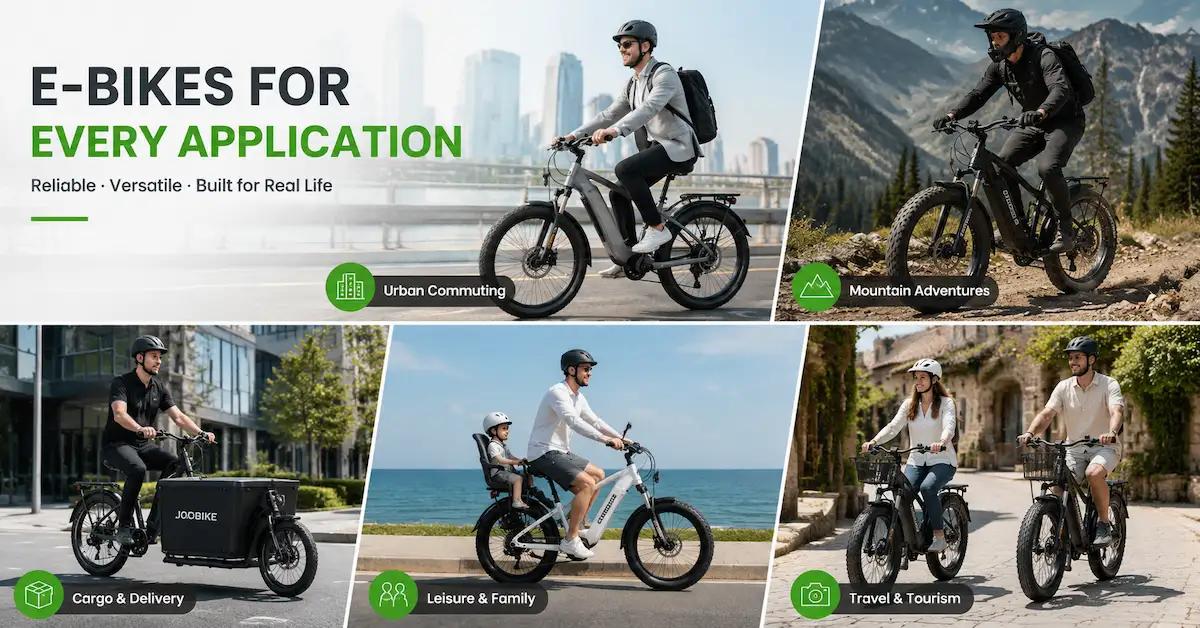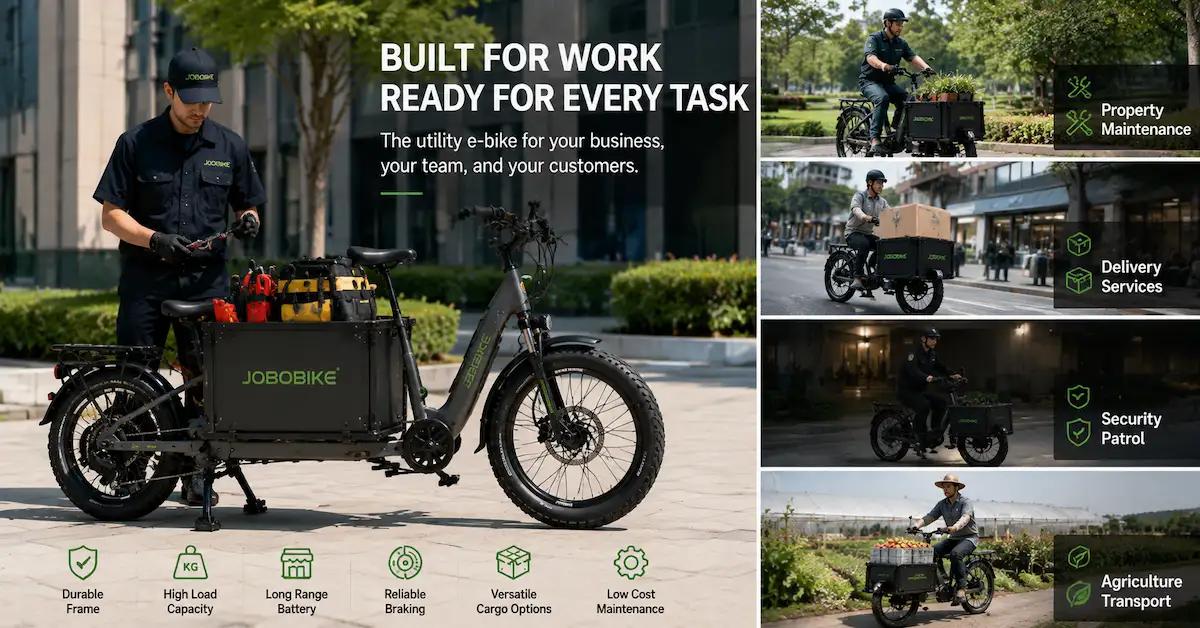
Commercial transportation does not always require a van, pickup truck, or fuel-powered service vehicle. Many daily tasks involve short routes, light-to-medium cargo, repeated stops, and limited parking space.
Utility electric bikes offer businesses a practical alternative for moving employees, tools, parcels, maintenance equipment, and operational supplies.
Typical users include:
- Hotels and resorts
- Property management companies
- Universities and hospitals
- Warehouses and industrial parks
- Municipal service departments
- Farms and vineyards
- Delivery businesses
- Security teams
- Retailers
- Maintenance contractors
However, a commercial utility bike must perform differently from a recreational e-bike. It may be used by several riders, carry additional weight, operate throughout the working day, and require predictable maintenance.
For this reason, choosing the right utility electric bike manufacturer is one of the most important decisions in a fleet project.
A suitable manufacturing partner should understand not only bicycle production but also commercial operations, fleet uptime, replacement parts, accessory integration, and market-specific requirements.
Buyers can explore available electric mobility platforms through the JOBOBIKE product range.
What Is a Commercial Utility Electric Bike?
A commercial utility electric bike is an electrically assisted bicycle designed to perform practical business tasks.
Unlike a standard commuter bike, it may include:
- Reinforced front and rear racks
- Lockable cargo boxes
- Tool storage
- Heavy-duty kickstands
- High-torque motors
- Larger battery capacities
- Stronger wheels
- Commercial-grade brakes
- Integrated lighting
- GPS or fleet-tracking equipment
- Business-specific accessories
The exact configuration depends on the application.
A hotel may require a quiet low-step model with enclosed storage. A farm may need wider tires and improved traction. A facility maintenance company may prioritize toolboxes, puncture-resistant tires, and easy access to replacement components.
A professional utility electric bike manufacturer should therefore begin with the operating requirements rather than offering one standard model to every buyer.
Utility E-Bike Applications by Industry
Facility and Property Maintenance
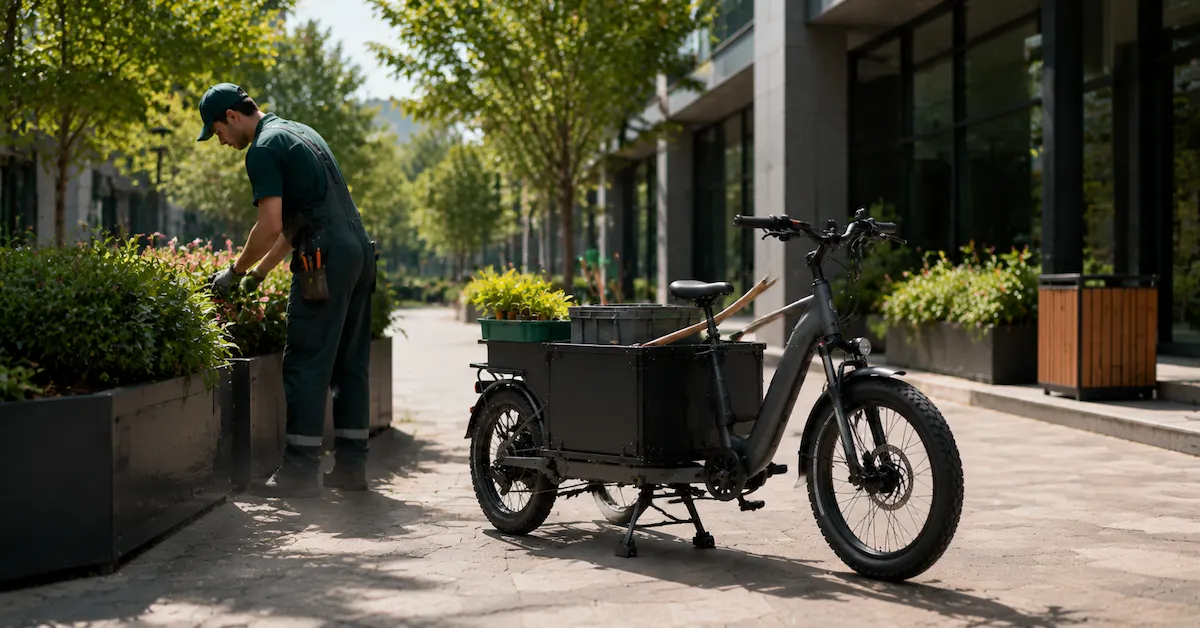
Large commercial properties often require technicians to move repeatedly between buildings, equipment rooms, parking areas, and outdoor facilities.
A utility e-bike can transport:
- Hand tools
- Testing equipment
- Spare components
- Cleaning materials
- Safety equipment
- Small repair supplies
Compared with walking, technicians can cover more locations during a shift. Compared with a service van, the bike is easier to park and operate in pedestrian-sensitive areas.
Important product features may include:
- Lockable tool compartments
- Wide rear racks
- Stable kickstands
- Bright lighting
- Low-step frame access
- Puncture-resistant tires
Hotel and Resort Operations
Hotels, resorts, holiday parks, and large recreational facilities may use electric work bikes for:
- Housekeeping support
- Linen transport
- Security patrol
- Landscaping
- Guest service
- Internal delivery
- Technical maintenance
Quiet operation is especially valuable in hospitality environments.
A resort buyer may also request branded colors, logo placement, weather-resistant boxes, and accessories that match the property’s visual identity.
Campus and Healthcare Transportation
Universities, hospitals, research centers, and corporate campuses often involve frequent short-distance movement.
Utility e-bikes can support:
- Internal mail delivery
- Maintenance teams
- Security personnel
- Medical supply movement
- IT support
- Grounds management
For these applications, ease of use is important because several employees may share the same bike.
Recommended features may include:
- Adjustable riding position
- Simple controls
- Step-through frame
- Removable battery
- Integrated wheel lock
- Clear battery display
Warehouses and Industrial Parks
Large factories and logistics centers may require employees to travel between warehouses, production buildings, inspection areas, and loading zones.
A utility e-bike can reduce internal travel time while carrying small tools, documents, parts, or inspection equipment.
Industrial buyers should prioritize:
- Durable frames
- Protected wiring
- Strong wheels
- Stable braking
- Visible lighting
- Easy maintenance
Agriculture and Rural Business
Farms, vineyards, nurseries, and agricultural facilities may use utility bikes for inspection, transportation, and light hauling.
These conditions can involve:
- Gravel roads
- Grass
- Uneven surfaces
- Mud
- Steeper gradients
- Longer distances
A rural utility e-bike may therefore require wider tires, increased ground clearance, stronger motor torque, and more protective electrical component placement.
Local Retail and Delivery
Retailers, pharmacies, cafés, florists, restaurants, and local service companies may use utility e-bikes for short-distance delivery.
The manufacturer may need to integrate:
- Insulated boxes
- Parcel containers
- Branding panels
- Front baskets
- Rear platforms
- Phone holders
- Tracking devices
The best configuration depends on the cargo size, delivery frequency, route length, and local traffic environment.
How to Define Your Fleet Requirements
Before contacting a manufacturer, buyers should prepare a clear project brief.
The following information helps the supplier recommend a more suitable platform.
| Requirement | Questions to Define |
|---|---|
| Application | What tasks will the bike perform? |
| Cargo | What items will it carry? |
| Load | What is the expected rider and cargo weight? |
| Terrain | Flat roads, hills, gravel, or mixed surfaces? |
| Daily Distance | How many kilometers per shift? |
| Users | One dedicated rider or multiple employees? |
| Charging | Where and when will batteries be charged? |
| Storage | Will the bikes be stored indoors or outdoors? |
| Market | Which country or region will receive the bikes? |
| Quantity | Prototype, trial fleet, or bulk order? |
A detailed requirement document reduces misunderstandings and unnecessary product revisions.
What a Utility Electric Bike Manufacturer Should Evaluate
Frame Geometry
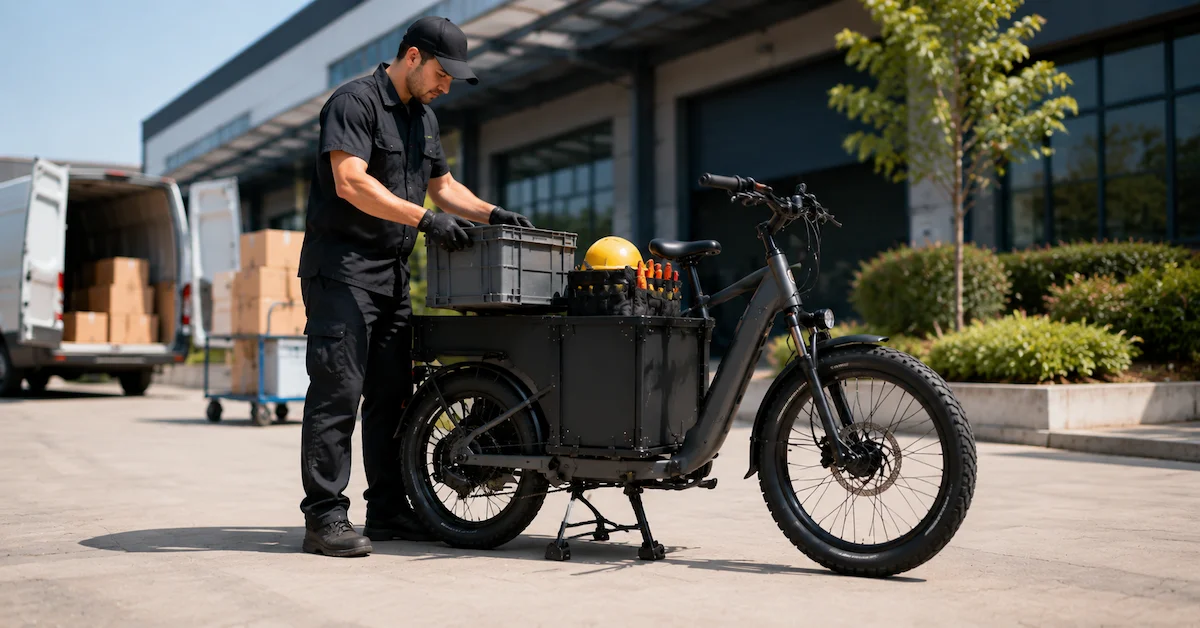
The frame must support the rider, electrical system, accessories, and commercial cargo without creating unstable handling.
Key factors include:
- Wheelbase
- Head-tube angle
- Rack location
- Battery position
- Cargo center of gravity
- Step-over height
- Frame reinforcement
- Mounting points
A poorly positioned cargo box can make a bike difficult to steer even when the frame has a high stated load capacity.
The manufacturer should evaluate the complete vehicle rather than treating the frame and accessories as separate products.
Motor and Torque Requirements
Utility bikes often operate at relatively low speeds while carrying additional weight. Strong acceleration and climbing support may therefore be more useful than a high maximum speed.
Buyers should discuss:
- Rated motor power
- Peak torque
- Hub motor or mid-drive system
- Hill-climbing requirements
- Wheel size
- Controller settings
- Local power restrictions
A reliable utility electric bike manufacturer should match the motor to the vehicle weight, terrain, expected cargo, and legal requirements of the destination market.
Battery Capacity
Battery selection should be based on a realistic working cycle.
A fleet may involve:
- Frequent starts and stops
- Heavy cargo
- Cold-weather operation
- High assistance levels
- Long shifts
- Shared use
These factors can reduce actual range.
Commercial buyers should ask for range estimates under relevant load and terrain conditions rather than relying only on theoretical figures.
Possible fleet solutions include:
- Removable batteries
- Battery-swapping systems
- Dual-battery configurations
- Centralized charging stations
- Spare battery packages
- Lockable battery compartments
Braking Performance
Braking requirements increase when the bike carries tools, goods, or equipment.
Buyers should evaluate:
- Brake type
- Rotor size
- Lever quality
- Heat management
- Brake cut-off sensors
- Replacement pad availability
- Loaded braking performance
Hydraulic disc brakes are commonly selected for commercial utility models because they can provide controlled and consistent braking.
Wheel and Tire Durability
Commercial fleets need wheels capable of repeated daily use.
Important considerations include:
- Rim strength
- Spoke quality
- Tire width
- Puncture protection
- Tread pattern
- Load rating
- Replacement availability
The correct tire should match the road surface. A tire designed for smooth city roads may not be suitable for farms or construction facilities.
Accessory Mounting System
The accessory system determines how useful the bike becomes for a specific business.
Common accessories include:
- Front platforms
- Rear racks
- Side panniers
- Toolboxes
- Delivery boxes
- Insulated containers
- Warning lights
- Mirrors
- GPS trackers
- Mobile-device holders
- Security locks
A modular mounting platform allows a distributor to offer several commercial configurations using one core bike design.
OEM and Private-Label Utility E-Bike Development
A distributor or electric bike brand may require products that differ from standard factory models.
OEM and ODM support can cover several areas.
Branding
- Frame logos
- Custom decals
- Battery labels
- Display startup graphics
- Product packaging
- User manuals
- Carton markings
Product Appearance
- Frame colors
- Rack colors
- Saddle materials
- Grip styles
- Cargo box finishes
- Reflective branding
Technical Configuration
- Motor systems
- Battery capacities
- Controllers
- Displays
- Brakes
- Drivetrains
- Lighting
- Wheel sizes
Commercial Accessories
- Maintenance toolboxes
- Delivery containers
- Mobile vending units
- Security equipment
- Waste collection boxes
- Agricultural racks
- Custom brackets
Buyers should determine which features are essential before requesting a quotation. Excessive customization can increase development costs, minimum order quantities, and lead times.
Prototype Development Before Bulk Production
A prototype is particularly important for utility e-bikes because accessory placement and cargo balance can be difficult to evaluate from drawings alone.
Prototype testing should include:
- Rider comfort
- Mounting and dismounting
- Cargo loading
- Kickstand stability
- Steering under load
- Braking performance
- Motor assistance
- Battery removal
- Toolbox access
- Cable protection
- Parking behavior
Fleet users should test the bike under real working conditions whenever possible.
A maintenance company, for example, should load the actual tools normally carried by its technicians. A delivery company should test the real box size and delivery route.
This process helps prevent costly changes after mass production begins.
Production and Quality-Control Process
A dependable commercial supplier should have a structured production system.
Incoming Component Inspection
Before assembly, the factory should check:
- Frame dimensions
- Surface finish
- Motor models
- Battery specifications
- Brake components
- Displays
- Controllers
- Wheels
- Accessory hardware
Assembly Control
During production, inspectors should verify:
- Bolt torque
- Wheel alignment
- Brake adjustment
- Cable routing
- Electrical connections
- Rack installation
- Battery locking
- Display functions
Electrical Testing
The complete electrical system should be checked for:
- Motor assistance
- Assistance levels
- Brake power cut-off
- Lighting
- Display readings
- Charging
- Battery connection
- Error codes
Road Testing
Final road tests may evaluate:
- Steering
- Noise
- Gear shifting
- Braking
- Motor response
- Stability
- Accessory movement
Loaded testing is especially relevant for commercial models.
Packaging Inspection
Utility bikes may include large racks and accessories that require specialized packaging.
The packaging design should protect:
- Frame paint
- Motor wiring
- Display
- brake rotors
- Racks
- Cargo boxes
- Lights
- Small accessories
Total Cost of Ownership Matters More Than Unit Price
A low initial price does not always create a low-cost fleet.
Fleet buyers should calculate:
- Purchase cost
- Shipping cost
- Assembly cost
- Battery replacement
- Brake maintenance
- Tire replacement
- Spare parts
- Downtime
- Warranty administration
- Technician training
A slightly higher-quality bike may offer better value if it requires fewer repairs and remains operational for longer periods.
| Cost Factor | Low-Cost Product Risk |
|---|---|
| Battery | Shorter service life |
| Brakes | Frequent adjustment |
| Tires | More punctures |
| Wiring | Intermittent faults |
| Racks | Cracking or loosening |
| Components | Difficult replacement |
| Packaging | Shipping damage |
| Documentation | Incorrect assembly |
The best supplier should help buyers balance initial cost, durability, serviceability, and expected fleet life.
Spare Parts and Fleet Maintenance Planning
Commercial buyers should confirm spare-part availability before ordering.
Recommended spare parts may include:
- Brake pads
- Brake levers
- Displays
- Controllers
- Sensors
- Chargers
- Wiring harnesses
- Inner tubes
- Tires
- Derailleur components
- Lights
- Battery locks
The supplier should also provide:
- Parts identification
- Installation guidance
- Electrical diagrams
- Maintenance instructions
- Warranty procedures
Standardized components can make fleet maintenance easier and reduce dependence on specialized repairs.
Supplier Evaluation Checklist
Use the following questions when comparing manufacturers:
- Does the supplier manufacture utility e-bikes directly?
- Can the frame and racks be customized?
- How is the rated load determined?
- Are loaded riding tests performed?
- Which motor and battery systems are available?
- Can replacement parts be supplied?
- What quality-control records are maintained?
- Can the supplier produce a working prototype?
- What is the minimum order quantity?
- How long does production take?
- Can packaging and manuals be customized?
- What export documentation is available?
- How are warranty cases managed?
- Can the configuration be adapted to local regulations?
- Is long-term component supply available?
A qualified utility electric bike manufacturer should provide clear and technically grounded answers rather than only sending a price list.
Why Work with JOBOBIKE?
JOBOBIKE supports international distributors, importers, fleet operators, and private-label electric bike brands.
Project support may include:
- Utility e-bike platform selection
- OEM and ODM development
- Frame configuration
- Motor and battery matching
- Rack and accessory customization
- Logo and color design
- Packaging development
- Quality inspection
- Spare-parts planning
- Export coordination
The company’s electric mobility portfolio can support several commercial and consumer applications. Learn more about JOBOBIKE and review additional sourcing information through the JOBOBIKE blog.
FAQ
What does a utility electric bike manufacturer produce?
A utility electric bike manufacturer develops e-bikes designed for commercial tasks such as maintenance, delivery, security patrol, facility management, agriculture, and internal transportation.
How is a utility electric bike different from a cargo bike?
Cargo bikes usually focus on transporting larger or heavier loads. Utility bikes often prioritize modular storage, maneuverability, tools, and flexible business applications.
Can utility e-bikes be customized for different industries?
Yes. Manufacturers can customize racks, toolboxes, delivery containers, motor systems, batteries, colors, logos, lights, tires, and other application-specific components.
What battery capacity should a commercial fleet choose?
The correct capacity depends on route distance, cargo weight, assistance level, terrain, temperature, and charging schedule. Buyers should calculate capacity using realistic operating conditions.
Are utility electric bikes suitable for multiple riders?
They can be configured for shared fleet use with adjustable saddles, step-through frames, simple displays, secure battery systems, and standardized controls.
Why is prototype testing important?
A prototype allows buyers to evaluate cargo balance, riding comfort, braking, accessory access, motor response, and actual working performance before approving mass production.
What spare parts should fleet buyers order?
Common spare parts include brake pads, chargers, displays, controllers, sensors, tires, tubes, lights, cables, and drivetrain components.
Can JOBOBIKE support private-label projects?
JOBOBIKE can discuss private-label requirements including logos, colors, components, accessories, packaging, documentation, and market-specific configurations.
What information is required for an accurate quotation?
Provide the destination market, application, estimated quantity, daily distance, cargo type, load requirements, terrain, preferred components, branding requirements, and expected delivery schedule.
Conclusion
Selecting a reliable utility electric bike manufacturer requires a complete evaluation of product engineering, commercial durability, accessories, quality control, maintenance support, and long-term component availability.
The ideal utility e-bike should be designed around the work it must perform. Frame geometry, motor torque, battery capacity, brakes, tires, racks, and cargo placement should function as one integrated system.
For distributors and fleet operators, total ownership cost is more meaningful than the lowest initial quotation. Reliable products, accessible replacement parts, realistic testing, and consistent production can reduce downtime and protect the buyer’s reputation.
JOBOBIKE supports commercial electric bike projects from initial configuration and prototype development to OEM production and international delivery.
Discuss your utility e-bike project: Contact JOBOBIKE