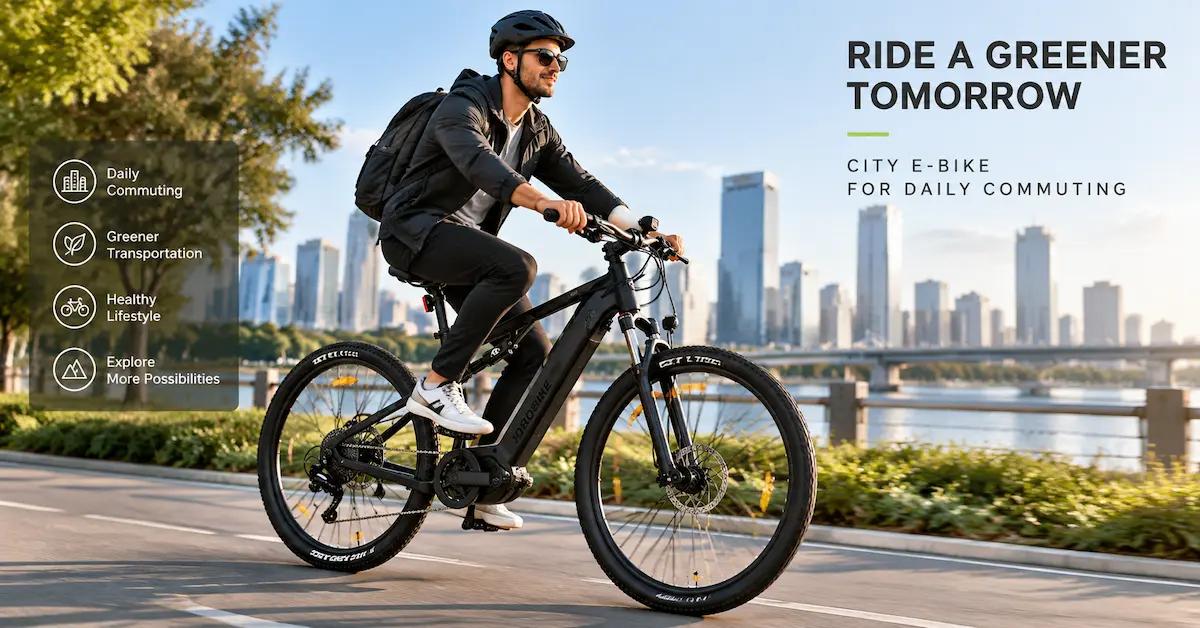
Quick Answer: What Makes a Good City E-Bike for Daily Commuting?
A reliable city e-bike for daily commuting should balance comfort, efficiency, reliability, and practical ownership costs. For brands, distributors, and fleet operators, the right urban e-bike supplier should provide a complete solution including suitable frame geometry, dependable motor and battery systems, easy maintenance, customization options, quality control, and long-term production support. Buyers should evaluate the bicycle based on real commuting scenarios rather than only comparing motor power or battery capacity.
Introduction: Why Urban Commuting E-Bikes Require More Than Basic Specifications
The demand for urban electric bicycles continues to grow because more riders are looking for practical transportation solutions between traditional bicycles, cars, and public transportation.
For many customers, a city e-bike is not purchased for extreme performance. It is purchased because it solves everyday problems:
- commuting through crowded streets;
- avoiding traffic congestion;
- reducing transportation costs;
- combining cycling with public transportation;
- reaching workplaces without excessive physical effort;
- creating a more convenient daily travel routine.
However, for companies sourcing electric commuter bikes, choosing the right product is more complex than selecting a bicycle with a motor and battery.
A successful city e-bike for daily commuting needs to satisfy both the rider and the business behind the product.
The rider expects:
- comfortable riding position;
- reliable assistance;
- practical range;
- easy charging;
- low maintenance;
- safe handling.
The business expects:
- stable production;
- predictable cost;
- consistent quality;
- available spare parts;
- supplier communication;
- repeat-order capability.
This is why choosing an electric commuter bike supplier is a strategic decision.
A bicycle that performs well in a showroom may not perform well after thousands of daily rides. A model that looks attractive in marketing photos may create problems if customers cannot remove the battery, dealers cannot repair common issues, or replacement parts are unavailable.
For brands and distributors, the goal should not simply be finding the cheapest city e-bike.
The goal should be finding a product platform that can support:
- customer satisfaction;
- dealer confidence;
- long-term inventory planning;
- profitable repeat sales.
JOBO provides electric bicycle manufacturing and OEM/ODM capabilities for different mobility applications. Buyers can review the electric bike product range to understand available platforms before developing an urban commuting product line.
What Is a City E-Bike for Daily Commuting?
A city e-bike for daily commuting is an electric bicycle designed primarily for regular urban transportation rather than specialized sports riding.
Its main purpose is to provide efficient, comfortable, and practical mobility for repeated daily trips.
Typical applications include:
- home-to-work commuting;
- campus transportation;
- urban errands;
- last-mile connections;
- business fleet programs;
- shared mobility services.
Compared with mountain e-bikes or performance-focused electric bicycles, city commuter models usually prioritize:
- comfort;
- usability;
- reliability;
- accessibility;
- operating efficiency.
Key Characteristics of Urban Commuter E-Bikes
Comfort-Oriented Riding Position
Daily commuting often means riding frequently rather than occasionally.
A comfortable city e-bike usually considers:
- upright riding posture;
- accessible frame design;
- comfortable saddle position;
- handlebar height;
- stable handling.
A rider who uses the bicycle five days per week notices comfort issues much faster than a weekend rider.
Practical Battery System
Commuter riders usually care about predictable daily range.
Important battery considerations include:
- sufficient energy capacity;
- charging convenience;
- battery lifespan;
- replacement availability;
- safe storage.
A commuter does not necessarily need the largest battery.
The better choice depends on:
- average commute distance;
- terrain;
- charging opportunities;
- bicycle weight expectations.
Easy Maintenance
City bikes experience frequent use.
Maintenance considerations include:
- common replacement parts;
- accessible components;
- reliable electrical connections;
- simple service procedures.
For distributors and fleet operators, serviceability directly affects operating costs.
Who Needs a City E-Bike Supplier?
Different businesses approach urban electric bikes with different goals.
Urban Mobility Brands
Companies building mobility brands often need bicycles that represent a lifestyle and transportation solution.
They usually focus on:
- product appearance;
- customer experience;
- brand differentiation;
- reliable supply.
A city e-bike can become the foundation of a complete urban mobility product line.
Electric Bike Importers
Importers usually evaluate:
- wholesale pricing;
- market demand;
- supplier reliability;
- shipping efficiency;
- compliance documents.
They need a supplier that can provide consistent products across multiple orders.
Retailers and Dealer Networks
Retail businesses need products that are easy to explain and sell.
Important factors include:
- customer-friendly design;
- low return rates;
- dealer service support;
- available replacement parts.
A bicycle that creates fewer after-sales problems usually creates stronger dealer relationships.
Corporate and Fleet Operators
Some organizations purchase electric bicycles for:
- employee transportation;
- delivery operations;
- campus mobility;
- hospitality services.
Fleet buyers usually prioritize:
- durability;
- maintenance efficiency;
- battery management;
- operational reliability.
Private Label Brands
Private-label companies need control over:
- appearance;
- branding;
- packaging;
- specifications;
- customer positioning.
The supplier must balance customization with production stability.
How to Choose the Right City E-Bike Supplier
Choosing a supplier requires evaluating more than product appearance.
A professional buyer should review:
- product design;
- technical capability;
- factory experience;
- OEM flexibility;
- quality system;
- support capability.
1. Evaluate Frame Design for Urban Use
The frame is the foundation of a commuter e-bike.
Urban riding usually requires:
- comfortable geometry;
- stable handling;
- practical mounting points;
- battery integration;
- suitable rider access.
A city e-bike frame should support everyday usage rather than only showcase appearance.
Buyers should ask:
- Is the frame designed for daily riding?
- Can accessories such as racks and fenders be integrated?
- How is frame consistency controlled?
- Can future models share components?
JOBO provides frame manufacturing information through its frame factory, supporting discussions around frame production, customization, and manufacturing capability.
2. Select Motor Systems Based on Real Commuting Needs
Motor selection should match the intended application.
Important factors include:
- riding distance;
- terrain;
- rider expectations;
- regulations;
- maintenance capability.
A commuter bicycle used on flat city roads has different requirements from one used in hilly areas.
Buyers should evaluate:
- motor type;
- power rating;
- controller tuning;
- assistance behavior;
- replacement support.
Higher power does not always create a better commuter product.
A smoother and more predictable riding experience may be more valuable.
3. Match Battery Capacity With Daily Usage
Battery selection is one of the most important purchasing decisions.
A buyer should consider:
- average commute distance;
- charging location;
- bicycle weight;
- replacement requirements.
For example:
A customer who rides 8 km daily may prefer a lighter bicycle with a smaller battery.
A customer commuting 40 km daily may prioritize larger battery capacity.
The supplier should help match the battery system with the actual customer profile.
4. Consider Accessories as Part of the Product Solution
City commuting often requires practical accessories.
Common requirements include:
- rear rack;
- fenders;
- lights;
- kickstand;
- baskets;
- integrated displays.
These components influence:
- customer experience;
- product positioning;
- final cost.
A city e-bike without practical commuting features may be difficult to position against competitors.
5. Review OEM and Customization Capability
Brands often need more than a standard catalog product.
OEM customization may include:
- colors;
- logo;
- packaging;
- accessories;
- component selection.
ODM development may include:
- frame redesign;
- new integration solutions;
- unique product concepts.
JOBO supports OEM and ODM electric bike development, helping brands evaluate different customization approaches.
How to Select the Right Configuration for a City E-Bike for Daily Commuting
Selecting a city e-bike for daily commuting requires understanding how each component affects the complete riding experience.
Many buyers compare bicycles by looking at:
- motor wattage;
- battery capacity;
- wheel size;
- price.
However, these numbers alone do not determine whether a bicycle is suitable for urban transportation.
A successful commuter e-bike configuration should balance:
- comfort;
- efficiency;
- reliability;
- maintenance;
- total ownership cost.
Frame Geometry and Rider Accessibility
Urban commuter bicycles are usually used by a wide range of riders.
Therefore, accessibility becomes an important consideration.
Buyers should evaluate:
- step-through design;
- frame height;
- rider adjustment range;
- mounting and dismounting convenience;
- stability at low speeds.
For daily commuting, a bicycle that feels easy and natural often performs better than one designed only around technical specifications.
A distributor should ask:
- Can different rider groups use the same model?
- Is the riding posture comfortable after 30–60 minutes?
- Can customers easily understand the controls?
- Are accessories practical for everyday use?
These questions directly influence customer satisfaction.
Battery Selection for Urban Commuting Applications
Battery selection should be based on customer behavior rather than marketing numbers.
A commuter e-bike supplier should help buyers evaluate:
| Battery Consideration | Buyer Evaluation |
|---|---|
| Capacity | Does it match the average daily route? |
| Weight | Does additional capacity reduce portability? |
| Charging | Can customers charge conveniently? |
| Replacement | Are spare batteries available? |
| Safety | Is the battery system documented and traceable? |
For urban users, charging convenience is often as important as battery size.
A customer who can easily recharge at home or work may not require the largest battery option.
Motor System Selection for City Riding
The motor determines how the bicycle feels during daily use.
A supplier should explain:
- motor type;
- power rating;
- controller settings;
- assistance response;
- maintenance requirements.
Hub Motor Systems
Advantages:
- simple structure;
- easier maintenance;
- cost efficiency;
- suitable for many urban applications.
Mid-Drive Systems
Advantages:
- balanced weight distribution;
- different riding characteristics;
- suitable for customers requiring stronger climbing ability.
The correct choice depends on:
- customer expectations;
- terrain;
- product price positioning;
- service capability.
A city commuter model does not always need the highest-performance motor.
Wheel and Tire Selection for Urban E-Bikes
Wheel selection affects:
- comfort;
- rolling efficiency;
- storage;
- appearance;
- maintenance.
Common urban considerations include:
Smaller Wheels
Benefits:
- compact design;
- easier storage;
- responsive handling.
Larger Wheels
Benefits:
- smoother riding;
- improved stability;
- better performance on uneven roads.
The supplier should help match wheel size with the intended customer.
For example:
A compact city commuter product may prioritize storage.
A comfort-focused urban cruiser may prioritize stability.
Display and Control System Considerations
The display is the customer's interaction point with the bicycle.
A good commuter system should provide:
- clear battery information;
- easy assistance adjustment;
- simple operation;
- reliable visibility.
For retail customers, complicated interfaces can create unnecessary support issues.
For fleet operators, simple controls reduce training requirements.
How to Evaluate an Electric Bike Factory for Urban Products
A professional city e-bike supplier should demonstrate manufacturing capability beyond product assembly.
Buyers should evaluate:
- production process;
- engineering support;
- quality management;
- customization capability;
- supply stability.
JOBO provides manufacturing information through its China factory, including electric bicycle production capability, assembly operations, engineering support, and OEM/ODM development resources.
Factory Evaluation Checklist for Importers
Before selecting a supplier, buyers should review:
| Evaluation Area | Questions |
|---|---|
| Production | Can the factory support repeat orders? |
| Engineering | Can technical changes be managed? |
| Components | Are key suppliers controlled? |
| Assembly | Are production procedures standardized? |
| Quality | Are inspections documented? |
| Communication | Are changes recorded clearly? |
A supplier should be able to explain not only how bicycles are produced but also how production problems are prevented.
OEM Development Strategy for City E-Bike Brands
For brands entering the urban e-bike market, OEM development should focus on creating a commercially useful product.
A common mistake is adding too many customized features before understanding customer demand.
A better approach is:
Phase 1: Select a Proven Platform
Start with:
- existing frame;
- proven electrical system;
- tested components.
Advantages:
- faster launch;
- lower development risk;
- easier service.
Phase 2: Add Market-Specific Customization
After understanding customer feedback, brands can adjust:
- colors;
- accessories;
- battery options;
- displays;
- packaging.
Phase 3: Develop Unique Product Features
For established brands, deeper development may include:
- new frame concepts;
- integrated solutions;
- exclusive configurations.
This approach helps balance differentiation and production reliability.
Quality Control Requirements for City E-Bike Production
Quality control directly affects customer satisfaction.
A commuter bicycle may be used hundreds of times per year, so small issues can become major business costs.
A professional supplier should control quality through multiple stages.
Incoming Material Inspection
Check:
- frames;
- batteries;
- motors;
- brakes;
- electronic components.
Early inspection prevents defective parts from entering production.
Assembly Quality Control
Inspect:
- torque settings;
- cable routing;
- brake adjustment;
- wheel alignment;
- electrical connections.
Final Bicycle Inspection
Before shipment:
Evaluate:
- riding function;
- battery charging;
- display operation;
- appearance;
- packaging.
JOBO provides quality-control information through its QC Labs, supporting discussions around inspection processes and manufacturing quality management.
Compliance and Documentation for Urban E-Bikes
International buyers should consider documentation early.
Important documents may include:
- product specifications;
- battery information;
- charger documentation;
- manuals;
- labels;
- market-specific compliance files.
Documentation supports:
- import procedures;
- dealer confidence;
- customer support;
- product transparency.
Buyers should confirm that documentation matches the exact product configuration.
A change in:
- motor;
- battery;
- controller;
- charger;
- electrical settings
may require additional review.
City E-Bike Wholesale Pricing and Business Considerations
For distributors, purchasing price is only one part of the business decision.
A complete cost model should include:
- bicycle price;
- packaging;
- shipping;
- taxes;
- warehouse handling;
- spare parts;
- warranty reserve;
- marketing costs.
A lower purchase price does not always create higher profit.
A more reliable product may reduce:
- customer complaints;
- returns;
- service costs;
- dealer support pressure.
How Distributors Should Compare City E-Bike Suppliers
When comparing suppliers, avoid focusing only on price.
Use a broader evaluation:
| Factor | Importance |
|---|---|
| Product fit | Does it match the target customer? |
| Manufacturing | Can supply remain stable? |
| Quality | Will returns remain manageable? |
| Customization | Can the brand differentiate? |
| Support | Can dealers solve problems? |
| Documentation | Can products enter the market smoothly? |
The supplier with the lowest initial quote may not always create the lowest total business cost.
Building a City E-Bike Product Line for Retail Success
A strong urban e-bike range usually needs clear positioning.
Examples:
Entry Urban Commuter
Focus:
- affordability;
- simplicity;
- reliability.
Premium City Mobility Model
Focus:
- design;
- integrated components;
- comfort.
Fleet-Oriented Model
Focus:
- durability;
- serviceability;
- operational efficiency.
Each product should solve a specific customer problem.
Avoid creating multiple models that compete for the same buyer.
Preparing an RFQ for a City E-Bike Supplier
A detailed RFQ helps suppliers provide accurate proposals.
Include:
Company Information
- business type;
- sales channel;
- target country.
Product Requirements
- frame style;
- motor preference;
- battery requirements;
- accessories;
- branding.
Commercial Requirements
- expected quantity;
- delivery location;
- timeline;
- packaging needs.
Support Requirements
- spare parts;
- warranty;
- technical support.
A clear RFQ reduces communication delays and improves quotation accuracy.
City E-Bike Supplier Selection Checklist
Before placing an order, confirm:
- Does the supplier understand urban commuting needs?
- Can they provide the required configuration?
- Are specifications clearly documented?
- Can they support OEM customization?
- Is quality control established?
- Are spare parts available?
- Can they support future reorders?
A supplier relationship should support both the first shipment and future business growth.
How to Choose a City E-Bike Supplier for Daily Commuting Products?
Choosing a city e-bike supplier requires evaluating more than the bicycle price. Buyers should review the supplier's frame design capability, motor and battery solutions, production consistency, quality control, customization options, documentation support, and after-sales service.
A suitable supplier should understand the target market and recommend a configuration that matches real commuting needs instead of simply offering the highest specification.
What Features Matter Most in a City E-Bike for Daily Commuting?
The most important features depend on the customer's usage scenario.
For daily urban commuting, buyers usually evaluate:
- comfortable riding position;
- reliable battery range;
- easy charging;
- stable handling;
- practical accessories;
- simple maintenance.
The best configuration is not necessarily the most expensive one. It is the one that solves the customer's daily transportation problem.
What Motor Type Is Best for a City Commuter E-Bike?
There is no single motor system that is suitable for every commuter application.
Hub motors are often considered because of their simple structure and service convenience.
Mid-drive systems may be preferred when buyers need different riding characteristics or stronger climbing capability.
The correct choice depends on:
- terrain;
- customer expectations;
- regulations;
- price positioning;
- service capability.
How Much Battery Capacity Does a City E-Bike Need?
Battery requirements depend on the customer's daily riding distance.
A buyer should consider:
- average commute length;
- charging availability;
- terrain;
- bicycle weight;
- expected usage frequency.
A larger battery can provide more energy capacity but may increase weight and cost.
The supplier should help match battery selection with the intended application.
Can City E-Bikes Be Customized for Private Label Brands?
Yes. Private-label customization may include:
- brand logo;
- frame color;
- packaging;
- accessories;
- selected components;
- product documentation.
Deeper customization, such as new frame development or electrical-system changes, usually requires additional engineering evaluation.
JOBO supports OEM/ODM electric bicycle development through its OEM/ODM services.
What Should Importers Check Before Ordering City E-Bikes?
Importers should confirm:
- exact model specification;
- motor and battery configuration;
- production capability;
- quality inspection process;
- shipping terms;
- documentation;
- spare parts support.
A complete purchasing review reduces risks after products arrive.
How Can Retailers Reduce City E-Bike Returns?
Retailers can reduce returns by selecting products that match customer expectations.
Important steps include:
- testing the sample before ordering;
- understanding the correct application;
- providing accurate product information;
- ensuring replacement parts availability;
- training dealers.
Many returns happen because the product does not match customer expectations rather than because the bicycle has a manufacturing defect.
What Makes a Good Electric Bike OEM Factory?
A strong OEM factory should provide:
- stable production;
- engineering support;
- controlled components;
- quality systems;
- customization capability;
- long-term communication.
Manufacturing capability should be evaluated through evidence such as production processes, inspection methods, and product consistency.
How Important Are Spare Parts for City E-Bike Distribution?
Spare parts are essential for long-term business success.
Distributors should discuss:
- replacement batteries;
- chargers;
- displays;
- controllers;
- brake components;
- common wear parts.
A product that cannot be serviced efficiently can damage dealer relationships and customer trust.
How Can I Start a City E-Bike OEM Project With JOBO?
Prepare information about:
- target market;
- customer type;
- product requirements;
- expected quantity;
- customization needs;
- delivery requirements.
Then contact JOBO through the official contact page to discuss suitable electric bike platforms, OEM options, and project requirements.
Conclusion
Choosing the right city e-bike for daily commuting requires a complete understanding of both customer needs and business requirements.
For riders, the ideal commuter e-bike should provide:
- comfortable daily transportation;
- reliable electric assistance;
- practical battery performance;
- easy ownership.
For brands, distributors, and fleet operators, success depends on more than product appearance.
A reliable supplier should provide:
- suitable urban e-bike platforms;
- stable manufacturing;
- OEM/ODM flexibility;
- quality control;
- documentation support;
- spare parts solutions;
- long-term cooperation capability.
The right electric commuter bike supplier helps businesses create products that customers can use every day while maintaining sustainable commercial value.
JOBO provides electric bicycle manufacturing solutions, product platforms, frame development capability, quality management support, and OEM/ODM services for global mobility businesses.
Companies planning an urban electric bike project can review the JOBO electric bike product range and contact the JOBO team with their target market, application requirements, quantity expectations, and customization goals.
A successful city e-bike program starts with choosing the right product strategy and the right manufacturing partner.