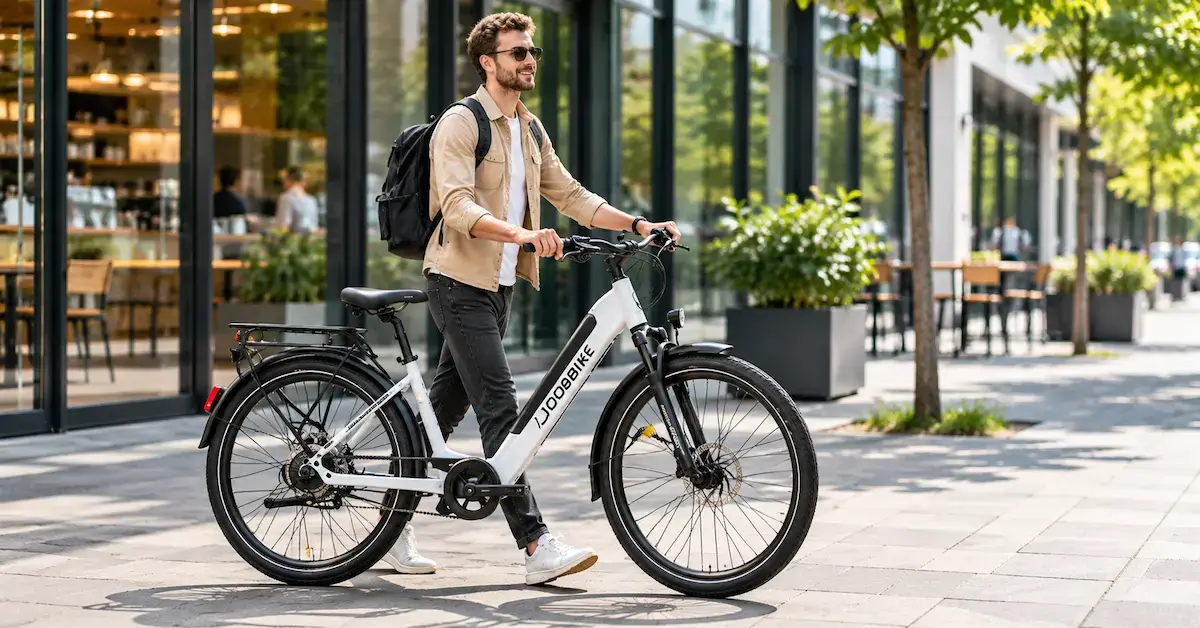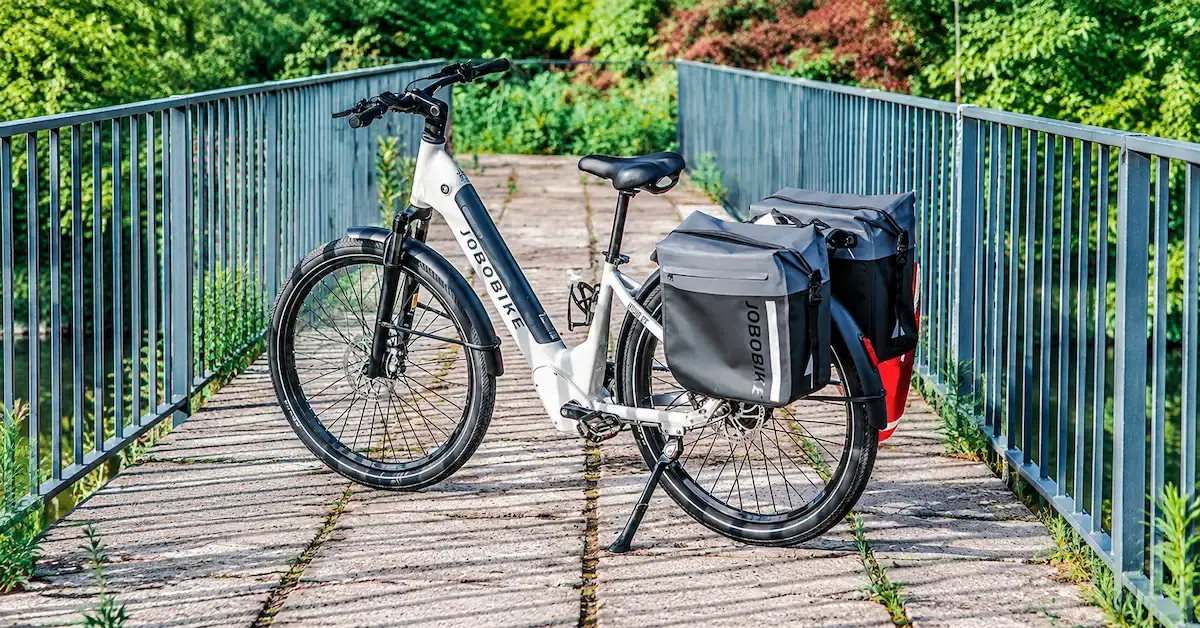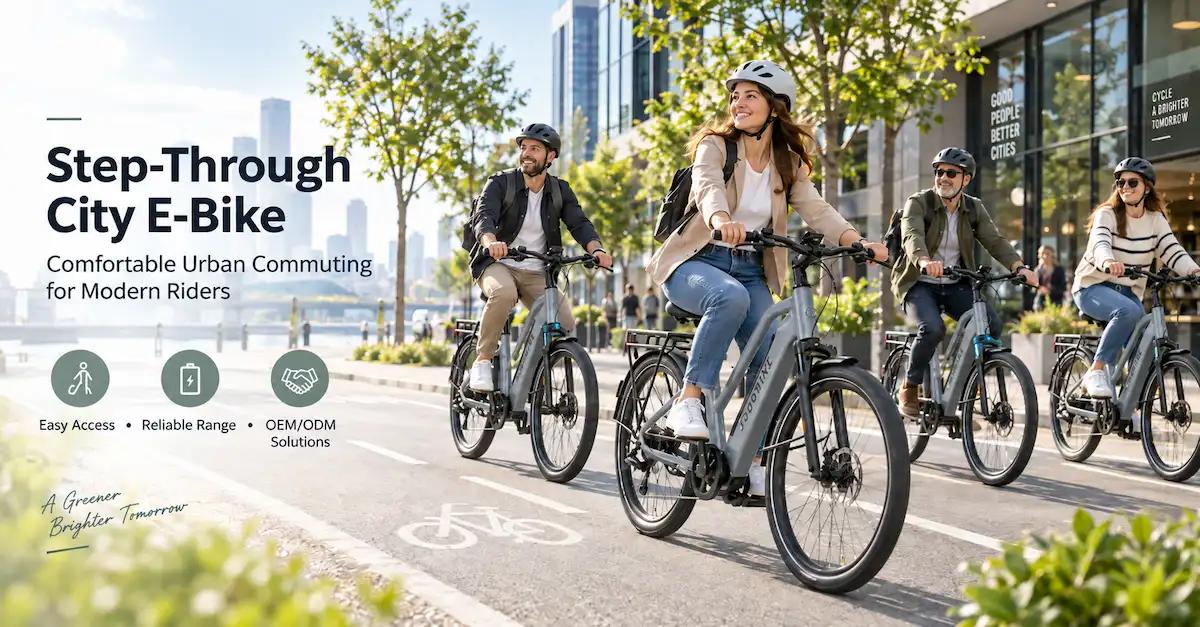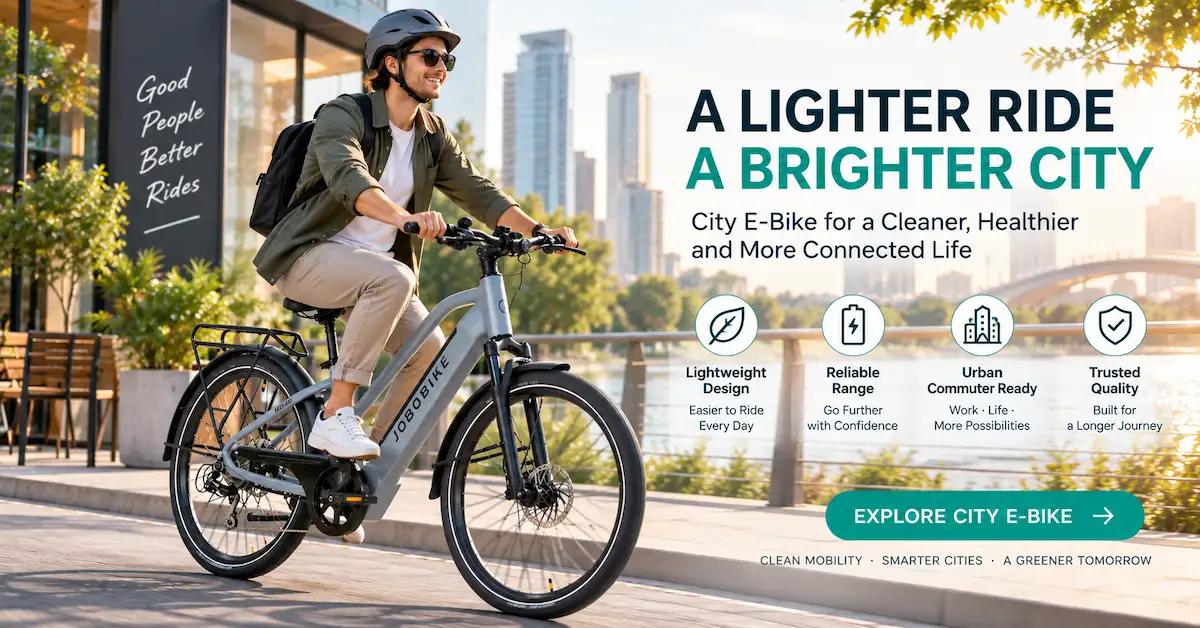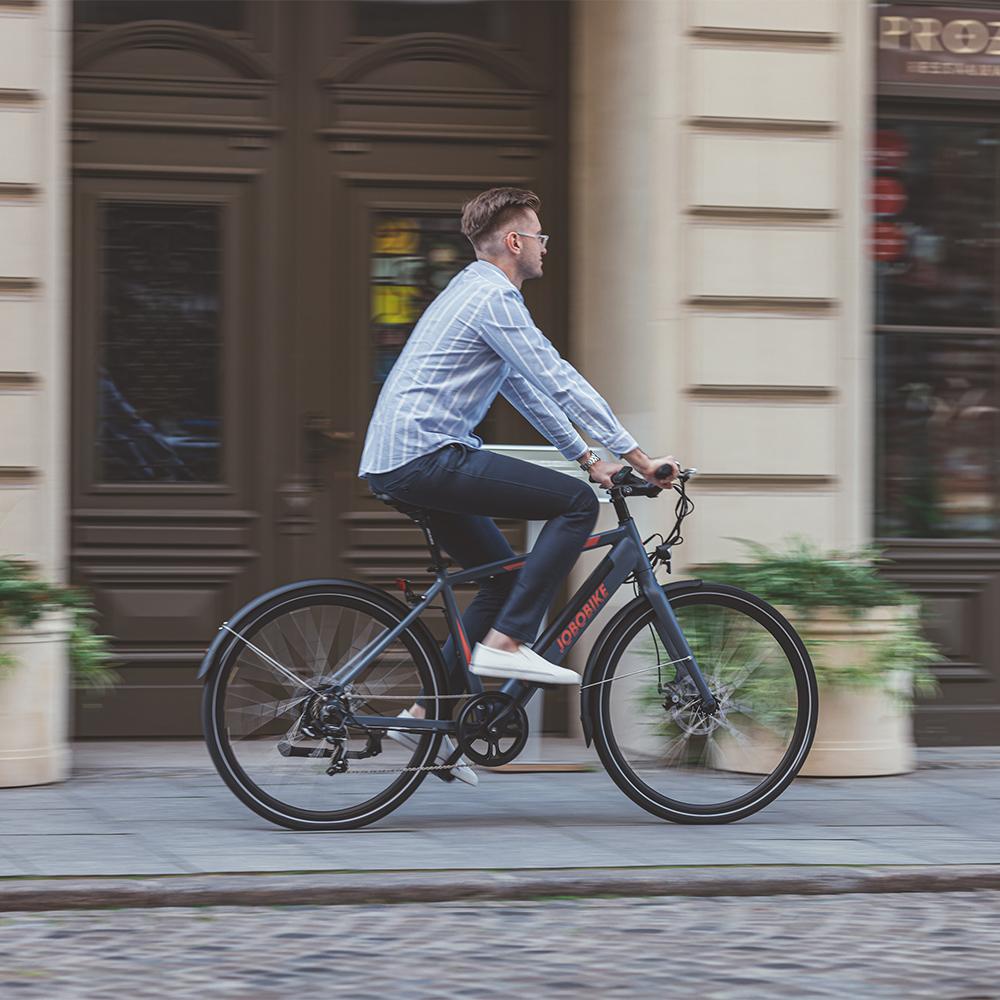
A step-through electric bike can attract customers through its approachable frame shape, practical accessories, and everyday riding comfort. For a retailer, however, an attractive demonstration model is only the beginning. The product must also fit the store's customer base, arrive in an assembly-ready configuration, generate a sustainable margin, and remain serviceable after the first sale.
That is why sourcing wholesale step-through e-bikes for retailers should involve more than comparing factory prices and battery sizes. Purchasing managers need to understand showroom fit, demo-bike preparation, inventory exposure, market-specific configurations, warranty obligations, and replenishment reliability. An inexpensive bike that requires repeated workshop corrections or becomes difficult to restock may be a poor commercial choice.
This guide explains how bicycle shops, multi-store retailers, and regional distributors can move from initial selection to a profitable reorder plan. It uses JOBO's publicly described city commuter platforms as technical references, while directing readers only to the site's main product catalogue and confirmed company service pages instead of product URLs that may no longer be accessible.
Quick Answer: How Should Retailers Buy Wholesale Step-Through E-Bikes?
Choose wholesale step-through e-bikes by evaluating rider fit, complete landed cost, showroom demonstration quality, pre-delivery inspection effort, and dependable after-sales supply. Begin with one or two clearly differentiated models, request current configuration and market-compliance documentation, and test a representative sample before ordering stock. Calculate the cost of assembly, transaction fees, service provision, and unsold inventory—not just the difference between the wholesale quote and retail price.
A useful manufacturing partner should provide a controlled bill of materials (BOM), agreed sample and quality procedures, replacement-part identification, and a written process for component changes. Retailers can explore JOBO's current product range or request a wholesale quotation with their intended market and forecast.
1. Start With Your Store's Actual Customer, Not the Largest Catalogue
Step-through describes a frame with a relatively low entry area, but it does not establish universal fit or suitability. Reach, standover, saddle adjustment, handlebar position, bicycle mass, and rider confidence still matter. Customers may value the frame because they commute in work clothes, stop frequently, or simply prefer an easier mounting experience; these are different sales conversations.
| Retail channel | Typical customer question | Stocking implication |
|---|---|---|
| Independent cycle shop | Will this bike feel comfortable and easy to ride? | Prioritize representative demo sizes and trained staff |
| Urban mobility retailer | Does it include practical commuting equipment? | Check lights, rack, fenders, kickstand, and battery access |
| Regional dealer network | Can all stores obtain consistent replacements? | Use agreed BOM revisions and a spare-parts plan |
| Online-first e-bike seller | How much assembly will buyers need? | Test packaging, instructions, and damage rates |
| Lifestyle retailer | Is there a visible reason to choose this model? | Focus on design, fit, and clear product differentiation |
A business serving mountain-bike enthusiasts may not need the same step-through assortment as one serving daily commuters. The first purchase decision should therefore be a defined customer profile and intended use, not a volume discount.
2. Limit the Initial Range to Meaningful Choices
A frequent retail mistake is launching too many frame sizes, finishes, and battery combinations before demand is known. Suppose a shop considers two commuter models, three colors, two sizes, and two battery options: this already creates 24 possible finished-bike SKUs. Even when the factory can build them, the store may not have the floor space, cash, or demand to support every combination.
Consider two positions instead:
Everyday step-through commuter. A practical city model with intuitive assistance, appropriate gears, secure battery installation, and familiar service parts. The primary promise is comfortable everyday transport.
Premium low-maintenance commuter. A distinctly different configuration that may emphasize a validated belt-drive arrangement, refined assistance, finish quality, or other demonstrable ownership benefits. The premium must be justified by actual riding and service advantages.
Avoid marketing a model as step-through merely because it appears in a city-bike collection. The exact frame geometry must be confirmed before a retailer uses that description in product listings.
JOBO platform references without unstable deep links
JOBO's publicly described JB-TDB29Z City Commuter is a relevant reference because its product information identifies a 6061 aluminum step-through frame, torque-sensing assistance, Shimano eight-speed drivetrain, and hydraulic disc brakes. The published configuration lists a 36V 350W motor and 36V 15Ah battery.
The JB-TDB30Z Belt Drive City E-Bike is another publicly described urban platform, useful for comparing drivetrain service requirements and premium positioning. Its exact frame-entry design should be confirmed before presenting it as a step-through product. Both are reference platforms, not a promise of current stock, price, universal regulatory compliance, or identical spare parts. Find the current model listings through the JOBO Products page.
| Procurement question | JB-TDB29Z reference | Belt-drive city reference |
|---|---|---|
| Main retail proposition | Comfortable step-through commuting | Low-maintenance urban positioning |
| Drivetrain | Published Shimano 8-speed configuration | Belt-drive architecture described |
| Dealer evaluation | Rider fit, torque-sensor feel, shifting | Belt tension, alignment, replacement supply |
| Must reconfirm | Latest specification and destination-market version | Frame design and exact drivetrain components |
3. Design a Repeatable Showroom and Test-Ride Process
Retailers can distinguish themselves from online-only sellers by showing how a bicycle actually fits and feels. A consistent demonstration also makes sales feedback more useful to purchasing teams.
First, check that the customer can approach, mount, and dismount the bicycle comfortably. Then adjust saddle and handlebar positions within approved limits, confirm access to brake levers, and explain the assistance controls. A controlled test ride should let the customer experience starting, stopping, steering, shifting where applicable, and braking in an appropriate permitted setting.
Finish by demonstrating the tasks that will matter after purchase: battery removal and charging, lights, locking arrangements, rack use within its approved rating, and routine service needs. Do not make age-based or medical claims about frame accessibility; suitability is individual.
| Demonstration | Buyer question it resolves |
|---|---|
| Step-through opening | Can I mount and dismount comfortably? |
| Reach and saddle adjustment | Does this size fit me? |
| Pedal assist and gearing | Does it respond naturally on my route? |
| Braking and steering | Can I control it confidently? |
| Battery access | Can I charge it in my living arrangement? |
| Rack and accessories | Does the complete bike meet everyday needs? |
Staff should record reasons for purchase and nonpurchase by model. Those observations can be more valuable for the second wholesale order than a broad assumption that one frame style suits every customer.
4. Require a Retail-Ready Technical Specification
Before asking for the lowest price, request a complete specification for the proposed sales market. At minimum, it should identify frame sizes and intended load limits, motor and controller configuration, battery and charger, brake components, drivetrain, tires, lighting, and included accessories. Each item should be tied to a version of the BOM rather than left as a generic statement such as "Shimano or equivalent."
| System | What the retailer needs in writing | Why it matters |
|---|---|---|
| Frame | Geometry, fit range, material, approved loads | Customer suitability and accessories |
| Motor/control | Rated specification and assistance behavior | Ride quality and legal category |
| Battery/charger | Actual pack ID, charger compatibility, replacement policy | Charging and after-sales support |
| Brakes | Caliper, rotor, pad, inspection procedure | Safety and workshop stock |
| Transmission | Chain or belt parts and service instructions | Maintenance economics |
| Accessories | Included rack, fenders, lights, kickstand | Comparable finished retail price |
| Packaging | Carton, protection, assembly state | Delivery cost and damage risk |
The nominal battery-energy calculation is voltage multiplied by amp-hours: a 36V × 15Ah pack is approximately 540Wh of nominal energy. That does not establish a real-world riding range. A manufacturer's range statement must be interpreted with its test conditions, load, temperature, and assistance level.
For some EU pedal-assist categories, a maximum continuous rated motor power of 250W and assistance cut-off conditions are relevant. A website listing 350W does not establish compliance with a 250W category. Request documents for the actual market-specific version rather than assuming a display speed setting makes a bicycle compliant.

5. Test Pre-Delivery Inspection Before Buying in Volume
A retail bike can arrive in a carton yet still need substantial work before customer handover. Ask for the approved assembly instructions and build a pre-delivery inspection (PDI) process with the correct tools and torque values. Test the process on a representative sample, recording the labor and any recurring adjustment.
A practical PDI record includes the model and serial number; frame and transport-damage inspection; wheel, headset, brake, and drivetrain checks; battery retention; charger identity; display and assistance behavior; lights and accessories; and the final test and customer handover documentation. Specific steps must follow the manufacturer's procedures and applicable requirements.
A good wholesale arrangement should answer who supplies missing parts, how nonconforming units are handled, which defects require quarantine, and who pays for approved remedial labor. JOBO describes factory inspection capabilities through its QC Labs, but retailers should still request product-specific evidence and an actual PDI instruction set.
6. Calculate the Margin After Real Selling Costs
Retail margin is often overstated when purchasing discussions compare only a bicycle's wholesale price with its shelf price. A better first measure is contribution before fixed overhead:
Net sales revenue − landed bicycle cost − PDI labor − transaction expenses − expected warranty/service provision.
| Illustrative item | Amount |
|---|---|
| Retail revenue excluding relevant sales taxes | $1,799 |
| Landed bicycle cost | $1,250 |
| Preparation and PDI | $70 |
| Payment/transaction expense | $35 |
| Expected warranty/service provision | $45 |
| Contribution before fixed overhead | $399 |
This is a hypothetical example, not JOBO pricing or a retailer profit forecast. The $399 must still support store rent, wages, marketing, financing, returns, and unsold stock. A slightly lower unit quote can be less attractive if it produces much higher assembly or warranty costs.
When comparing quotations, insist on the same included battery, charger, lighting, accessories, packaging, Incoterms, and support commitments. Ask whether demo units, spare parts, brand labels, or compliance documentation are additional costs.
7. Reorder on Sell-Through, Not on Enthusiasm
A strong showroom launch should produce data that improves the next purchase. Track sales by exact model, size, color, and approved configuration. Measure the rate of sale over a consistent period and identify which variants attract demonstrations but fail to convert.
For businesses sourcing wholesale step-through e-bikes for retailers, an effective replenishment strategy should consider sales performance, inventory turnover, supplier lead times, and replacement-parts availability. Choosing consistent product configurations can help bicycle shops reduce stocking risks while improving long-term purchasing efficiency.
Useful measures include:
- Sell-through: units sold during a period compared with the units available under a consistent definition.
- Stock cover: sellable units divided by average weekly sales.
- Reorder point: expected demand during confirmed replenishment lead time plus suitable safety stock.
For instance, a hypothetical shop selling three units weekly with an eight-week replenishment lead time and a four-unit safety allowance would consider a reorder point of 28 units: (3 × 8) + 4. This is arithmetic for planning, not a JOBO lead time or MOQ.
Actual reorder decisions should account for seasonality, minimum order requirements, cash flow, shipping variability, and the possibility that a new specification revision affects compatibility. For multi-store retailers, moving stock between locations may be preferable to ordering additional slow-moving variants.
8. Make Warranty and Replacement Parts Part of the First Purchase Order
Step-through bikes often compete on day-to-day convenience. A long wait for a proprietary battery, brake part, display, or controller can undermine that customer promise. Ask for a model-specific spare-parts catalogue with revision numbers and compatibility notes.
The service agreement should address warranty claim evidence, response procedures, approved local repairs, faulty-part returns, diagnostic information, and replenishment of common wear items. Similar nominal battery voltage does not prove that two battery packs or chargers are interchangeable.
For a retail chain, establish one person responsible for coordinating supplier changes with the shop's inventory and service records. If a manufacturer replaces a component in a repeat order, the buyer should receive notice and a decision on any fit, testing, or documentation implications.
JOBO's OEM/ODM service page describes product selection, engineering, production, quality control, and delivery support. Confirm which warranty and spare-parts commitments apply to your contract rather than assuming that every option is standard.
9. Use a Wholesale RFQ That Produces Comparable Offers
The strongest request for quotation defines the intended customer and fully configured product instead of asking for "best step-through e-bike price." Include the destination market, store or distributor profile, preferred low-entry frame and size range, motor and battery requirements, approved equipment, color selection, quantity, packaging expectations, PDI requirements, and expected reorders.
| RFQ field | What to provide or request |
|---|---|
| Market and buyer | Country, retail channels, target riders |
| Product | Confirmed step-through geometry, sizes and full BOM |
| Electrical | Motor/control version, battery and charger IDs |
| Retail equipment | Lights, rack, fenders, kickstand, display |
| Order plan | Demo units, first shipment, forecast and variants |
| Quality | Sample approval, inspections and PDI instructions |
| Compliance | Documentation for the exact destination-market version |
| Commercial | MOQ, pricing, Incoterms, lead time, payment terms |
| After-sales | Warranty, manuals, parts and technical escalation |
Sample inquiry: “We are sourcing step-through commuter e-bikes for retail stores in [market]. Our customer profile is [description], with [number] stores and a planned first order of [quantity]. Please recommend current models from your product catalogue and provide complete specifications, demo-sample options, retail assembly instructions, compliance documents, MOQ, delivery conditions, warranty terms, and spare-parts pricing. We also need a repeat-order process that preserves the approved BOM.”
Send your retailer RFQ to JOBO.
10. Ten Frequently Asked Questions
1. Where can stores source wholesale step-through e-bikes?
Retailers can buy through manufacturers, importers, or authorized distributors. When approaching JOBO, begin with the current product catalogue and request a model-specific quotation rather than relying on an old product-page link.
2. Why is a step-through frame useful for city retail?
Its lower entry can make mounting and dismounting appealing for many commuters and frequent-stop riders. Actual rider fit, handling, and suitability still require individual assessment.
3. Is JB-TDB29Z a confirmed step-through reference?
JOBO's published product information describes JB-TDB29Z as a step-through city commuter. The current sales configuration, availability, and destination-market documents should be confirmed before placing an order.
4. Is a belt-drive city bike always step-through?
No. Belt drive describes the transmission, not the frame shape. A belt-drive model should only be marketed as step-through after checking its actual geometry.
5. How many models should a new retailer initially stock?
There is no fixed number. One or two differentiated models with suitable sizes and demo availability can be easier to test than a broad launch with many unproven variants.
6. Does a 36V 15Ah battery guarantee a stated range?
No. It represents approximately 540Wh nominal energy; real distance depends on rider load, temperature, terrain, assistance level, and other factors.
7. What is included in pre-delivery inspection?
The model-specific process generally covers assembly condition, brakes, wheels, steering, electrical controls, battery, accessories, documentation, and final checks under approved instructions.
8. How can stores calculate realistic wholesale margins?
Include landed cost, assembly, transaction expenses, expected warranty support, and other relevant costs. The factory-to-retail price difference alone is not net profit.
9. Can JOBO support private-label retail orders?
JOBO advertises OEM/ODM services, including branding and configuration work. Actual options, quantities, validation and delivery commitments depend on the selected model and project.
10. How do I request a current JOBO step-through e-bike quotation?
Use the contact page with your market, intended customers, required frame configuration, forecast volume, retail equipment, and after-sales needs. Ask for a current product listing and signed specification.
Conclusion
Sourcing wholesale step-through e-bikes for retailers is a showroom-to-reorder decision, not a search for the lowest catalogue price. The strongest retail program combines a truly suitable frame and riding experience with controlled specifications, reasonable preparation costs, market-ready documentation, dependable service parts, and demand-led replenishment.
Retailers should start with a focused assortment, test representative bicycles, document pre-delivery inspection, calculate realistic contribution after support costs, and agree how a manufacturer will handle changes before placing a repeat order. JOBO's product range, OEM/ODM capabilities, and quality-control information provide starting points for that discussion. For a current model shortlist, specifications, sample options, and wholesale terms, contact JOBO for a retailer quotation.