What Should Buyers Actually Look for in a Lightweight City E-Bike Factory?
A reliable lightweight city e-bike factory should be able to reduce unnecessary mass without creating new problems in frame strength, battery capacity, braking performance, ride stability, manufacturing consistency or after-sales support.
That distinction matters.
For an OEM buyer, “lightweight” should never be treated as a single marketing number. A 21 kg bicycle with a large removable battery, full commuter equipment and a strong frame may be more commercially suitable than an 18 kg bicycle that reaches the lower number by using a smaller battery, lighter-duty fork, narrow tires or fewer accessories.
The correct sourcing question is therefore not:
“Which factory can build the lightest city e-bike?”
It is:
“Which factory can achieve our target finished weight while protecting the range, ride quality, durability, compliance and service requirements of our market?”
That is the question brands, importers, distributors and private-label buyers should resolve before freezing a BOM.
At JOB, city e-bike development can be approached through a combination of existing commuter platforms, OEM component changes and deeper ODM engineering. Buyers who already know their target market can also review the company's broader OEM/ODM capabilities before defining the project.
What Does “Lightweight” Mean for a City E-Bike?
There is no useful B2B definition of a lightweight city e-bike unless the supplier also explains how the weight is measured and which configuration the figure refers to.
A sourcing specification should distinguish at least four numbers:
| Weight Item | Why It Matters |
|---|---|
| Finished bike weight with battery | Most relevant to the end user's real handling experience |
| Finished bike weight without battery | Useful when buyers compare removable-battery designs |
| Frame weight | Helps evaluate structural engineering separately from components |
| Packed gross weight | Important for warehousing, shipping and dealer handling |
A buyer should also clarify whether the quoted bicycle includes:
- fenders;
- rear rack;
- integrated lights;
- kickstand;
- suspension fork;
- display;
- chain guard;
- bell;
- lock;
- basket;
- cargo accessories;
- battery;
- charger.
Two suppliers may both advertise a “20 kg city e-bike” while quoting completely different equipment levels.
This is why the target weight should appear in the project specification together with the exact approved BOM.
For a private-label project, a more useful requirement might be:
Target finished weight: ≤22 kg including battery, fenders, rear rack, front and rear lights, kickstand and production-standard tires.
That statement is actionable.
“Make it lightweight” is not.
Why Weight Matters More in Urban E-Bike Programs
Weight affects more than the rider's ability to lift the bike.
For city e-bike buyers, it can influence the entire product proposition.
Apartment and Urban Storage
Many city riders live in apartments or mixed-use buildings. They may need to move the bicycle through elevators, corridors, bicycle rooms or short staircases.
A lighter bicycle can make those situations easier, particularly when the battery is removable.
However, reducing weight at the expense of frame stiffness or practical equipment would be a poor trade.
A commuter still needs a bicycle that works in daily rain, traffic, stop-and-go riding and repeated parking.
Dealer Handling
Dealers regularly:
- unbox bicycles;
- place them on service stands;
- move them around showrooms;
- install accessories;
- perform maintenance;
- load and unload bikes.
Weight therefore affects dealer experience as well as rider experience.
Fleet and Rental Operations
Rental and corporate mobility buyers often care less about achieving the lowest possible weight and more about predictable maintenance.
In those projects, a slightly heavier component may be justified if it reduces service frequency.
The best specification depends on the business model.
Battery Efficiency
Lower system weight can contribute to energy efficiency, but buyers should be careful about oversimplifying range.
Actual electric bicycle range depends on multiple variables, including:
- rider mass;
- cargo;
- terrain;
- temperature;
- tire pressure;
- stop frequency;
- riding speed;
- motor assistance level;
- battery capacity;
- motor efficiency.
A supplier should therefore present claimed range as a test or reference condition, not as an unconditional result every rider will achieve.
Freight and Packaging
A few kilograms per bicycle can become commercially meaningful when multiplied across large shipments.
But procurement teams should compare packed gross weight, not just bicycle net weight.
A lightweight bicycle in an oversized or heavy carton may not deliver the logistics benefit the buyer expected.
The Eight Main Engineering Levers Behind a Lightweight City E-Bike
There is rarely one component responsible for a successful lightweight design.
Factories normally need to balance several systems together.
1. Frame Architecture
The frame is one of the most important areas because weight reduction cannot simply mean “use less aluminum.”
A city e-bike frame has to manage forces from:
- rider load;
- motor assistance;
- battery mounting;
- road impacts;
- braking;
- steering;
- racks and accessories;
- repeated daily use.
Frame geometry, tube profile, wall thickness, reinforcement position and welding quality all matter.
JOBO's frame factory supports in-house frame manufacturing, including CNC-related processing, robotic welding, heat treatment, correction, measurement and finishing.
That type of vertical integration can be important for an ODM project because lightweight design often requires changes at the frame level rather than simply replacing bolt-on parts.
A buyer developing a proprietary city platform should ask:
- Is the frame an existing platform or a new geometry?
- Is 6061 aluminum being used?
- Which areas have been reinforced?
- Has the battery opening affected down-tube stiffness?
- Is the motor interface standardized?
- How is cable routing designed?
- What dimensional tolerances are controlled?
- What testing is planned after structural changes?
These questions reveal much more than asking for frame weight alone.
2. Motor Selection
A more powerful motor is not automatically better for a city bicycle.
Motor selection should reflect:
- destination market;
- legal vehicle category;
- expected gradients;
- rider weight;
- acceleration expectations;
- battery capacity;
- desired bicycle weight;
- controller settings.
For a commuter-focused product, excessive motor size can increase weight, battery demand and cost without improving the customer's real use case.
Conversely, undersizing the motor can create poor hill performance and higher customer dissatisfaction.
This is why motor power should be selected after the riding scenario is defined.
3. Battery Capacity
Battery selection creates one of the clearest weight-versus-range trade-offs.
A larger battery normally supports longer riding distance but also adds:
- mass;
- cost;
- charging time;
- packaging requirements.
A smaller battery may help reach a weight target, but it can weaken the product if the brand's marketing promise is “all-day urban commuting.”
Buyers should therefore begin with the required operating scenario.
For example:
A short-distance city commuter product might prioritize lower mass.
A long-distance suburban commuter model may justify a larger battery.
A rental fleet might prioritize easy battery replacement and serviceability.
There is no universally correct battery size.
4. Suspension
Suspension forks can improve comfort on rough urban surfaces, but they add parts and weight.
A rigid fork may be attractive for a lightweight city bike intended for relatively smooth roads.
A suspension fork may be better for markets with:
- potholes;
- brick roads;
- damaged pavement;
- mixed bicycle paths.
The choice should come from market research rather than from a spreadsheet weight target.
5. Wheels and Tires
Wide tires can provide grip, comfort and visual presence but generally add mass and rolling resistance compared with narrower commuter tires.
Very narrow tires, however, may reduce comfort or durability in poor road conditions.
OEM buyers should evaluate:
- wheel diameter;
- tire width;
- puncture protection;
- tread;
- rim specification;
- spoke count;
- rider load;
- local road quality.
The lightest tire is not necessarily the lowest-cost tire over the warranty period.
6. Brakes
Brake selection should not be treated as a simple opportunity to remove weight.
Urban e-bikes may experience:
- frequent stops;
- heavier system mass than conventional bicycles;
- wet-weather operation;
- downhill sections;
- cargo accessories.
Hydraulic disc brakes may be appropriate for some city programs because of their braking characteristics and user expectations.
Other programs may choose a different solution for price or maintenance reasons.
The key is to connect brake choice to the actual bicycle configuration and market position.
7. Drivetrain and Accessories
A large amount of “hidden” weight is found in everyday commuter equipment.
Consider:
- racks;
- fenders;
- baskets;
- chain guards;
- locks;
- adjustable stems;
- suspension seatposts;
- kickstands;
- lights;
- heavy saddles;
- reinforced pedals.
Removing these parts may create a lighter specification but also make the bicycle less useful.
For urban products, practical equipment often sells the bicycle.
8. Electrical Integration
Poorly integrated wiring can increase complexity, service time and perceived product quality.
A well-engineered city e-bike should consider:
- battery integration;
- controller location;
- display wiring;
- light wiring;
- sensor routing;
- connector protection;
- service access.
The goal is not only to save grams.
It is to create a clean, repeatable production design that dealers can service.
Why In-House Frame Manufacturing Matters for Lightweight OEM Projects
Many lightweight e-bike decisions begin before final assembly.
If a supplier purchases finished frames from another factory, the buyer may have fewer options when asking for:
- geometry changes;
- tube adjustments;
- battery integration;
- routing changes;
- motor interface changes;
- rack mounting changes;
- step-through reinforcement.
An integrated manufacturer can potentially control more of the development chain.
JOBO's China manufacturing operation combines frame-related manufacturing, painting and bicycle assembly.
For B2B buyers, that matters for three reasons.
Faster Engineering Feedback
If a prototype reveals a geometry, welding or battery-fit problem, the frame engineering team and assembly team can work from the same project specification.
Better Change Control
A weight-reduction decision often affects several downstream processes.
For example, changing a tube profile may affect:
- welding fixtures;
- cable routing;
- paint preparation;
- battery clearance;
- rack mounting;
- packaging.
The more fragmented the supply chain, the harder those changes can be to control.
Better Repeatability
The sample is only useful if mass production can repeat it.
That is the real OEM challenge.
A perfect showroom sample followed by inconsistent production is not a successful development program.
A Real City E-Bike Platform Example
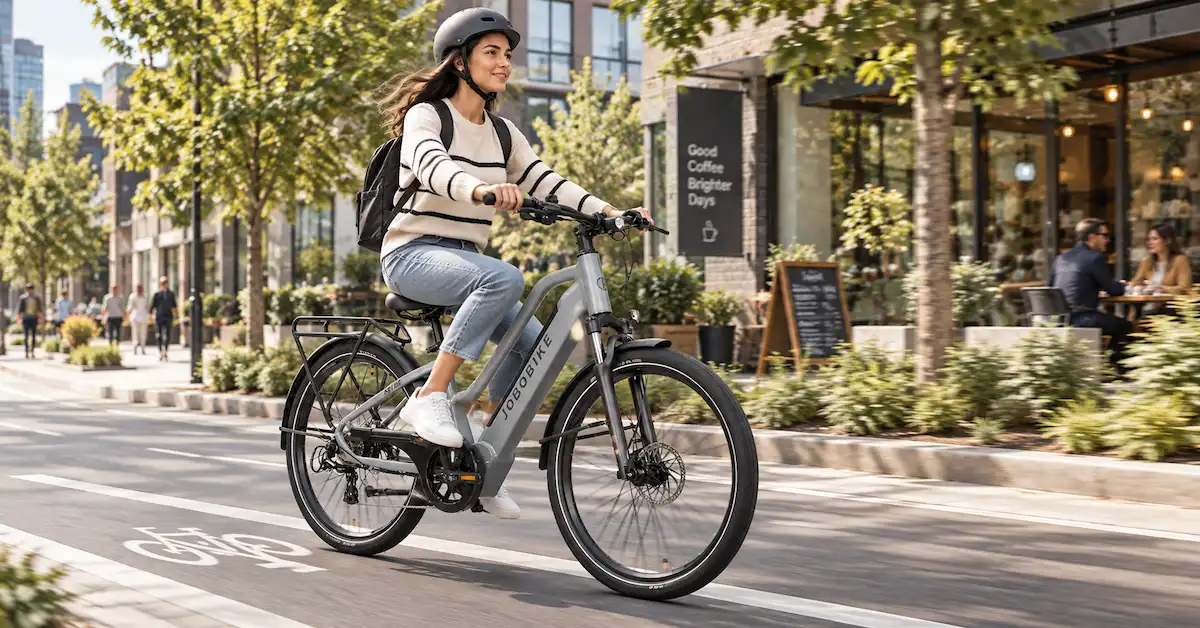
JOBO's city commuter electric bike provides a useful example of how an OEM buyer can start evaluating a commuter platform.
The published configuration for model JB-TDB29Z includes:
- 36V 350W motor;
- 36V 15Ah Samsung battery;
- 25 km/h reference speed;
- approximately 60 km stated range;
- 27.5 × 2.35 tires;
- hydraulic disc brakes;
- torque sensor;
- multi-speed drivetrain;
- commuter-oriented frame and components.
This does not automatically make the model the answer to every lightweight project.
Instead, it gives buyers a reference platform from which they can ask engineering questions.
For example:
Could a different tire size reduce mass while preserving city comfort?
Could the fork specification be changed?
Does the target market need a 15Ah battery, or would another battery configuration fit the customer profile?
Are the rack and fenders essential?
Does the motor configuration comply with the intended market category?
Which accessories will be installed at the factory?
What will the actual finished-bike weight be after the final BOM is approved?
That is how a B2B buyer should use an existing platform.
Not as a fixed product, but as a starting point for a commercially relevant specification.
Build the Requirement Sheet Before Requesting a Quote
One of the fastest ways to receive poor quotations is to send a factory a vague request:
“Please quote your best lightweight city e-bike.”
Factories will make different assumptions.
The quotations will not be comparable.
A professional RFQ should look closer to this:
| Requirement | Buyer Should Define |
|---|---|
| Target market | EU, UK, North America, other |
| Buyer type | Brand, importer, distributor, retailer, fleet |
| User scenario | Daily commuting, rental, corporate mobility |
| Frame style | Step-through, diamond, other |
| Target bike weight | Define with or without battery and accessories |
| Rider / payload | Expected load range |
| Motor | Required performance and market restrictions |
| Battery | Capacity target and desired range |
| Brake | Hydraulic/mechanical/other |
| Fork | Rigid or suspension |
| Tire | Diameter, width, puncture requirements |
| Sensor | Cadence or torque |
| Display | Basic, color, Bluetooth, app requirements |
| Accessories | Rack, fenders, lights, basket, lock |
| Branding | Logo, decals, color, packaging |
| Compliance | Target standards and documentation |
| Packaging | Carton dimensions, shipping requirements |
| Service | Spare parts, warranty components |
| Volume | Trial order and projected annual demand |
A factory can engineer around this information.
Without it, both sides spend time comparing numbers that describe different bicycles.
How to Compare Lightweight City E-Bike Factory Quotations
Price comparison only works when the BOMs are equivalent.
A quotation that is USD 40 lower may use a different:
- cell brand;
- battery capacity;
- brake;
- drivetrain;
- tire;
- fork;
- display;
- controller;
- charger;
- paint process;
- packaging;
- accessory package.
The buyer should therefore request a structured BOM comparison.
Compare the Complete Configuration
Do not compare only:
Motor: 250W
Battery: 36V 10Ah
Brake: Disc
Those descriptions are too broad.
Ask for enough detail to understand exactly what is being supplied.
Confirm What Is Included in the Weight
If the supplier gives a low number, ask:
- Is the battery included?
- Are fenders included?
- Is the rear rack installed?
- Does it include pedals?
- Are production tires installed?
- Is this sample weight or theoretical weight?
- What weight tolerance is expected in production?
Lock the Golden Sample
The approved sample should become the reference for:
- component selection;
- color;
- decals;
- cable routing;
- functions;
- ride feel;
- packaging;
- accessories.
Any later BOM change should be documented and approved.
That process protects both the buyer and the manufacturer.
Lightweight Should Never Mean Under-Engineered
One of the most common sourcing mistakes is assuming that less material automatically means better engineering.
It does not.
A city e-bike frame experiences repeated stress over thousands of real-world riding cycles.
Removing material without understanding load paths can create:
- excessive flex;
- alignment issues;
- fatigue problems;
- welding concentration points;
- rack instability;
- battery-mount movement.
This is where manufacturing engineering becomes more important than marketing language.
JOBO describes its frame operation as including CNC-related processing, robotic welding, heat treatment, dimensional correction and inspection. Buyers evaluating an ODM program can review the frame manufacturing capability as part of supplier qualification.
The procurement lesson is simple:
Do not ask a factory to make a frame lighter without asking how the revised design will be validated.
Quality Control for a Lightweight City E-Bike Program
Weight optimization increases the importance of process control.
When specifications become tighter, small production variations become more visible.
A professional project should manage quality through several stages rather than relying on a final visual inspection.
JOBO's published quality approach includes incoming, in-process, final and QA-related inspection stages.
For the buyer, those stages can be translated into practical questions.
Incoming Components
Ask how the factory checks:
- batteries;
- motors;
- controllers;
- displays;
- brakes;
- forks;
- tires;
- chargers.
Frame Production
Ask about:
- tube dimensions;
- welding consistency;
- frame alignment;
- motor interface;
- battery fit;
- mounting holes;
- paint thickness and appearance.
Assembly
Check:
- torque requirements;
- brake setup;
- drivetrain adjustment;
- sensor operation;
- display functions;
- wiring;
- lighting;
- fasteners.
Final Bike
The final inspection should confirm:
- approved BOM;
- cosmetic condition;
- electrical operation;
- braking;
- shifting;
- wheel alignment;
- accessories;
- packaging.
Factories may perform different tests depending on model, market and project scope.
The buyer should therefore request a project-specific inspection and test plan rather than assuming every possible test applies automatically.
Compliance Must Be Matched to the Exact Configuration
A common sourcing error is asking:
“Does your factory have CE?”
That question is too broad.
Compliance is not simply a factory badge that automatically covers every electric bicycle configuration.
The correct questions include:
- Which exact model is covered?
- Which configuration was tested?
- Which standard version applies?
- Who is the certificate holder?
- Does changing the motor affect the approved configuration?
- Does changing battery architecture require additional verification?
- What documentation is available for the destination market?
JOBO's certifications and patents page lists documentation and certifications associated with the company's products and management systems, including EN-related, CE, TUV and other materials.
However, B2B buyers should still verify the certificate against the exact product they plan to purchase.
This is particularly important when optimizing weight because a lighter project may involve changing:
- motor;
- battery;
- fork;
- tires;
- frame;
- electronics.
A modified BOM is not automatically the same tested configuration.
OEM or ODM: Which Route Is Better for a Lightweight City E-Bike?
The answer depends on how differentiated the product needs to be.
Choose OEM When:
- you want a faster project;
- an existing city frame already fits the market;
- most changes involve branding and components;
- you need a manageable development budget;
- product launch speed matters.
Typical OEM customization may include:
- paint color;
- logo;
- decals;
- battery;
- motor;
- display;
- brakes;
- drivetrain;
- tires;
- saddle;
- grips;
- rack;
- lighting;
- packaging.
Choose ODM When:
- the frame geometry needs to change;
- the battery should be integrated differently;
- you need proprietary structural features;
- weight reduction requires tube redesign;
- the product needs a distinct market identity.
JOBO's OEM and ODM service covers both platform-based customization and deeper product development.
For many brands, the most efficient strategy is not to begin with a completely new bicycle.
Start with a proven platform.
Identify what prevents it from meeting the commercial target.
Then redesign only what creates measurable value.
That approach can reduce development risk while still giving the final product a distinct identity.
A Practical Eight-Step Development Process
A lightweight city e-bike should move through a controlled development process.
JOBO's manufacturing workflow can be organized into eight practical stages.
1. Requirements and Market Brief
Define:
- destination country;
- buyer type;
- rider;
- use scenario;
- price position;
- target weight;
- expected range;
- regulatory requirements.
This is where bad projects are usually either prevented or created.
2. Configuration and BOM Review
Review all major systems:
- frame;
- motor;
- battery;
- controller;
- sensor;
- brake;
- fork;
- wheel;
- tire;
- drivetrain;
- display;
- lighting;
- accessories.
At this stage, the buyer should already be watching total weight.
3. Engineering and Industrial Design
If changes are needed, engineering work may include:
- geometry;
- frame structure;
- battery placement;
- cable routing;
- accessory mounting;
- paint design.
4. Frame Manufacturing and Painting
The physical frame and finish are produced according to the approved engineering plan.
Buyers considering deeper frame customization can review JOBO's China factory and frame production capability.
5. Prototype and Testing
The prototype allows both sides to check whether the specification works as a complete bicycle.
This stage is especially important for lightweight projects.
A spreadsheet can predict weight.
Only a built bicycle can confirm handling, fit, installation and user experience.
6. Sample Approval and Production Lock
The buyer approves:
- GOOD;
- appearance;
- functions;
- color;
- branding;
- packaging;
- accessories.
Changes after this point should be controlled.
7. Controlled Mass Production
Production should follow the approved sample and locked specification.
If a component becomes unavailable, substitute parts should not simply be installed without review.
8. Final Inspection and Delivery
Before shipment, the final bikes should be checked against the agreed specification.
Commercial documentation, packaging and spare parts should also be confirmed.
Buyers ready to discuss a project can use the JOBO contact page to submit the market, volume and specification requirements.
Where Many Lightweight City E-Bike Projects Go Wrong
The most expensive mistakes often happen before mass production.
Mistake 1: Comparing Weight Without a Common Definition
Factory A quotes without battery.
Factory B quotes with battery.
The buyer chooses Factory A because the spreadsheet appears better.
Always define the measurement method.
Mistake 2: Reducing Battery Size Only to Hit a Weight Target
A smaller battery may look good on the specification sheet.
It becomes a problem when customer reviews complain about real-world range.
Weight needs context.
Mistake 3: Treating Accessories as “Optional”
If the retail bike is sold with a rack, fenders, lights and kickstand, those parts belong in the weight budget.
Otherwise the buyer is optimizing a bicycle that customers will never actually receive.
Mistake 4: Making the Frame Lighter Without Structural Validation
Tube changes should be engineering decisions.
Not purchasing decisions.
Mistake 5: Ignoring Serviceability
A beautifully integrated city e-bike can become a dealer problem if technicians cannot easily access:
- controller;
- connectors;
- battery mount;
- display wiring.
OEM engineering needs to consider the service department.
Mistake 6: Chasing the Lowest Quote
A cheaper bicycle with high warranty demand can become the more expensive program.
Evaluate total commercial risk.
Mistake 7: Treating Compliance as a Logo
A CE mark on a brochure does not answer which exact configuration and documentation package applies to your order.
Verify before purchase.
Mistake 8: Approving a Sample but Not the BOM
A sample alone is not enough.
Component codes, specifications and acceptable alternatives should be documented.
How Brands Should Think About Cost Versus Weight
Weight reduction usually has a cost curve.
The first few kilograms may be relatively easy to address by removing unnecessary equipment or selecting a better-integrated design.
The next kilogram may require:
- upgraded components;
- different battery cells;
- lighter wheelsets;
- proprietary frame work;
- more expensive manufacturing processes.
Eventually the commercial return becomes questionable.
The correct question is therefore:
How much will our target customer pay for each additional improvement in weight?
A premium commuter brand may justify a more expensive lightweight specification.
A fleet buyer may not.
A value-focused distributor may prefer a few extra kilograms in exchange for:
- lower cost;
- larger battery;
- robust rack;
- simpler maintenance.
This is why a professional city e-bike factory should help the buyer optimize commercial value, not simply minimize kilograms.
What Should Be Included in a Lightweight City E-Bike Sample Review?
When the first sample arrives, do not only ride it around the parking lot.
Create a structured review.
Record the Actual Weight
Measure:
- bike with battery;
- bike without battery;
- battery;
- charger;
- carton gross weight.
Test Real Handling
Evaluate:
- lifting;
- parking;
- walking beside the bike;
- low-speed control;
- turning;
- starting on an incline.
Check Battery Removal
Can a normal user remove and reinstall it easily?
Does the battery rattle?
Is the lock intuitive?
Review Braking
Pay attention to:
- lever feel;
- stopping response;
- rotor noise;
- alignment.
Inspect Cables
Look for:
- tight bends;
- exposed connectors;
- rubbing;
- poor routing near moving parts.
Inspect Welds and Paint
Check repeatability and finish quality.
Test Accessories
Rack, fenders, kickstand and lights must be treated as part of the product.
Review Packaging
A lightweight bicycle can still arrive damaged if packaging does not protect:
- derailleur;
- brake rotor;
- fork;
- display;
- frame paint.
When Does a China-and-Europe Manufacturing Model Matter?
For European brands, product development is only one part of the supply-chain question.
Buyers may also need to consider:
- assembly location;
- inventory;
- regional delivery;
- spare parts;
- local technical support.
JOBO operates manufacturing in China and also maintains a European factory operation.
For EU-focused customers, this can be relevant when building an overall sourcing model.
However, regulatory, customs, origin and trade-treatment questions should be assessed according to the exact project.
No manufacturer should present one supply-chain structure as a universal legal or tax solution for every product.
Which Buyers Are a Good Fit for a Custom Lightweight City E-Bike Program?
A project like this is especially relevant for:
Established E-Bike Brands
Brands that need a differentiated commuter platform but do not want to own manufacturing infrastructure.
New Private-Label Brands
Companies entering the market with a clear target customer but limited internal engineering capacity.
Importers and Distributors
Buyers who understand their local dealer network and need a product adapted to regional preferences.
E-Commerce Brands
Online-focused brands that care about:
- carton size;
- assembly experience;
- return rate;
- visual differentiation;
- customer reviews.
Corporate Mobility Programs
Companies building commuting or staff mobility schemes.
Rental Operators
Buyers who need an urban bicycle balancing:
- handling;
- durability;
- serviceability;
- repeat use.
When Is a Lightweight Custom Project Probably the Wrong Choice?
Not every buyer needs custom development.
It may be unnecessary when:
- purchase volume is very small;
- the market has not been validated;
- the buyer has no clear target customer;
- price is the only purchasing criterion;
- there is no internal capacity to review samples;
- the buyer wants a certification promise before fixing the configuration;
- product launch timing does not allow adequate validation.
In those cases, selecting a more mature existing platform may be the lower-risk commercial decision.
A good manufacturer should be willing to say that.
What Information Should You Send to a Lightweight City E-Bike Factory?
A useful RFQ can be surprisingly short if the information is specific.
Include:
- Target market.
- Estimated order quantity.
- Annual forecast.
- Target retail or wholesale position.
- Rider type.
- Riding environment.
- Desired frame style.
- Target finished weight.
- Required range.
- Preferred motor system.
- Battery target.
- Required accessories.
- Branding requirements.
- Packaging requirements.
- Required compliance documents.
- Target sample date.
- Target mass-production date.
- Reference products, if available.
The clearer the brief, the more useful the quotation.
If you are comparing multiple city-bike platforms, you can also review JOBO's wider electric bicycle product range before preparing the RFQ.
Frequently Asked Questions
1. What weight qualifies as a lightweight city e-bike?
There is no single B2B threshold that suits every market. Buyers should define an acceptable finished weight based on battery capacity, motor, accessories, frame style and retail positioning. The important point is to compare bicycles using the same measurement method.
2. Can a factory reduce city e-bike weight without reducing durability?
Yes, but weight reduction should come from engineering, component selection and integration rather than simply removing structural material. Frame design, battery size, wheels, tires, fork and accessories all influence the final result.
3. Does a smaller battery always make a city e-bike better?
No. A smaller battery can reduce weight and cost, but it also reduces stored energy. The correct battery should be chosen according to the expected commuting distance, rider profile and charging behavior.
4. Is a hub motor or mid-drive better for a lightweight city e-bike?
There is no universal answer. Motor choice affects weight distribution, ride feel, climbing performance, maintenance and cost. The correct system depends on the target rider, terrain and market position.
5. Can JOBO customize a city e-bike for a private-label brand?
JOBO provides OEM/ODM services that can include branding, color, components, battery, motor, brakes, tires, display, accessories and deeper engineering depending on project requirements. Buyers can review the company's OEM/ODM service before discussing a project.
6. Can the frame itself be customized?
For suitable ODM projects, frame-related development can include geometry, integration and structural changes. JOBO operates an in-house frame manufacturing facility, which is relevant for buyers requiring more than surface-level customization.
7. How should buyers verify the claimed bike weight?
The approved BOM and sample should define whether weight includes the battery and all production accessories. Buyers should measure the approved sample and specify acceptable production tolerances before mass production.
8. Are all city e-bike configurations automatically covered by the same certification?
No. Certification and compliance should be verified against the exact model, configuration, standard version and target market. Component or structural changes may affect the applicable documentation. JOBO publishes available company and product-related documentation on its certifications page.
9. How much range should a lightweight city e-bike have?
There is no single correct range. Battery capacity should match the real commuting scenario. Published ranges are normally reference values, while actual range can vary with rider weight, terrain, weather, speed, tire pressure and assistance level.
10. What is the best way to start an OEM lightweight city e-bike project?
Begin with a clear market brief rather than asking only for a catalog and price list. Define target rider, market, finished weight, range, battery, motor, accessories, expected volume, compliance requirements and timeline. Then compare suitable platforms and agree on the development path. Buyers can submit those requirements through the JOBO contact page.
Conclusion
Choosing a lightweight city e-bike factory is ultimately a product-engineering and procurement decision, not a contest to find the lowest number on a specification sheet.
For B2B buyers, a commercially successful lightweight commuter e-bike has to balance finished weight, frame integrity, battery capacity, motor performance, braking, rider comfort, serviceability, compliance, manufacturing consistency and target cost.
The strongest sourcing process therefore begins with a clearly defined use case.
Set the real finished-weight target.
Specify what equipment is included.
Define the destination market.
Lock the expected range and battery architecture.
Compare complete BOMs rather than headline specifications.
Validate the sample as a full bicycle.
Then control the approved configuration through mass production.
For buyers who need more than a standard catalog model, a vertically integrated manufacturer can offer additional control over frame development, painting, component integration, assembly and quality management. JOBO combines electric bicycle manufacturing, in-house frame production and OEM/ODM development, allowing brands to approach a lightweight city e-bike as a complete product-development project rather than a simple component-shopping exercise.
If your project already has a target market, expected annual volume, desired finished weight, battery requirement and retail positioning, the next useful step is to turn those requirements into a controlled BOM and prototype brief. You can review the current JOBO product portfolio or send the project requirements through the contact page for a configuration discussion.