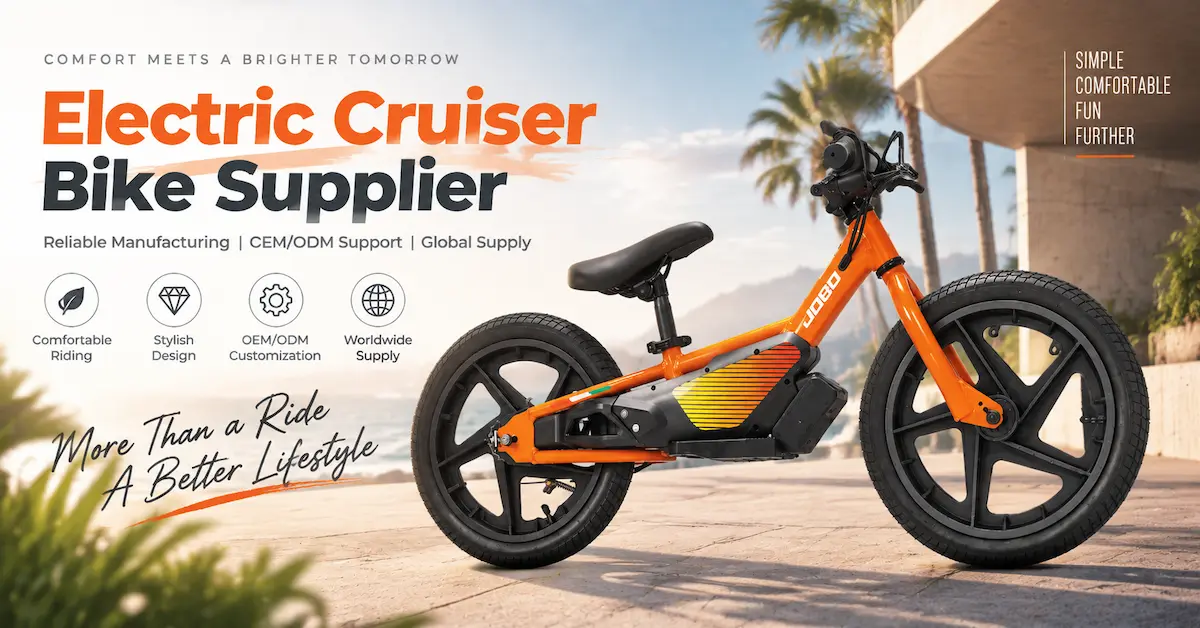
Quick Answer: What Should Buyers Expect From an Electric Cruiser Bike Supplier?
A reliable electric cruiser bike supplier should provide more than a stylish bicycle design. Professional buyers should evaluate whether the supplier can deliver a complete product solution, including frame engineering, comfortable riding geometry, stable electrical systems, OEM customization, production consistency, quality control, documentation, spare parts support, and long-term supply capability. For brands, distributors, and rental operators, the right supplier should help transform a cruiser e-bike concept into a market-ready product with predictable quality and commercial value.
Introduction: Why Choosing the Right Electric Cruiser Bike Supplier Matters
For many buyers, an electric cruiser bike looks like a simple product category. It has a comfortable seat, relaxed riding position, attractive frame design, and electric assistance. However, for brands and distributors, developing a successful cruiser e-bike line requires much more than selecting a visually appealing model.
A cruiser electric bike sits between transportation and lifestyle products. Customers often purchase it because they want a comfortable and enjoyable riding experience rather than only maximum speed or extreme performance.
This creates a different purchasing logic.
A mountain e-bike buyer may focus on suspension travel, climbing capability, and aggressive riding performance.
A folding e-bike buyer may focus on portability, storage space, and weight.
A cruiser e-bike buyer usually evaluates:
- comfort during longer rides;
- riding stability;
- appearance and lifestyle appeal;
- ease of operation;
- practical battery range;
- maintenance convenience.
For distributors and retailers, these expectations directly affect sales performance.
A product that looks attractive online but feels uncomfortable during a test ride may generate returns. A model with impressive specifications but difficult replacement parts may create after-sales problems. A customized design without stable production control may become difficult to reorder.
Therefore, selecting an electric cruiser bike supplier should be treated as a business decision rather than a simple product purchase.
A professional sourcing process should evaluate:
- target customers;
- application scenarios;
- frame design;
- motor and battery system;
- customization scope;
- factory capability;
- quality control;
- compliance documentation;
- spare parts;
- future product expansion.
JOBO provides electric bicycle manufacturing and OEM/ODM capabilities for different market applications. Buyers can review the electric bike product range to understand available platforms before discussing customized cruiser e-bike projects.
What Is an Electric Cruiser Bike Supplier?
An electric cruiser bike supplier is a manufacturer or production partner that provides electric cruiser bicycles for commercial buyers, including brands, importers, distributors, retailers, and rental operators.
Unlike general electric bicycle suppliers, cruiser bike suppliers need to understand the relationship between comfort, appearance, riding experience, and market positioning.
A cruiser e-bike normally combines several important systems.
Comfort-Oriented Frame Design
The frame is one of the most important elements of a cruiser bicycle.
Typical design considerations include:
- step-through accessibility;
- relaxed riding position;
- comfortable handlebar height;
- stable wheelbase;
- balanced weight distribution;
- accessory compatibility.
A cruiser bicycle should allow riders to enjoy longer, more relaxed rides.
The frame should not only support the motor and battery but also create the riding experience customers expect.
Smooth Electric Assistance System
Most cruiser customers do not search for aggressive acceleration.
They usually prefer:
- predictable assistance;
- smooth starting;
- comfortable cruising speed;
- sufficient daily range;
- easy controls.
The supplier should recommend motor and battery combinations based on:
- rider type;
- terrain;
- market regulations;
- expected usage.
A supplier that only promotes higher wattage may not understand the actual cruiser market.
Lifestyle Product Positioning
Cruiser e-bikes are often purchased as lifestyle products.
Important commercial elements include:
- frame appearance;
- color selection;
- accessories;
- branding;
- packaging;
- photography.
For private-label brands, these details influence whether customers recognize the product as unique.
Who Needs an Electric Cruiser Bike Supplier?
Different customer groups evaluate cruiser e-bike suppliers from different perspectives.
Electric Bike Brands Expanding Their Product Portfolio
Many bicycle brands already have products such as:
- mountain electric bikes;
- commuter e-bikes;
- folding electric bikes;
- cargo electric bikes.
Adding an electric cruiser model can help brands reach customers who want comfort-oriented mobility.
These buyers usually need:
- unique product positioning;
- stable production;
- customized appearance;
- consistent component supply;
- technical documentation.
The supplier becomes part of the brand development process rather than only a manufacturing source.
Importers and Distributors Building Product Lines
Importers usually focus on commercial factors.
They need to understand:
- wholesale pricing;
- product differentiation;
- market demand;
- dealer support;
- replacement parts;
- reorder capability.
A distributor does not only purchase bicycles. They purchase inventory that needs to generate revenue over time.
A good supplier should help distributors understand which cruiser model fits their market instead of offering every available option.
Rental and Hospitality Operators
Cruiser e-bikes are commonly used in:
- resorts;
- hotels;
- coastal destinations;
- tourist areas;
- recreational communities.
Rental operators usually prioritize different factors compared with retail customers.
They often value:
- durability;
- easy maintenance;
- simple controls;
- battery management;
- replacement availability.
For fleet applications, the cheapest bicycle is not always the lowest-cost solution.
A bicycle with fewer service problems can create better operating economics over time.
Private Label Brands
Private-label buyers need more control over product identity.
Customization may include:
- logo placement;
- frame colors;
- accessories;
- packaging;
- manuals;
- product configuration.
However, customization should be managed carefully.
Every additional option can affect:
- production complexity;
- inventory planning;
- spare parts;
- quality control;
- future reorders.
A professional OEM partner should help brands choose meaningful customization rather than unnecessary complexity.
How to Evaluate an Electric Cruiser Bike Supplier Before Ordering
Choosing a supplier requires more than checking product photos or comparing factory prices.
Buyers should evaluate several areas.
1. Frame Engineering and Manufacturing Capability
The cruiser frame determines:
- riding comfort;
- stability;
- appearance;
- durability;
- customization possibility.
A supplier should understand:
- frame geometry;
- tube structure;
- welding process;
- battery integration;
- accessory mounting;
- production consistency.
A beautiful prototype does not automatically mean reliable mass production.
The factory must be able to reproduce the approved design across multiple production batches.
JOBO provides frame manufacturing capabilities through its frame factory, supporting frame processing, production control, and customized development discussions.
Questions Buyers Should Ask About Frames
Before selecting a supplier, ask:
- Who controls the frame design?
- Can the frame geometry be customized?
- How are welding quality and alignment checked?
- How are production changes recorded?
- Can the same frame specification be repeated for future orders?
These questions help distinguish a manufacturing partner from a simple trading source.
2. Motor Selection and Riding Experience
Motor selection should match the product positioning.
A cruiser e-bike designed for relaxed urban riding does not necessarily need the most powerful motor.
The supplier should consider:
- expected riding environment;
- customer expectations;
- local regulations;
- battery requirements;
- maintenance capability.
Important motor questions include:
- What motor type is used?
- What assistance experience does it provide?
- How does it perform under load?
- What replacement support is available?
For distributors, a smooth and reliable riding experience is often more valuable than a higher specification number.
3. Battery System and Range Planning
Battery selection influences:
- product weight;
- price;
- riding distance;
- charging method;
- replacement cost.
A professional supplier should provide clear information about:
- battery voltage;
- capacity;
- charger;
- battery management system;
- replacement process.
Buyers should avoid comparing batteries only by Ah numbers.
A complete evaluation should consider:
- voltage;
- watt-hour capacity;
- motor efficiency;
- rider weight;
- terrain;
- riding style.
A cruiser bike for flat coastal roads and a cruiser bike for hilly urban areas may require different battery strategies.
4. Comfort and Ergonomic Design
Comfort is the core value of a cruiser bicycle.
Buyers should evaluate:
- saddle position;
- handlebar height;
- step-through access;
- riding posture;
- suspension;
- tire size.
A product that looks comfortable but creates poor rider positioning will struggle in real-world sales.
The sample evaluation should include actual riders, not only engineers or purchasing staff.
Different body sizes can reveal problems that are invisible during factory inspection.
5. OEM and ODM Development Capability
OEM and ODM are often discussed together, but they represent different development levels.
OEM Cruiser E-Bike Projects
Usually include:
- branding;
- colors;
- packaging;
- accessories;
- selected components.
This approach is suitable for buyers who want faster market entry.
ODM Cruiser E-Bike Projects
May include:
- new frame design;
- unique geometry;
- battery integration;
- structural development;
- customized components.
This approach requires more engineering communication and validation.
JOBO provides OEM/ODM electric bike solutions for brands requiring customized product development.
A buyer should define the required customization level before requesting pricing.
How an Electric Cruiser Bike Supplier Should Support the Manufacturing Process
A professional electric cruiser bike supplier should support the complete product journey, from the first product concept to repeat production. For commercial buyers, the supplier's value is not only the ability to assemble bicycles but also the ability to control specifications, manage changes, maintain quality, and support future orders.
A typical OEM cruiser e-bike development process includes:
- market requirement analysis;
- product platform selection;
- technical specification confirmation;
- prototype development;
- sample evaluation;
- production approval;
- mass manufacturing;
- quality inspection;
- shipment;
- after-sales support.
Each stage affects the final business result.
A supplier that focuses only on production may deliver bicycles, but a supplier with development capability can help buyers avoid costly mistakes before inventory arrives.
Step 1: Define the Market Position Before Product Development
Before contacting an electric cruiser bike supplier, buyers should define the product purpose.
Important questions include:
- Who will buy the bicycle?
- Where will customers ride it?
- What price range is expected?
- Is it a retail product or rental product?
- What level of customization is required?
For example:
A resort rental business may prioritize durability, simple controls, and easy maintenance.
A premium lifestyle brand may prioritize design, color, accessories, and customer experience.
A city commuter brand may focus on comfort, battery efficiency, and daily usability.
The same cruiser frame cannot automatically satisfy every market.
A clear market position helps the supplier recommend the correct configuration.
Step 2: Build a Technical Specification Sheet
A detailed specification sheet prevents misunderstandings between buyer and factory.
A professional RFQ should include:
| Specification Area | Buyer Should Confirm |
|---|---|
| Frame | Material, geometry, size, finish, battery integration |
| Motor | Type, power rating, controller configuration |
| Battery | Voltage, capacity, charger, replacement plan |
| Tires | Size, brand, riding environment |
| Brakes | Mechanical or hydraulic system, maintenance needs |
| Display | Functions, language, interface requirements |
| Accessories | Rack, lights, fenders, basket, kickstand |
| Branding | Logo, colors, packaging, manuals |
| Documentation | Required market documents |
| Delivery | Quantity, destination, schedule |
The purpose is not to make the specification longer.
The purpose is to make every important decision visible before production.
Step 3: Sample Development and Approval
The sample stage is where buyers verify whether the supplier can translate documents into a real product.
A professional sample review should evaluate:
Appearance
Check:
- paint quality;
- logo placement;
- cable appearance;
- finishing details;
- accessory installation.
Riding Experience
Evaluate:
- comfort;
- steering;
- braking;
- acceleration;
- stability.
Daily Usage
Test:
- charging;
- battery removal;
- storage;
- controls;
- maintenance access.
Production Consistency
Confirm:
- actual components;
- model number;
- battery specification;
- motor configuration;
- accessories.
The approved sample should become the production reference.
A common mistake is approving one bicycle while ordering another configuration later.
The supplier and buyer should maintain:
- approved BOM;
- drawings;
- photos;
- component list;
- packaging information.
This reduces production differences.
How to Evaluate an Electric Cruiser Bike Factory
Selecting an electric cruiser bike supplier also means evaluating the factory behind the product.
A buyer should not only ask:
“How many bicycles can you make?”
The better questions are:
- How do you control production quality?
- How do you manage component changes?
- How do you support repeat orders?
- How do you trace production issues?
- How do you handle warranty cases?
JOBO provides manufacturing information through its China factory page, including electric bicycle production capabilities, assembly operations, engineering support, and OEM/ODM development information.
Factory Capability Evaluation Checklist
1. Frame Production Capability
For cruiser bicycles, frame capability is especially important.
Review:
- welding quality;
- frame alignment;
- finishing process;
- battery mounting;
- accessory compatibility.
A supplier that controls frame production usually has better control over product consistency.
2. Assembly Capability
Assembly quality affects:
- braking;
- shifting;
- electrical connections;
- cable routing;
- final riding experience.
A professional assembly process should define:
- work instructions;
- torque requirements;
- inspection points;
- final testing.
3. Engineering Support
OEM projects often require adjustments.
Engineering support is important when buyers need:
- component changes;
- battery adjustments;
- accessory integration;
- market-specific configurations.
A factory without engineering support may struggle when problems appear during development.
Quality Control Requirements for Cruiser E-Bike Buyers
Quality control should not only happen at the end of production.
A professional supplier should control quality throughout the manufacturing process.
JOBO provides information about its QC Labs, including quality management processes and testing capabilities.
A cruiser e-bike quality system may include:
Incoming Material Inspection
Before assembly:
Check:
- frame materials;
- motor components;
- batteries;
- brakes;
- electrical parts.
Problems discovered early reduce production delays.
In-Process Quality Control
During assembly:
Inspect:
- frame alignment;
- cable routing;
- fastener tightening;
- electrical connections;
- component installation.
This stage prevents defects from moving to finished products.
Final Product Inspection
Before shipment:
Check:
- appearance;
- braking;
- motor operation;
- display function;
- battery charging;
- packaging condition.
A final inspection report provides buyers with production visibility.
Why Documentation Matters for Electric Cruiser Bike Buyers
Many sourcing problems happen because buyers focus on the physical bicycle and ignore documentation.
For international sales, documentation supports:
- customs;
- market entry;
- dealer confidence;
- after-sales support;
- product information.
Buyers should confirm:
- product specification;
- battery documents;
- charger information;
- user manuals;
- labels;
- applicable certificates.
JOBO provides a certifications and patents page as a reference point for buyers reviewing available company information and documentation.
However, buyers should always confirm that documents match:
- exact model;
- actual configuration;
- destination market.
A certificate related to one product version should not automatically be applied to every customized model.
Electric Cruiser Bike Wholesale Pricing: Evaluate Total Business Cost
Many buyers search for an electric cruiser bike supplier because they want competitive wholesale pricing.
However, the lowest factory price does not always create the best business result.
A distributor should evaluate:
Total business cost = purchase price + logistics + inventory risk + service cost + warranty cost + replacement parts + marketing cost
For example:
Supplier A offers a lower bicycle price but provides limited documentation and expensive replacement parts.
Supplier B offers a slightly higher price but provides better product consistency, clearer specifications, and stronger after-sales support.
The second option may create better long-term profitability.
Factors That Influence Cruiser E-Bike Pricing
Frame and Design
Customized frames usually require:
- engineering time;
- tooling;
- testing;
- development resources.
Electrical System
Cost changes depending on:
- motor type;
- battery capacity;
- controller;
- display;
- charger.
Components
Important pricing factors include:
- brakes;
- drivetrain;
- suspension;
- tires;
- accessories.
Order Quantity
Higher volume may improve unit economics, but buyers should consider:
- inventory turnover;
- market demand;
- storage cost.
Customization Level
A standard model and a fully customized private-label product represent different projects.
OEM Electric Cruiser Bike Development Strategy
A smart OEM strategy usually starts with controlled customization.
Instead of changing everything at once, buyers should decide:
Must-Have Features
Examples:
- brand identity;
- required battery;
- specific frame style;
- market-required components.
Optional Features
Examples:
- upgraded accessories;
- premium display;
- additional colors.
Future Development
Examples:
- new frame;
- new platform;
- advanced integration.
This approach reduces initial risk while allowing future expansion.
How Brands Can Build a Private Label Cruiser E-Bike Line
A successful private-label cruiser e-bike program requires consistency.
Brand elements may include:
- logo;
- color system;
- packaging;
- product photography;
- manuals;
- dealer materials.
However, branding should not replace product planning.
A strong private-label product needs:
- clear customer value;
- reliable supply;
- stable components;
- service support.
JOBO supports OEM/ODM discussions for brands developing customized electric bicycles.
Electric Cruiser Bike Supplier Checklist Before Ordering
Before selecting a supplier, buyers should confirm:
Product Questions
- Who is the target customer?
- What riding scenario does this model support?
- What makes this cruiser different from competitors?
Technical Questions
- What frame design is used?
- What motor and battery system are included?
- What components are fixed?
Factory Questions
- Where is the bicycle manufactured?
- How is quality controlled?
- How are changes approved?
Commercial Questions
- What is MOQ?
- What is the lead time?
- What are the shipping terms?
After-Sales Questions
- What spare parts are available?
- How are warranty issues handled?
- Who provides technical support?
Frequently Asked Questions
How Do I Choose an Electric Cruiser Bike Supplier?
Choose a supplier by evaluating product capability, manufacturing control, OEM experience, quality systems, documentation, and after-sales support. The right supplier should understand your target customers and help create a product suitable for your market.
What Markets Are Suitable for Electric Cruiser Bikes?
Electric cruiser bikes are commonly considered for urban leisure, coastal areas, resorts, recreational communities, lifestyle retail, and comfortable commuting markets.
Can Electric Cruiser Bikes Be Customized for Private Labels?
Yes. Customization may include colors, logos, accessories, packaging, and selected components. Deeper changes such as frame redesign or electrical-system changes require additional engineering review.
What Should Importers Check Before Ordering Cruiser E-Bikes?
Importers should check the complete specification, supplier capability, quality control process, documentation, spare parts, shipping terms, and sample approval process.
Is a More Powerful Motor Always Better for Cruiser Bikes?
Not necessarily. The best motor depends on customer needs, riding environment, regulations, battery strategy, and product positioning.
How Can Rental Operators Evaluate Cruiser E-Bikes?
Rental operators should focus on durability, maintenance simplicity, battery management, replacement parts, and ease of operation.
What Documents Should an Electric Cruiser Bike Supplier Provide?
Documents depend on the destination market but may include specifications, battery information, charger details, manuals, labels, and applicable compliance documents.
How Important Are Spare Parts for Cruiser E-Bike Distribution?
Spare parts are critical because they directly affect customer satisfaction and dealer service capability.
Should Buyers Start With OEM or ODM Development?
Many brands start with OEM customization before investing in deeper ODM development. The best approach depends on market demand, budget, and differentiation goals.
How Can I Request an Electric Cruiser Bike Quote From JOBO?
Prepare your target market, product requirements, estimated quantity, customization needs, and delivery expectations, then contact JOBO through the official contact page.
Conclusion
Choosing the right electric cruiser bike supplier is not simply about finding a factory that can produce bicycles. Successful brands and distributors need a supplier that understands product positioning, customer expectations, manufacturing consistency, quality control, customization requirements, and long-term support.
A reliable cruiser e-bike program should connect several elements together:
- comfortable frame design;
- suitable motor and battery configuration;
- attractive product appearance;
- stable production;
- clear documentation;
- available spare parts;
- scalable OEM capability.
JOBO provides electric bicycle platforms, manufacturing resources, frame development capability, quality control support, and OEM/ODM services for businesses developing electric mobility products.
For brands, importers, distributors, and commercial operators planning a cruiser e-bike project, the next step is to define your target market, application scenario, product requirements, expected quantity, and customization goals.
Visit the JOBO product range and contact the JOBO team to discuss suitable electric cruiser bike solutions, OEM options, and project requirements.