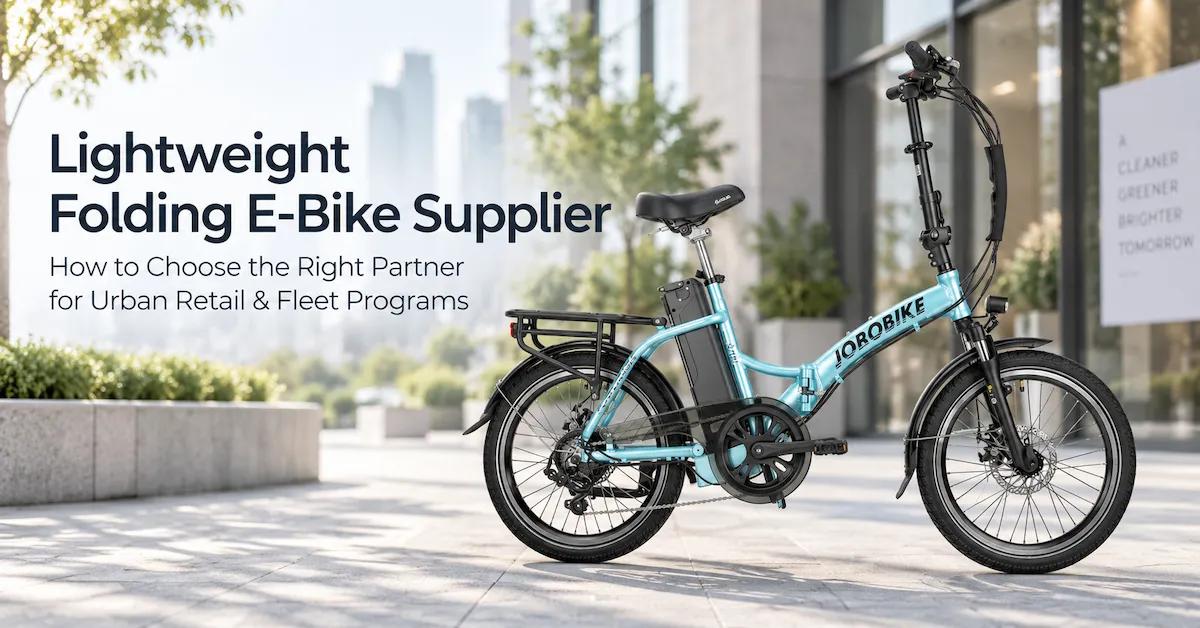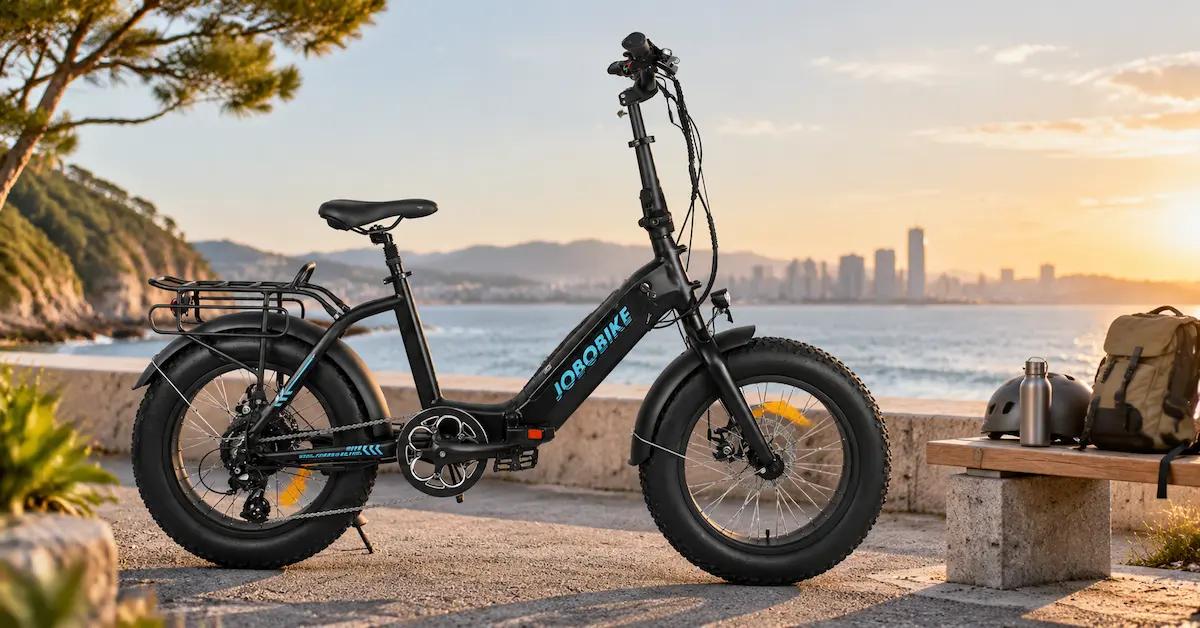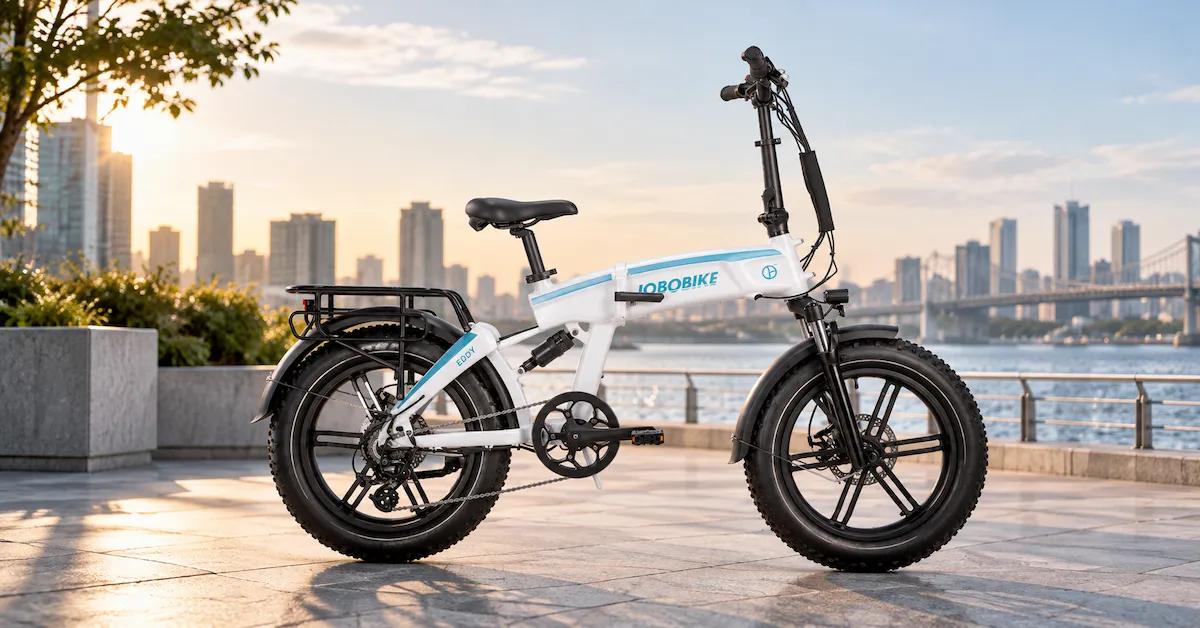
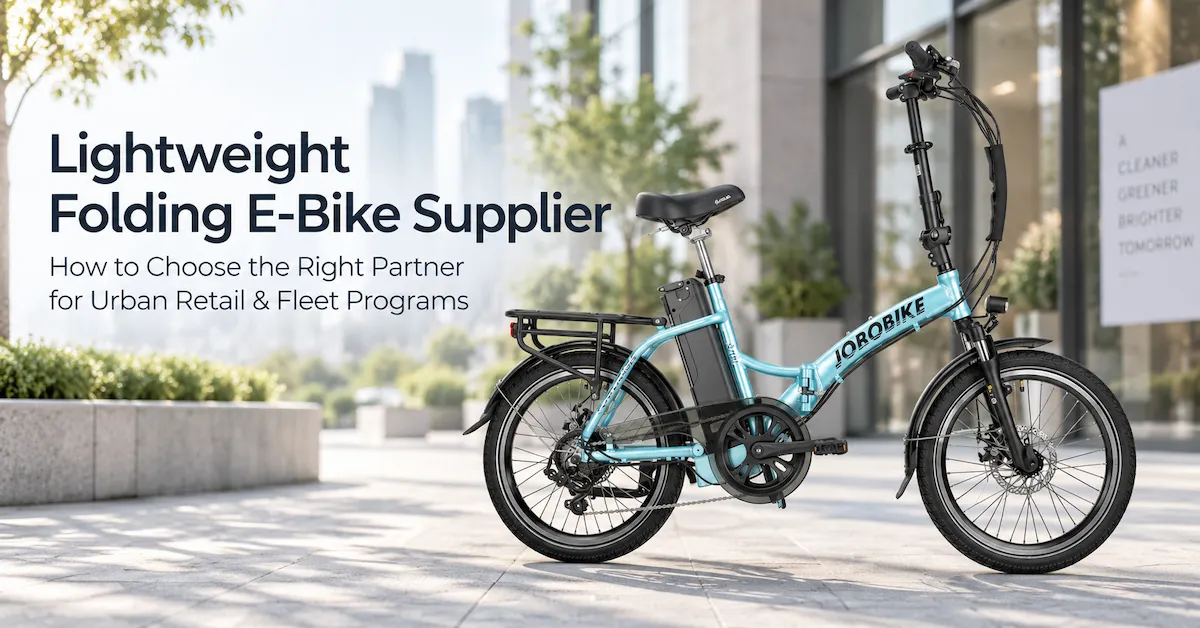
Folding-bike buyers often receive weights measured in different configurations, so this guide gives distributors, retailers, fleet operators, and private-label teams a common way to compare suppliers. It connects everyday handling with frame and hinge checks, drive-system choices, OEM scope, compliance records, landed cost, sample trials, and dealer support.
Do not shortlist a lightweight folding e-bike supplier from the catalog weight alone. Ask what was fitted when the bike was weighed, handle the sample folded and unfolded, inspect the hinge, and match its motor, battery, documents, and spare-parts plan to the sales market. The useful supplier is the one that can reproduce an approved bike in volume, explain any component change before production, and support dealers after delivery. Put those points in the sample record and purchase terms.
Introduction: Start with the Lift, Not the Label
Picture the sale after the sale. A commuter reaches a station staircase, folds the bike, and discovers that the handlebar swings into one knee. A hotel employee tries to store ten bikes and finds that the folded pedals add another shelf's worth of width. A parcel return arrives because the number on the product page excluded the rack and battery. These are ordinary handling failures, yet each one becomes a retailer's cost.
Making an electric bicycle light and making it fold well are separate engineering jobs. The joint itself adds plates, a pin, a lever, and reinforcement. The motor and battery bring their own mass. A tall seatpost and adjustable stem have to fit several riders without feeling loose. Strip material in the wrong place and the showroom bike may impress on a scale while feeling unsettled on a broken street.
Quotations make the problem harder. Supplier A may weigh a bare bicycle. Supplier B may include pedals, lights, mudguards, rack, stand, and battery. Supplier C simply prints "lightweight." None of the three numbers can be compared until the buyer defines the carried configuration. Who lifts it? For how long? Are stairs involved? Can the battery come off first? Those questions belong at the start of the RFQ.
The pages below turn those awkward, physical details into buying controls. They cover a fair weight definition, the fold and frame, drive-system choices, wholesale comparisons, OEM scope, sample testing, documentation, landed cost, and the parts a dealer will need once bikes are in customers' hands.
What Is a Lightweight Folding E-Bike Supplier?
In procurement terms, a lightweight folding e-bike supplier is the party responsible for delivering a compact electric bicycle that is practical to carry or store and remains consistent from sample to shipment. Some companies weld and assemble in-house; others integrate a bought-in motor system or manage specialist subcontractors. Ask one blunt question: whose name appears beside the final bill of materials and who releases the completed bike?
The work does not end at a low scale reading. Paint changes the fit of a hinge. A cable takes a slightly different path each time the bicycle closes. Motor position is obvious when the customer lifts one end. Battery capacity follows the rider upstairs. Even the carton, instructions, controller stock, and model-specific derailleur hanger eventually reach the service desk, so review them as parts of the offer.
Use these four prompts in the first supplier call:
- Show the quoted bicycle. State the sale-ready weight and folded envelope, then identify its rider limit, drive system, battery, and every fitted accessory.
- Explain the fold. Point out who designed the frame joint and stem, how cables pass the moving areas, what holds the battery, and which test belongs to this revision.
- Price the actual order. Separate standard equipment from buyer changes; add MOQ, named Incoterm, tooling, sample charges, and the volume steps used for reorders.
- Walk through a failure. Name the available technical file and parts, then describe who answers the dealer, approves a warranty claim, and serves the destination market.
Listen for precise answers tied to one model revision. A sales team that keeps switching from the quoted bike to general factory claims has not answered the question. A useful partner can show what will be built, what may change, who approves that change, and how the same configuration will be supported next season.
Start by Defining “Lightweight” for the Customer
No single number makes a folding e-bike "light." Take a 16 kg bicycle: one lift into a hatchback may be unremarkable. Carry it around a tight landing and up three floors every evening, and 16 kg feels like a different product. Meanwhile, a somewhat heavier station bike can be the easier choice if it rolls without unfolding and only leaves the ground at the train door.
Write the handling scene in one sentence before asking for quotations. Here is a useful example: "The rider covers five kilometres to the railway station, wheels the folded bike through the concourse, lifts it aboard, and keeps it below a desk." Now the supplier knows that a positive folded latch, a sensible handhold, quiet rolling wheels, and surfaces that do not brush dirt onto clothing are worth discussing. "Send your lightest model" tells them almost nothing.
Put three separate weight boxes on the comparison sheet:
- Complete retail weight: bike, battery, pedals, lights, mudguards, rack, stand, and every item fitted when the customer rides away.
- Carry weight: the mass a user handles if a removable battery or other quick-release item is taken off first.
- Packed shipping weight: the bike, charger, manual, tools, protective material, and carton used for freight calculations.
Add the scale method, accessory list, and allowed tolerance beside those boxes. Production units rarely land on the exact figure of a hand-prepared sample; paint coverage, cable length, tires, rack hardware, and approved substitutes all move the result. Photograph the bike on the scale and attach that photograph to the signed sample sheet. It prevents a surprising amount of later argument.
Buyer Requirements by Application
| Application | Handling priority | Product questions | Commercial risk to control |
|---|---|---|---|
| Rail-plus-bike commuting | Fast fold, manageable carry weight, clean folded package | Fold time, latch security, folded rolling, battery removal, lighting | Customer returns caused by awkward daily handling |
| Apartment and office users | Small footprint, lift and stair handling, charging convenience | Folded dimensions, lifting point, charger access, tire marks, storage stability | A compact claim that does not match real indoor storage |
| Tourism or hotel fleet | Simple controls, adjustable fit, durable hinge, quick service | Rider range, speed setting, key management, consumables, spare batteries | Downtime and staff training costs |
| Motorhome, boat, or car travel | Compact loading, corrosion awareness, battery removal | Folded size, tie-down points, storage cover, transport precautions | Damage during repeated loading and storage |
| Urban retail and e-commerce | Broad rider fit, clear assembly, reliable packaging | Unboxing steps, tools, manuals, carton test, replacement parts | Freight damage, poor reviews, and costly reverse logistics |
The application column should drive the specification. A hotel mechanic cares about quick adjustments and common consumables; a rail commuter notices a swinging handlebar immediately. Motor wattage alone says little about either experience. Describe the customer's unremarkable weekday, then buy for that day.
How to Evaluate a Lightweight Folding Electric Bike Manufacturer
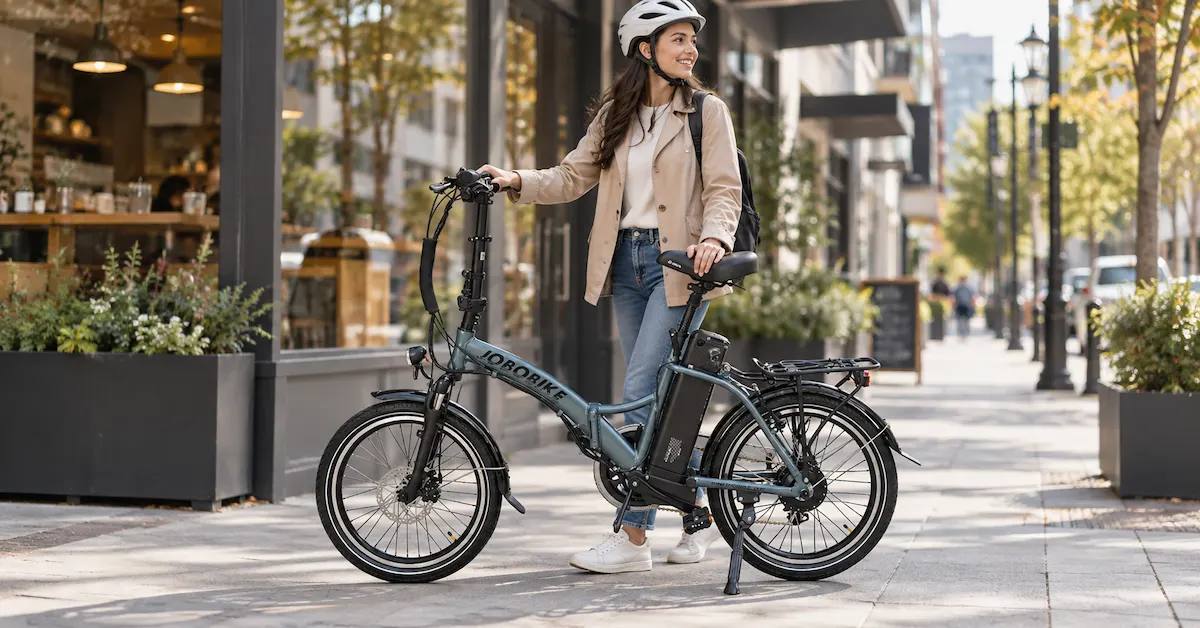
Begin an audit of a lightweight folding electric bike manufacturer at the hinge, then work outward. "Aluminium alloy" on a specification is only a material family. The road manners come from tube profiles, wall choices, weld design, reinforcement, heat treatment, alignment, and how tightly the process is held from one batch to the next.
JOBO's frame-factory page describes CNC cutting, drilling and bending, robotic welding, T4 and T6 heat treatment, dimensional correction, coating, and final tests. Its folding-frame page also discusses the lock and durability work. Use that public description to prepare questions for the selected SKU. For example: Who released drawing revision C? Which dimensions are logged after heat treatment? How is the hinge bore gauged? If one frame misses tolerance, where is the disposition recorded?
Use a normal production sample for the physical check. Open and close it until the showroom novelty wears off. Watch the cable bundle at the frame edge. Does the main lever need the same hand force on the tenth cycle? Does the secondary catch actually catch? Mark the joint with a removable reference line, ride over patched asphalt, apply several firm stops, and inspect the line and joint again. Have the original tester do this second check so that a new pair of hands does not hide a subtle difference.
Pick one frame number and trace it through the records. The trail might begin with incoming material and fixture ID, continue through weld and heat-treatment batches, then finish at paint, torque records, end-of-line inspection, and the retained unit. A video audit can do this too, provided the camera follows the real part and record instead of a slide presentation. What matters is repeatability on the next run, not the existence of a perfect display sample.
Motor Position, Battery Size, and the Weight Trade-Off
Do one motor comparison with the power off. Fold each bike, lift at the intended handhold, and turn through a doorway. A rear-hub model can tug toward its wheel; weight around the bottom bracket may sit closer to the carrier's body. Neither observation tells the whole riding story, and the second layout brings another frame interface and another service routine. Existing workshop skills and spare stock belong in the decision.
A compact hub motor is often easy for a sales team to understand and can fit a straightforward price ladder. A mid motor can give a different balance and pedalling character, but it may cost more and place greater importance on drivetrain setup. There is no universal winner. Carry both samples, ride the intended route, and ask a technician which faults can be diagnosed locally.
Battery discussions need the same realism. More watt-hours help some long or hilly journeys, but those cells join the customer on every staircase and add cost and charging time. Never lift a distance figure straight into retail copy. Ask how the run was made: ambient temperature, wind, hills, stops, tire pressure, rider mass, assistance setting, and the point at which the test ended all change the answer.
What does JOBO publish for the JB-TDN48L lightweight foldable e-bike? The page shows a 36 V, 250 W mid motor and a 36 V, 10.5 Ah battery. It identifies an LCD, a 20-inch 6061-alloy frame, Shimano 6/7-speed gearing, front and rear Tektro disc brakes, a suspension fork, and 20 x 2.125-inch tires. Speed is shown as 25-30 km/h; driving distance is shown as 50 km. Check those page figures against the current quotation, local setting, component schedule, test protocol, and destination rules.
Lightweight Folding Electric Bike Wholesale: Compare Like with Like
A lightweight folding electric bike wholesale price has little meaning by itself. Issue one locked comparison sheet, with a response column beside each requirement, to all candidates. Let suppliers attach catalogs for context, but insist that someone answers the sheet. Otherwise a buyer can easily rank a stripped EXW bike beside an equipped FOB one and call the gap a saving.
| Quote field | What the buyer should require | Common comparison error |
|---|---|---|
| Weight | Complete retail weight, carry weight, packed weight, and tolerance | Comparing a bare sample with a fully equipped bike |
| Folded dimensions | Length x width x height with the same pedals and handlebar position | Accepting a drawing that excludes protruding parts |
| Electrical system | Motor model, nominal rating, battery cell, capacity, BMS, charger, controller, display | Comparing voltage and watts without identifying the actual system |
| Mechanical equipment | Frame revision, hinge, fork, brakes, drivetrain, tires, rack, lights, and accessories | Assuming catalog photos define the supplied components |
| Documents | Model-specific declaration, reports, battery files, labels, and manuals | Accepting a certificate belonging to a different SKU |
| Commercial term | Named Incoterm, destination, MOQ, tooling, samples, payment, lead time, and validity | Ranking EXW, FOB, and warehouse prices in one column |
Read the completed sheet beside the handling story. An apartment commuter facing stairs morning and night may willingly pay for two kilograms less. In a hire fleet, bikes might remain unfolded for weeks; its mechanic may prefer stronger contact points, quick tire access, and batteries that swap across the fleet. Price the weight saving against the use it improves, the returns it might prevent, and the retail explanation it gives the shop.
OEM Lightweight Folding E-Bike: Choose the Right Development Depth
For an OEM lightweight folding e-bike, first ask how much new engineering the sales case can support. A mature platform with approved paint, graphics, carton, and equipment changes may be right for season one. Consider a fresh frame after research identifies a precise gap, such as a smaller folded width, easier step-through, moved battery, or distinctive shape with a defendable retail premium.
| Development route | Typical scope | Buyer advantage | Extra work to expect |
|---|---|---|---|
| Standard platform | Existing frame and approved component package | Fastest evaluation and lowest development exposure | Limited differentiation |
| Private-label OEM | Logo, paint, labels, manual, carton, and selected accessories | Brand-ready offer with a proven core platform | Artwork, color approval, packaging, and compliance review |
| Configured OEM | Motor, battery, display, brakes, drivetrain, tires, or rack changes | Closer fit to the target price and application | Compatibility validation and possible document updates |
| Deep ODM | New frame geometry, hinge, tooling, battery mount, and integration | Greater product distinction and ownership of the customer experience | Engineering, tooling, prototypes, fatigue tests, schedule, and higher MOQ |
"Make it lighter" is not a usable development brief. Give engineering a ceiling for complete retail weight and folded size, then lock the rider load, battery energy, wheel and tire envelope, mandatory accessories, target cost, and pass/fail tests. Mark the items that cannot move. Review every weight-saving proposal against that page; removing mass from the battery, rack, tire, or service access may simply move the loss somewhere the customer notices more.
How to Select a Lightweight Folding E-Bike for Distributors
When assessing a lightweight folding e-bike for distributors, look past the pleasant ten-minute demo. Ask a salesperson to explain its purpose in one sentence, let a mechanic perform a common repair, and run the invoice through the full margin sheet. Trouble in any one of those exercises will show up after stock arrives.
Start with the reason for purchase. Perhaps a customer has ruled out ordinary e-bikes because the apartment has no ground-floor storage. Perhaps the bicycle will live in a motorhome. Perhaps it is a cautious first step into electric commuting. Each story leads to a different battery, equipment level, and acceptable price. "It fits beside a desk" is a benefit a salesperson can demonstrate; "advanced urban mobility" is fog.
Run through an actual Saturday in the shop. Can a new employee fold the bike without trapping a cable or finger? Will it stand while the employee answers another customer? Is battery removal obvious? Can staff find the serial number quickly? Open the carton as a customer would, then try common repairs. A model that needs half the bicycle stripped to replace a controller will quietly eat workshop hours.
Only then finish the margin sheet. Start with the invoiced bike and add origin charges, freight, duty, inspection, payment cost, warehouse handling, dealer share, launch discount, warranty reserve, service stock, and a realistic end-of-season markdown. Lower shipping mass may help a little. Usually, though, the commercial return comes from a problem the customer can feel every day and fewer expensive surprises for the dealer.
Small Urban Platforms: A Different Route to Portability
A central motor is not the only route to a portable city bike. On the JB-TDN11Z small folding e-bike page, JOBO lists a 6061-alloy frame and a 36 V, 250 W motor. The battery is shown as 36 V and 13 Ah. Other listed details are an LCD, Shimano seven-speed gearing, mechanical discs, a suspension fork, and 20 x 2.125-inch tires. JOBO describes the use cases as short commuting, urban and mixed-mode travel, and last-mile connection.
That model is useful here as a comparison, not as a declaration that one drive layout is best. Put a compact hub-motor platform and a central-motor bike through the same stair carry, fold, route, repair, and landed-cost exercise. The right result depends on hills, customer expectations, the local mechanic's experience, and where the model sits in the retail range.
Bulk Lightweight Folding Electric Bikes: Control Variation Before Volume
The sample is rarely the weak point when buying bulk lightweight folding electric bikes. Batch variation is. If the specified tire is unavailable, an apparently harmless substitute may add weight or change the folded width. A new display can bring different firmware and labels. Another charger can affect the paperwork as well as the carton layout. "Equivalent" needs a written definition.
Build the golden sample into the order file. Alongside the physical bike, keep signed photographs, its exact component list, scale reading, folded measurements, approved colour chip, controller settings, label set, accessories, carton marks, and test record. Divide parts into two columns: no substitution without approval, and pre-approved alternatives. Require notice while there is still time to decide, not after the container is sealed.
A small pilot lot exposes the repeatability that one sample cannot. Use numbers where possible: lever force, hinge movement, wheel alignment, brake travel, scale weight, charger output, and carton dimensions. Then fold each bike and look for cable rub, paint contact, a moving seatpost, unusual noise, or damage to the protective packing. A checklist marked only "good" will not help anyone diagnose the third shipment.
Service stock should be ordered with the bicycles. Which items belong in that box depends on the platform and local workshop, but displays, chargers, controllers, pads, hangers, keys, latches, and model-specific cables are obvious discussion points. Put the reorder price, lead time, part code, and compatibility note in the agreement. A drawer full of unidentified electronics is not a spare-parts program.
Private Label Lightweight Folding E-Bike: Build a Focused First Range
The first private label lightweight folding e-bike should make one believable promise. Put the option sheet away until that promise is written. This prevents a launch bike from becoming a pile of individually attractive features that complicate forecasting, shop training, repairs, and the next order.
For a commuter brief, the priority could be a low-step 20-inch frame and battery that comes indoors, plus lights, mudguards, a tidy fold, and an uncomplicated display. A motorhome buyer may trade some of those items for corrosion protection, guarded contact points, and a fitted cover. At the premium end, budget might go to a mid motor, a quiet transmission, neat cables, braking, and finish. Write each as its own product job.
Keep the opening range narrow enough that a dealer can explain every version. Two colours of one stable build often beat four electrical and accessory combinations. Each extra variant multiplies labels, cartons, manuals, replacement parts, forecasts, and technical training. First-season returns and customer questions will reveal whether a second battery or rack deserves a place later.
Ownership clauses are part of product development. Name the owner of logo files, artwork, photography, drawings, moulds, firmware settings, and test documents; also state who may reuse them. JOBO's About page mentions NDA protection for ODM work. In the signed project agreement, record who paid for each tool, who can retrieve each file, what remains confidential, and what both parties must return or stop using at the end.
How to Audit a Compact Folding Electric Bike Supplier
Start an audit of a compact folding electric bike supplier with the serial number on the quoted sample. Follow that model into its build records, then reconcile the factory and legal paperwork. The sequence works during a visit or live video and makes it harder for a general company presentation to replace evidence for the SKU.
Product evidence
Ask for a current production unit rather than the polished bicycle kept beside reception. Weigh it with its fitted accessories. Once folded, hold a straight edge at each protruding pedal, lever, wheel, and bar end; those outer points define the storage box. Cycle every latch and adjustment. Then hand the unit to a mechanic and time access to the battery, controller, connectors, brakes, drivetrain, and rear tire. Keep the quotation open on the bench so mismatches are visible.
Process evidence
Trace one frame from incoming material through cutting, welding, heat treatment, finishing, assembly, inspection, and packing. Ask how fixtures are checked and how torque tools are calibrated. Look for a method to identify the operator, batch, or inspection result when a problem is reported months later.
Quality evidence
JOBO's QC Labs page describes incoming, in-process, final, and quality-assurance stages, together with frame fatigue, brake, complete-bike, battery thermal-shock, and motor testing. A buyer should ask which test plan applies to the selected lightweight folding model and request records that connect the model revision to the result. General laboratory capability is useful; traceable model evidence is better.
Commercial evidence
Reconcile names and addresses across the quotation, bank account, business record, certificates, and export paperwork. Ask where frame work, painting, assembly, and packing occur, and identify the legal party handling warranty claims. Capacity needs dates, not adjectives: which line and month are planned, which long-lead components have been ordered, and at what point does a forecast reserve anything?
What to Expect from a Lightweight Commuter E-Bike Factory
A lightweight commuter e-bike factory needs control over engineering details and enough repetition to hold them. JOBO says on its China factory page that frame production, automatic painting, and assembly are integrated, and gives annual capacity of up to 300,000 e-bikes. Its company material also describes a 50,000-square-metre site with three high-speed assembly lines.
Those figures provide scale, but they do not book a build slot. Ask the sales contact to put a line number and production week on the planning sheet. The same sheet should show release dates for frames, batteries, drive parts, and displays, the quantity actually reserved, and the revised ship week if sample approval slips. Annual capacity is background; the dated plan controls this order.
JOBO also describes a Polish operation for EU assembly, distribution, support, and parts inventory. European buyers should name the SKU and ask what is actually stocked or assembled there, which steps remain in China, how origin and conformity paperwork will read, and whether local technicians cover the chosen configuration. Regional capability is useful only when it is written into the project offer.
Compliance, Batteries, and Documents
Compliance follows the configuration, not the family photograph. Change the motor, pack, charger, controller, frame revision, display, speed setting, or certain accessories and part of the technical file may need another look. Model codes, drawings, labels, the bill of materials, and the purchase order should describe the same bicycle.
For an EU pedelec, the discussion may cover the applicable EN 15194 work, CE documentation, declarations, EMC, battery transport records, charger information, labels, instructions, and required languages. Different markets set different duties. Factory evidence is important, but an importer or brand cannot outsource its own legal role to a sales brochure; obtain suitable regulatory advice for the destination.
JOBO's certifications page refers to EN 15194, ISO 9001, and TUV standards and says the company holds more than 40 national patents. Its About and China factory pages say that more than 35 models have received TUV EN certification. These are company-level statements. For an order, request the certificate and underlying report for the current model, revision, electrical package, and destination. Do not turn "35 models" into "every folding bike."
Open a separate folder for the battery. It should identify the cells and pack maker, nominal voltage and capacity, BMS, housing, connectors, mating charger, UN 38.3 transport information, safety data, production marking, warranty route, storage instructions, and replacement plan. A lightweight bike is not easy to own if its battery becomes untraceable after two winters.
Cost and Margin: The Lightest Bike Is Not Always the Best Buy
Lower weight can support a higher ticket when customers can feel the benefit at their staircase, train, or car. It can also demand costlier tubing, components, tooling, or engineering time. Price each kilogram in context. A saving that never appears in the customer's routine is an expensive specification.
A useful margin model begins well before the warehouse door. Add the quoted bike, packing, origin handling, ocean or road freight, insurance, duty, brokerage, inspection, payment charges, receiving work, service stock, warranty reserve, sales commission, launch promotion, and likely markdown. Compare the total with an achievable selling price and stock turn. A handsome percentage on a slow-moving bike can still tie up cash for a year.
Stress the model with a service example. Imagine that Bike A is US$35 cheaper but creates two extra claims in every hundred sales. Two-way freight, workshop time, and one controller or hinge assembly may erase the entire purchase saving. Bike B is not automatically the answer either; premium electronics become a liability when local dealers cannot diagnose them or obtain replacements.
Request three priced bills of material: the supplier's established build, the buyer's desired lightweight build, and a version at credible annual volume. Put the price and weight delta beside every changed line, including the fork, pack, transmission, tires, rack, and mudguards. A product meeting can then decide, item by item, which saving deserves customer money.
Sample Evaluation: A Practical Two-Day Test
A drawing will not reveal a pedal brushing a trouser leg, and a specification cannot reproduce a cold latch under thick gloves. Reserve two normal workdays for every sample. Keep the test route, stair flight, car boot, riders, workshop tools, and report form unchanged so comparisons remain fair.
Day one: handling and setup
- Photograph the scale reading for the sale-ready bike, then repeat with its removable battery set aside.
- Find the true outermost points and record folded length, width, and height there.
- Time five fold-and-unfold cycles by a new user, then repeat with an experienced user.
- Carry it up one flight of stairs, through a doorway, and into a car boot.
- Roll it while folded if that is part of the product claim.
- Check cables, paint contact, latch engagement, pedals, handlebar, seatpost, and storage stability.
Day two: riding and service
- Use the same route with hills, stops, rough pavement, tight turns, and firm braking.
- Have several riders adjust the bike and note the usable fit range.
- Record assistance behavior, noise, brake feel, steering, comfort, and battery indication.
- Ask the mechanic to remove and refit the battery, one wheel, the display, and one likely service item.
- Fold it again while still dusty from the ride; note cable rub, joint movement, loose hardware, and fresh marks.
- Compare the physical bike with the BOM, labels, manual, carton, and compliance file.
Write what happened, not a grade. "One hand is comfortable for five seconds, then the handlebar swings toward the shin" gives engineering something to work with; "portability acceptable" does not. Send the notes, photographs, and measurements to the supplier. Production approval should reference the agreed response and the corrected sample, if a correction was needed.
RFQ Checklist for a Lightweight Folding E-Bike Project
A good RFQ removes assumptions before they become tooling, labels, or finished stock. It should tell the supplier enough to challenge an unrealistic combination, not merely ask for a price. Include:
- Target country, channel, customer, terrain, daily distance, and storage scenario.
- Maximum complete retail weight and the exact accessories included in that number.
- Maximum folded dimensions and whether the bike must roll or stand when folded.
- Rider height range, rated load, wheel size, tire width, and desired riding position.
- Motor architecture, local nominal rating and speed setting, battery voltage and energy, charger plug, display, and assistance controls.
- The frame and latch brief, fork, brake and drivetrain level, lights, mudguards, rack, stand, and tools packed with the bike.
- Brand files, colour reference, decals, legal labels, manual languages, carton artwork, barcode, and serial-number convention.
- Sample quantity, pilot quantity, first order, annual forecast, colors, and expected reorder schedule.
- A named list of test reports, declarations, pack and charger files, manuals, and destination-specific records.
- The delivery point and whether prices are needed EXW, FOB, CIF, DDP, or from a stated local warehouse.
- Part codes and pricing, the warranty workflow, expected technical response, and a support horizon.
- Timeline for drawing approval, sample, pilot, inspection, production, and shipment.
Leave a deviation column beside every requirement and insist that it is completed. A blank cell is not acceptance. Where the selected rack or battery breaks the weight ceiling, put both figures in that row, name the approver, and record the choice before authorising the sample.
Frequently Asked Questions
How do I choose a lightweight folding e-bike supplier?
Write down one customer's whole trip, including every lift and storage point. From it, set the sale-ready weight, folded box, electrical build, fitted kit, destination rules, quantity, documents, and delivery point; every candidate receives that page. Test a production-representative unit before ordering. Its model records, permitted substitutions, service parts, warranty route, and reorder conditions should all end up in the order file.
What is a good weight for a folding electric bike?
There is no honest universal cutoff. A rider lifting once into a car has a different limit from someone climbing three flights nightly. Define the distance and duration of the carry, whether the battery comes off first, and which accessories stay fitted. On every quote, separate sale-ready weight, battery-removed carry weight, and packed freight weight.
Is a mid motor suitable for a lightweight folding e-bike?
It can be. A mid motor may centralize mass and provide a natural assistance feel, while a hub motor may offer a different cost and service structure. Evaluate complete weight, balance while carrying, frame integration, drivetrain wear, service skills, and customer expectations. JOBO's JB-TDN48L page describes a 36V 250W mid-motor folding platform.
Can lightweight folding e-bikes be private labeled?
Yes. Common private-label work includes colors, logos, decals, labels, manuals, cartons, accessories, and selected components. New frames, hinges, battery housings, or geometry require deeper ODM development, tooling, testing, a longer schedule, and usually a different MOQ.
Which documents should a distributor request?
Request the documents required in the target market and make sure they identify the actual model and configuration. Depending on the market, these may include declarations, relevant test reports, battery and charger files, transport information, user manuals, labels, serial traceability, and quality records. Obtain independent regulatory advice when necessary.
How can I request a JOBO lightweight folding e-bike quotation?
Send the intended market, application, model interest, weight and folded-size targets, electrical requirements, branding, quantity, destination, documents, and Incoterm through JOBO's official contact page. The public page lists info@jobobikes.com and +86 198 8586 5520.
Discuss Your Lightweight Folding E-Bike Project
Share your target market, complete-weight goal, folded dimensions, motor and battery needs, branding, order quantity, and destination. JOBO can review a suitable existing platform or discuss an OEM/ODM development route.
View the JB-TDN48L lightweight foldable e-bike or browse the folding e-bike category.
Final Sourcing Takeaway
A low number in a catalog is the beginning of the lightweight conversation, not the result. The right lightweight folding e-bike supplier can show how the sale-ready bicycle is carried, where it fits, how its joint behaves after use, and which exact electrical build and records will travel with the shipment.
Define the lift before the bicycle. Weigh the sale-ready sample. Put rival builds through the same fold, stairs, ride, repair, and carton routine. For production, preserve the approved result with a golden sample and written change control. Budget for parts and warranty work while building the retail price. This behind-the-scenes discipline is what allows a distributor to reorder with confidence.