Quick Answer
A reliable folding fat tire e-bike manufacturer should be able to control the folding frame, hinge, battery integration, wide-tire clearance, electrical system, quality inspection, and repeat-production specification—not simply assemble standard parts. B2B buyers should compare the intended riding environment, folded dimensions, complete-bike weight, component traceability, OEM flexibility, applicable product documentation, spare-parts support, and change-control process before approving a supplier or production order.
Introduction: Why This Product Is Harder to Source Than It Looks
For an importer or e-bike brand, a folding fat-tire bicycle combines two product ideas that naturally compete with each other. Folding bikes are expected to be compact and easy to store. Fat-tire bikes use wider wheels, stronger structures, and often more substantial electrical components. Bringing both into one product means every design decision affects something else.
A wider tire can improve stability on uneven roads, yet it also increases folded width and shipping volume. A larger battery may support longer rides, but it can make the bicycle harder to lift into an RV or apartment. A stronger folding frame may improve confidence, while additional material adds weight. None of these choices is automatically wrong; they simply need to match the buyer's real market.
That is why choosing a folding fat tire e-bike manufacturer is fundamentally a product-development decision. Buyers should start with the customer and use case, then work backward into frame structure, wheel format, drive system, battery, brakes, packaging, testing, and after-sales support.
JOBO's current electric folding bike range provides several folding platforms that can be used as starting points for these discussions.
What Is a Folding Fat Tire E-Bike Manufacturer?
A folding fat tire e-bike manufacturer is a supplier capable of producing electric bicycles that combine a foldable frame with wide tires, typically for customers who want compact storage but more stability and comfort on uneven surfaces than a narrow-tire folding commuter provides.
The product usually combines four systems that must work together: a folding frame and locking mechanism, wide wheel-and-tire package, electric drive and battery system, and bicycle components such as brakes, drivetrain, suspension, lighting, and controls.
The category can serve several markets, including urban riders who encounter poor pavement, RV and camper users who need compact storage, leisure riders using mixed paved and gravel routes, dealers looking for visually differentiated products, and private-label brands building a commuter-adventure crossover range.
It should not automatically be positioned as an extreme mountain bike, downhill bike, deep-snow vehicle, beach vehicle, or motorcycle simply because it uses 4-inch tires. The intended use and applicable product classification still need to be established for the specific model and destination market.
Start With the Application Before Choosing a Model
A buyer should be able to describe where the bicycle will spend most of its time before asking for motor, battery, or color options. The following purchasing framework helps turn a vague request into a usable development brief.
| Target Application | What Buyers Usually Care About | What the Factory Should Help Confirm |
|---|---|---|
| Urban commuting | Storage, comfort, braking, carrying and daily charging | Folded dimensions, finished weight and commuter configuration |
| RV and camper travel | Vehicle storage, battery removal and recreational riding | Folded package, handling method and transport protection |
| Mixed urban and gravel riding | Stability, tire grip, comfort and range | Tire specification, suspension and approved riding conditions |
| Leisure rental | Ease of use, inspection and replacement parts | Hinge maintenance, controls, parts availability and QC |
| Private-label retail | Product differentiation and repeatable specifications | OEM options, BOM control, branding and packaging |
| Distributor product line | Price positioning and dealer service | Model selection, documentation and spare-parts planning |
A product sold primarily to apartment commuters should not be configured in exactly the same way as one designed for RV travelers. The bicycle may share the same basic frame, but the priorities can differ significantly.
Compare a Fat-Tire Folding Platform With a Standard Folding E-Bike
Fat tires add a recognizable product advantage, but they are not the right answer for every folding-bike customer. Buyers should decide whether the additional tire width creates real value in their sales channel.
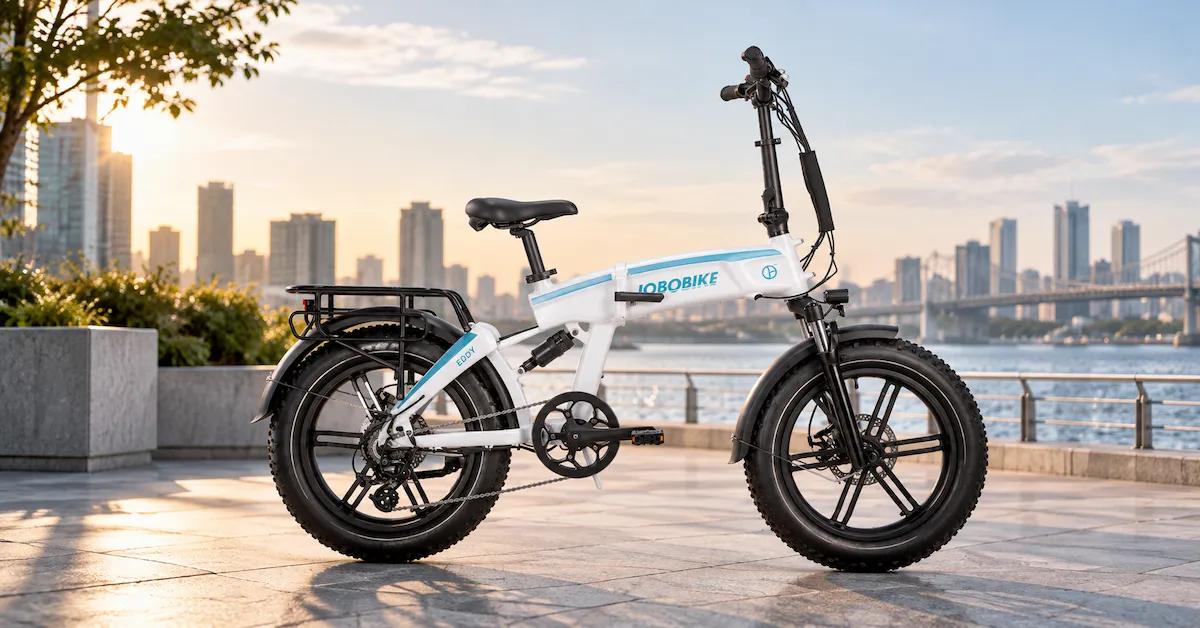
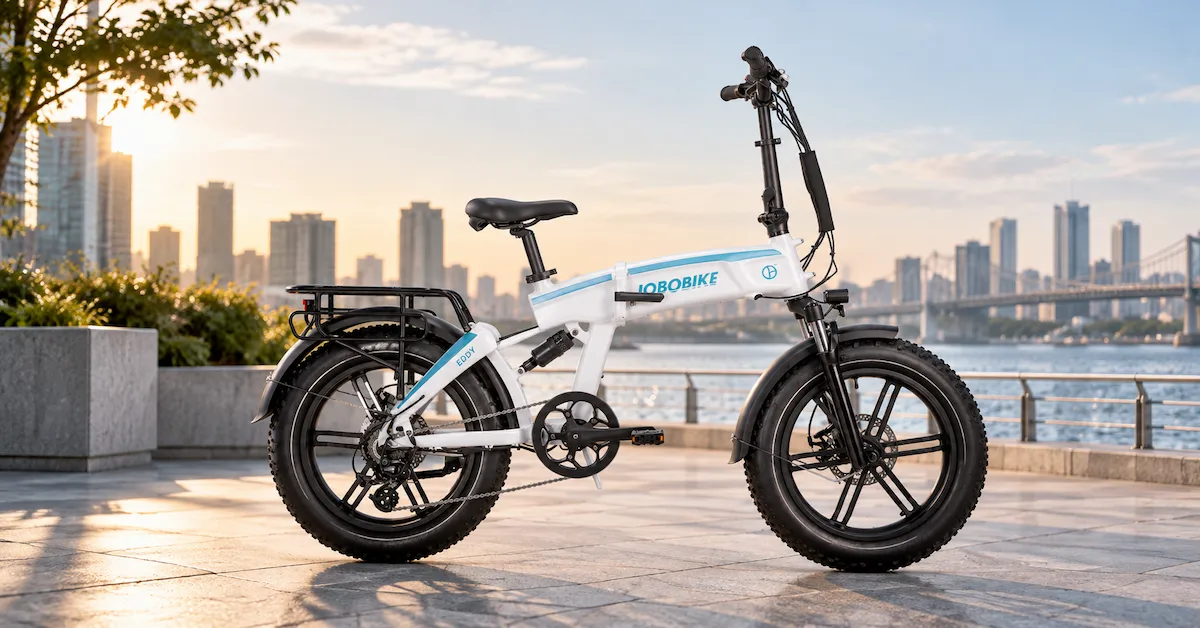
JOBO's Long Range Folding E Bike JB-TDN46Z-FS uses a 20-inch folding 6061 aluminum frame with 20×4.0-inch tires. The currently published configuration lists a 48V 250W Bafang motor, 48V 14Ah LG battery option, Shimano 7-speed drivetrain, Tektro disc brakes, and suspension fork.
By comparison, JOBO's Small Folding E-Bike JB-TDN11Z uses 20×2.125-inch tires with a 36V 250W drive configuration and 36V 13Ah battery listed on the product page.
| Evaluation Point | Standard Folding Platform | Fat-Tire Folding Platform |
|---|---|---|
| Tire format | Narrower tire | Wider 4.0-inch class tire |
| Storage volume | Generally easier to minimize | Wider wheel package needs more space |
| Product positioning | Commuting and last-mile mobility | Commuting, leisure and mixed-surface use |
| Weight sensitivity | Often a major purchase factor | Extra wheel and component mass deserves more attention |
| Ride feel | Efficient on conventional urban roads | Added tire volume may help on uneven surfaces |
| Dealer service | Conventional folding-bike parts | Tire availability and wider-wheel compatibility need checking |
| Packaging | Easier to minimize carton width | Wheel and tire size can affect carton dimensions |
This is why a buyer should not ask simply, “Which model is better?” A better question is, “Which platform gives my intended customer a reason to accept its trade-offs?”
Evaluate the Folding Mechanism Before the Motor
A catalog often gives the motor the largest font, but the folding mechanism is one of the first things a customer will physically use. It deserves serious attention.
A manufacturer should be able to explain how the frame is folded, how the locking system engages, what prevents partial locking, how cable routing behaves during repeated folding, and how the hinge should be inspected during service.
A sample review should include repeated opening and closing rather than a single demonstration. Check for unwanted movement when the bicycle is open, clearance between folded parts, cable pinching, accessory interference, and whether the rider can tell when the locking mechanism is fully secured.
For private-label projects involving deeper structural changes, JOBO's in-house frame manufacturing operation is relevant. Its published production process includes CNC cutting, drilling and bending, robotic welding, heat-treatment stages, dimensional correction, coating, and final testing.
The value of that capability for an OEM buyer is not simply that machinery exists. It allows the conversation to move from “Can you change this frame?” to more useful questions about geometry, drawings, tooling, tolerances, inspection, and production repeatability.
Check How Fat Tires Affect the Complete Bicycle
A 20×4.0 tire is easy to describe but can affect several systems at once. It changes frame and fork clearance, folded width, wheel weight, tire availability, fender design, motor load, packaging, and customer expectations.
Before production, ask the folding fat tire e-bike manufacturer to identify the exact tire model rather than only the nominal size. Confirm rim specification, approved pressure range, replacement sourcing, reflective or puncture-protection features if relevant, and whether another tire can be substituted without review.
JOBO's current long-range folding platform lists KENDA 20×4.0-inch tires on its detailed product information. That makes it useful as a reference platform when discussing an OEM fat-tire folder, but an approved production order should still identify the exact tire used in the buyer's BOM.
Treat Folded Size and Finished Weight as Purchase Specifications
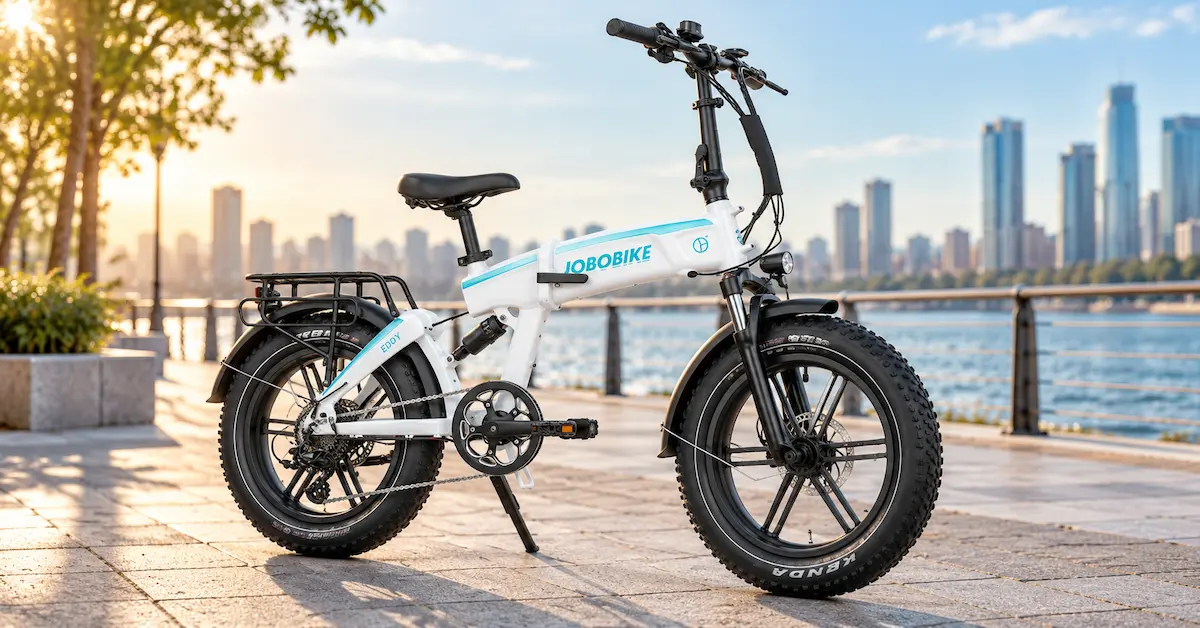
A folding bicycle can photograph well and still be awkward to handle. That is especially true when wide tires, suspension, racks, fenders, and a larger battery are added.
Instead of asking whether a bike is “portable,” ask for three measurements:
Folded length × folded width × folded height
Then request finished weight under a clearly defined configuration, including whether the quoted weight includes the battery, rack, fenders, lights, and accessories.
If the intended customer will regularly place the bicycle in an SUV, RV, train luggage area, apartment lift, or office storage room, test those scenarios with the actual sample.
Compactness should be demonstrated by measurement, not inferred from the word “folding.”
Battery Capacity Should Match the Route, Not a Marketing Number
Battery selection is another area where buyers can easily compare the wrong thing. Ampere-hours alone do not represent stored energy unless voltage is also considered.
For example, a 48V 14Ah pack represents approximately 672Wh of nominal energy:
48 × 14 = 672Wh
That calculation does not guarantee a particular riding distance. Assistance setting, rider mass, tire pressure, stops, hills, wind, temperature, and road surface all affect consumption.
JOBO currently publishes a 48V14Ah LG battery option and a listed driving-distance range for its JB-TDN46Z-FS platform. These values should be treated as model-page reference information rather than a guaranteed result for every OEM version or riding condition.
For a B2B program, agree on a realistic route test and record its conditions. The data becomes far more useful when dealers can explain what kind of riding produced the result.
Motor Power Should Follow Market and Use Requirements
A folding fat tire e-bike manufacturer should be able to propose a drive system that matches the buyer's destination market, target rider, terrain, and price level.
More power does not automatically mean a better product. A larger motor can influence battery demand, weight, price positioning, riding behavior, and regulatory classification.
Ask for the exact motor model and nominal rating, controller configuration, assistance behavior, and the version intended for the target market.
JOBO's long-range folding platform currently shows a 48V250W Bafang motor on its product page, while its folding category contains multiple platforms with different product directions.
The important procurement question is not “What is your highest wattage?” It is “Which drive configuration matches the product we are trying to sell?”
Check Brakes, Suspension, and Drivetrain as a System
Fat tires can encourage customers to ride on rougher surfaces than they would with a conventional commuter bicycle. The rest of the specification needs to reflect that positioning.
For brakes, request the exact manufacturer, brake type, rotor specification, and service parts. For suspension, confirm fork model, travel where relevant, maintenance needs, and intended operating conditions. For the drivetrain, confirm the gear system and whether replacement parts are readily available in the destination market.
The JB-TDN46Z-FS product information currently lists front/rear Tektro disc brakes, an RST suspension fork, and Shimano 7-speed transmission.
These details are useful for a reference comparison, but a private-label specification should identify its own final component set rather than copy a website configuration without written confirmation.
Look Beyond the Sample: Can the Factory Repeat It?
A good prototype proves that the supplier can build one bicycle. A production order asks a harder question: can the same configuration be reproduced across hundreds or thousands of units?
JOBO's China manufacturing base currently publishes a 50,000 m² facility, three assembly lines, and annual capacity of up to 300,000 electric bikes. The page also describes integrated frame production, painting, assembly, R&D, and OEM/ODM development.
Those factory-level figures help demonstrate production scale, but they should not be confused with an individual project's confirmed lead time or reserved capacity.
A buyer should still ask:
- Which production line will handle the project?
- When will materials be ready?
- Which components have the longest procurement cycle?
- How is the approved sample stored?
- How is the production BOM controlled?
- Which substitutions need written approval?
- What inspection records can be linked to the batch?
This is the point where supplier evaluation moves from marketing to manufacturing management.
Use a Frozen BOM to Control OEM Production
For a private-label order, the bill of materials should become one of the most important project documents.
The BOM should identify the frame version, motor, battery, charger, controller, display, brakes, drivetrain, fork, tires, lights, accessories, labels, and packaging components.
Once the sample is approved, the buyer and manufacturer should also define what happens if one of those items becomes unavailable.
An acceptable substitution process normally answers four questions:
- What component is changing?
- Why does it need to change?
- Does the replacement affect fit, function, appearance, service, or documentation?
- Does the buyer need to approve another sample or test?
Without this process, a second shipment can quietly become different from the model originally tested and marketed.
Evaluate Quality Control at Several Stages
Final inspection is important, but a mature QC system starts before final assembly.
JOBO's QC Labs describe incoming quality control, in-process control, final quality control, and quality-assurance activities. The facility also lists equipment for frame fatigue, brake fatigue, complete-bike testing, battery thermal shock, and motor evaluation.
For a folding fat-tire model, the project-specific inspection plan may include:
| QC Stage | Typical Items to Define |
|---|---|
| Incoming inspection | Battery, motor, tire, brake, hinge hardware and charger identity |
| Frame production | Dimensions, welds, alignment, hinge interfaces and coating |
| Assembly | Fastener control, cable routing, battery mounting and wheel clearance |
| Functional check | Folding operation, brakes, gears, motor assistance, display and lights |
| Final inspection | Appearance, serial numbers, documentation and accessories |
| Packaging | Folded position, protection, carton condition and included parts |
The important point is that inspection criteria should relate to the approved product rather than being a generic statement that “every bike is checked.”
Ask Which Certifications Apply to the Exact Version
A manufacturer may hold many certificates, but buyers still need to establish which document applies to the bicycle they are actually purchasing.
JOBO publishes product certifications and company-level information on its Certifications & Patents page.
For an OEM project, provide the target country and final configuration, then ask the manufacturer to identify the applicable documents. If the motor, controller, battery, charger, or speed configuration is changed, confirm whether the documentation needs additional review.
This is more useful than simply asking, “Is the bike CE certified?”
Decide What Needs OEM Customization
Customization is most useful when it strengthens the reason a customer would choose the product.
A private-label program might customize:
- frame color and graphic system;
- brand logo and decals;
- component level;
- display and interface options;
- rack, fenders, lights, or accessories;
- battery configuration;
- packaging;
- manual and label design.
Deeper ODM development can involve:
- revised frame geometry;
- battery integration;
- folding structure;
- component interfaces;
- mounting points;
- distinctive frame appearance.
JOBO's frame and China manufacturing operations support discussions around both OEM and deeper ODM projects. The appropriate route depends on how much engineering work the buyer actually needs.
A brand that only needs its own color and component package should not automatically pay for an entirely new frame. Equally, a brand that wants real structural differentiation should not expect cosmetic customization to create it.
Compare OEM Cost Beyond the Quoted Bicycle Price
When comparing manufacturers, place all quotes into the same commercial structure.
The landed project can include:
- bicycle unit price;
- sample costs;
- engineering or tooling where applicable;
- customized packaging;
- inspection;
- spare parts;
- transportation;
- destination costs;
- dealer preparation;
- warranty-support inventory.
One supplier may appear less expensive because its quotation excludes items that another supplier already includes.
MOQ should also be confirmed for the actual configuration. A standard model, custom color, special component package, and newly developed frame may all have different commercial requirements.
Do not publish an assumed MOQ or sample lead time unless it has been confirmed for the project.
Plan Spare Parts Before the First Wholesale Order
The folding mechanism, wider tires, battery, charger, electrical components, and selected bicycle parts all create after-sales requirements.
A distributor should request a model-specific spare-parts list before launch. Useful fields include part number, description, photograph, applicable model, price, estimated availability, and whether specialist tools are needed.
Start with components that can stop the bicycle from being used:
- charger;
- display;
- controller;
- battery-related parts;
- brake pads;
- derailleur hanger;
- tires and tubes;
- folding hardware;
- electrical connectors.
JOBO also operates a European manufacturing and service base. European buyers should confirm which parts and models are actually supported locally for their own contract rather than assuming the complete global catalog is held in European inventory.
A Practical Supplier Selection Scorecard
A sourcing team can use a simple weighted comparison rather than selecting a folding fat tire e-bike manufacturer from unit price alone.
| Evaluation Area | Suggested Buyer Focus |
|---|---|
| Product fit | Does the model solve the customer's real storage and riding needs? |
| Frame engineering | Can the supplier explain hinge, geometry and structural control? |
| Components | Are important parts clearly identified and serviceable? |
| OEM/ODM | Can customization be separated into practical development levels? |
| QC | Is inspection connected to the actual production specification? |
| Documentation | Are reports and certificates linked to the supplied version? |
| Production control | Is the BOM frozen and are substitutions controlled? |
| Spare parts | Can the distributor support the bike after sale? |
| Logistics | Are folded size, carton size and delivery terms clear? |
| Communication | Can the supplier give written answers and revision-controlled documents? |
The exact weighting should depend on your business. A rental operator may weight service and parts more heavily. A private-label retailer may give more weight to design and brand differentiation.
Frequently Asked Questions
How Do I Choose a Folding Fat Tire E-Bike Manufacturer?
Begin with the target rider, route, storage requirement, destination market, and sales channel. Then compare the supplier's folding-frame engineering, component specification, battery integration, QC, OEM capability, change control, documentation, and spare-parts support rather than comparing unit price alone.
What Tire Size Is Common for a Folding Fat-Tire E-Bike?
JOBO's JB-TDN46Z-FS currently uses a 20×4.0-inch tire configuration. A buyer should still confirm the exact tire model, rim, clearance, pressure, replacement availability, and folded width for the final OEM specification.
Is a Folding Fat-Tire E-Bike Better Than a Normal Folding E-Bike?
Neither platform is universally better. A narrower-tire folding model may prioritize compactness and urban efficiency, while a fat-tire version may target mixed surfaces, comfort, and recreational positioning. The better choice depends on the customer's actual use.
Can a Folding Fat-Tire E-Bike Be Used for RV Travel?
It can be evaluated for RV and camper applications when folded dimensions, total weight, battery handling, transport security, and intended riding conditions fit the user's vehicle and travel plan. Buyers should test the actual sample inside the intended storage space.
Can JOBO Customize a Folding Fat-Tire E-Bike for Private Label Brands?
JOBO publishes OEM/ODM capabilities across its manufacturing and frame operations. Buyers can discuss branding, colors, components, accessories, packaging, and deeper engineering changes, subject to project feasibility and written confirmation.
What Should I Check on the First Sample?
Check the folding and locking action, folded dimensions, finished weight, riding fit, brake operation, motor assistance, shifting, tire clearance, battery mounting, charging, cable routing, accessories, service access, and packaging. Record the exact component configuration before approval.
What Is the MOQ for an OEM Folding Fat-Tire E-Bike?
MOQ can vary according to the model, color, component package, branding requirements, and development depth. Buyers should request a quotation for the exact configuration rather than assume a single MOQ applies to every JOBO project.
How Can I Prevent Component Changes During Production?
Approve a version-controlled BOM and reference sample, then state which components require written buyer approval before substitution. Ask the supplier to document the reason for any proposed change and whether additional validation is necessary.
What Documents Should a Distributor Request?
Request the model specification, component list, applicable test or certification documents, battery and charger information, user manual, labels, inspection records where agreed, packaging details, and spare-parts list. The required set depends on the target market and product configuration.
How Do I Start an OEM Project With JOBO?
Prepare your target market, customer profile, riding environment, required folded size, preferred tire and electrical configuration, expected order quantity, customization level, and launch schedule. Review JOBO's folding e-bike products and contact JOBO with that project brief so the team can evaluate a suitable platform and development route.
Conclusion
Selecting a folding fat tire e-bike manufacturer requires balancing two objectives that do not always point in the same direction: compact portability and wider-tire versatility. Buyers should therefore evaluate the bicycle as a complete system—folding structure, wheel package, battery, motor, brakes, drivetrain, manufacturing control, QC, documentation, packaging, and after-sales parts—not as a list of headline specifications. JOBO's JB-TDN46Z-FS folding fat-tire platform, in-house frame manufacturing, China production base, and QC resources provide relevant starting points for brands and distributors evaluating this product category. For an OEM quotation, define the intended customer, market, riding environment, folded-space requirement, customization scope, and forecast quantity first, then contact JOBO to turn those requirements into a model proposal and sample-validation plan.